Insurance Implications of Backflow Prevention Non-Compliance
Insurance Implications of Backflow Prevention Non-Compliance
Backflow prevention is usually framed as a public-health and utility-compliance issue, and it is. But for property owners, facility managers, landlords, HOA leaders, and small business operators, there is a quieter dimension that often gets ignored until something goes wrong: how non-compliance can shape the experience of filing an insurance claim, going through underwriting, or sitting through a renewal conversation.
This article is not legal advice and not coverage interpretation. Insurance outcomes always depend on the specific policy, the carrier, the facts of the loss, and the local compliance requirements that applied at the time. What we can do is walk through the practical risk picture, so you can decide where compliance gaps are worth closing before they become a problem.
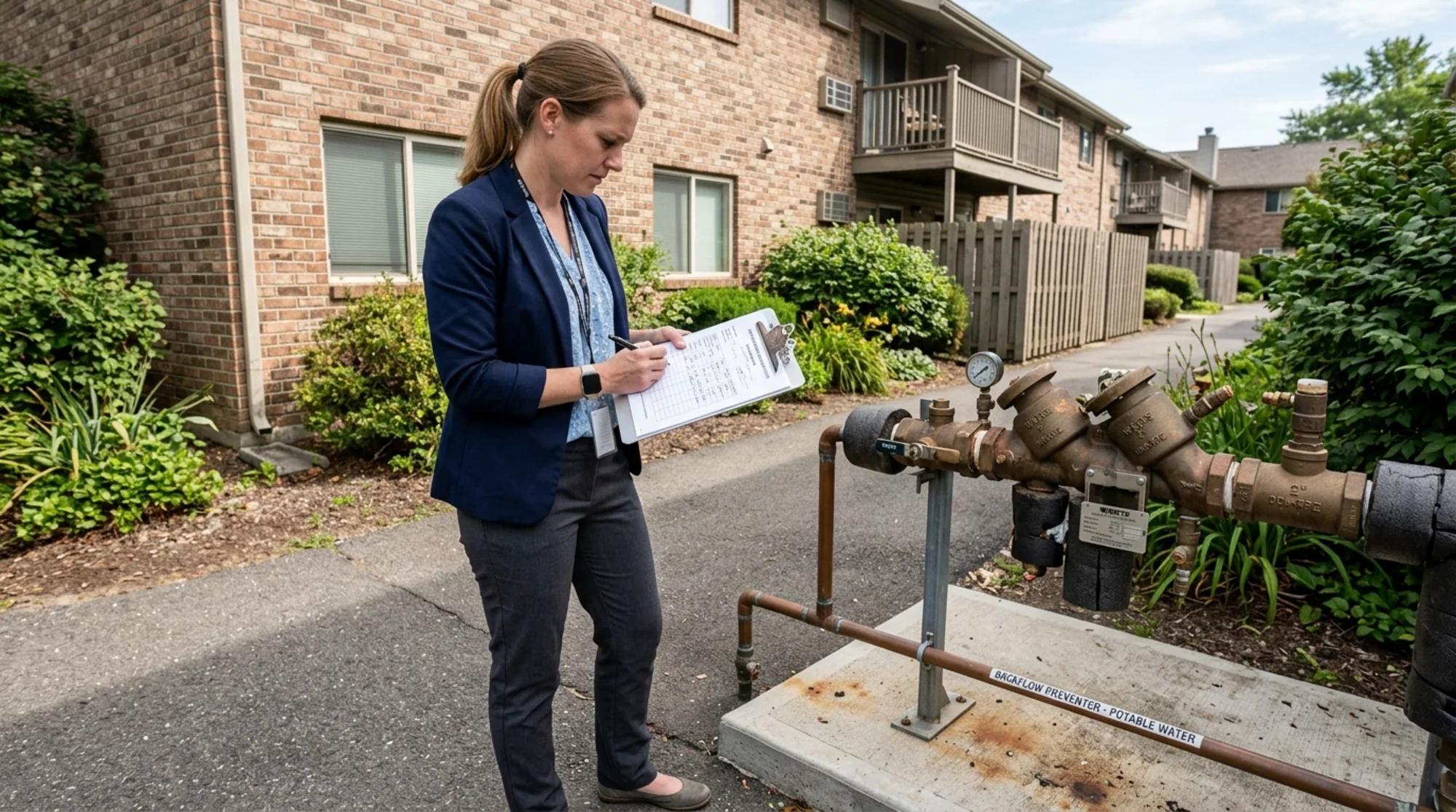
Property manager in business-casual attire reviewing a utility compliance notice on a clipboard beside an outdoor backflow assembly at a commercial or multi-family property
Why this matters beyond the utility notice
When a utility sends a backflow test reminder, most owners read it as a deadline to schedule a tester. That is correct, but it understates what the assembly is actually doing. The Safe Drinking Water Act, originally passed in 1974, regulates the nation's public drinking water supply, with EPA, states, and water systems working together to make those standards real. Backflow assemblies are one of the points where that protection plays out at the building scale.
Local programs translate that into specific obligations. Seattle Public Utilities, for example, states that annual testing is the only way to ensure assemblies are functioning properly, that all assemblies must be tested by a State of Washington Certified Backflow Assembly Tester, and that the owner is responsible for on-time testing. Failure to test can lead to non-compliance charges and possible water-service termination, and test reports cannot be submitted without the tester's certification and calibration documents on file. Philadelphia Water Department similarly maintains cross-connection control regulations, an approved assemblies list, certified technicians, and official test and maintenance forms because non-potable supplies containing hazardous substances can compromise drinking water if a cross-connection is left unprotected.
If you want a fuller primer on why these programs exist, our overview of why backflow testing is required covers the public-health and regulatory backdrop in plain language.
The point for risk management is simple: the assembly is the engineered control standing between your building and a contamination, pressure-loss, or water-damage event. When that control is undocumented, overdue, or known to be failing, you have a control gap. Control gaps are where insurance conversations get harder.
The insurance risks non-compliance can magnify
Non-compliance does not automatically void coverage and does not guarantee a denial. It can, however, magnify several kinds of exposure that insurers and adjusters care about. A few worth understanding:
Contamination and third-party exposure. As the NYC DEP backflow FAQ notes, backflow devices prevent contaminated water or chemicals from flowing back into the public drinking water supply, and certain property types are legally mandated to install and operate them. If a contamination event is traced back to a property where the required assembly was not tested or maintained, the owner can face fines and water-service consequences from the utility, plus potential third-party concerns from tenants, customers, or neighbors. None of that is friendly territory for a claim file.
On-site water damage. The Portland Water Bureau page explains that a properly functioning reduced pressure backflow assembly can periodically release water and should be installed where discharge will not cause damage, and that a clogged or malfunctioning RPBA may discharge a large volume of water. Translation for owners: an assembly that is overdue, unrepaired, or installed where its discharge can reach finished space is a water-damage incident waiting to happen. A loss that involved a known-failing assembly will look very different to an adjuster than a loss involving an assembly with current passing reports on file.
Business interruption and tenant impact. Utilities can terminate or disconnect water service for non-compliance. Seattle and NYC both spell that out. For a restaurant, medical office, salon, multifamily building, or HOA, a water shutoff can trigger a real business-interruption or habitability problem on top of the original compliance issue. If the shutoff is the proximate cause of a downstream loss, the documentation trail matters.
Underwriting and renewal questions. At renewal, carriers increasingly ask about preventive maintenance, life-safety systems, and code compliance. A property that cannot produce recent backflow test reports, repair records, or evidence that overdue items were addressed has a weaker story to tell than one that can. That does not predetermine pricing or terms, but it does shape the conversation.
Fines and required follow-up. Both NYC and Seattle reference fines or non-compliance charges for missed testing. Those costs are usually not insurable losses, and they can pile up alongside whatever caused the original miss.
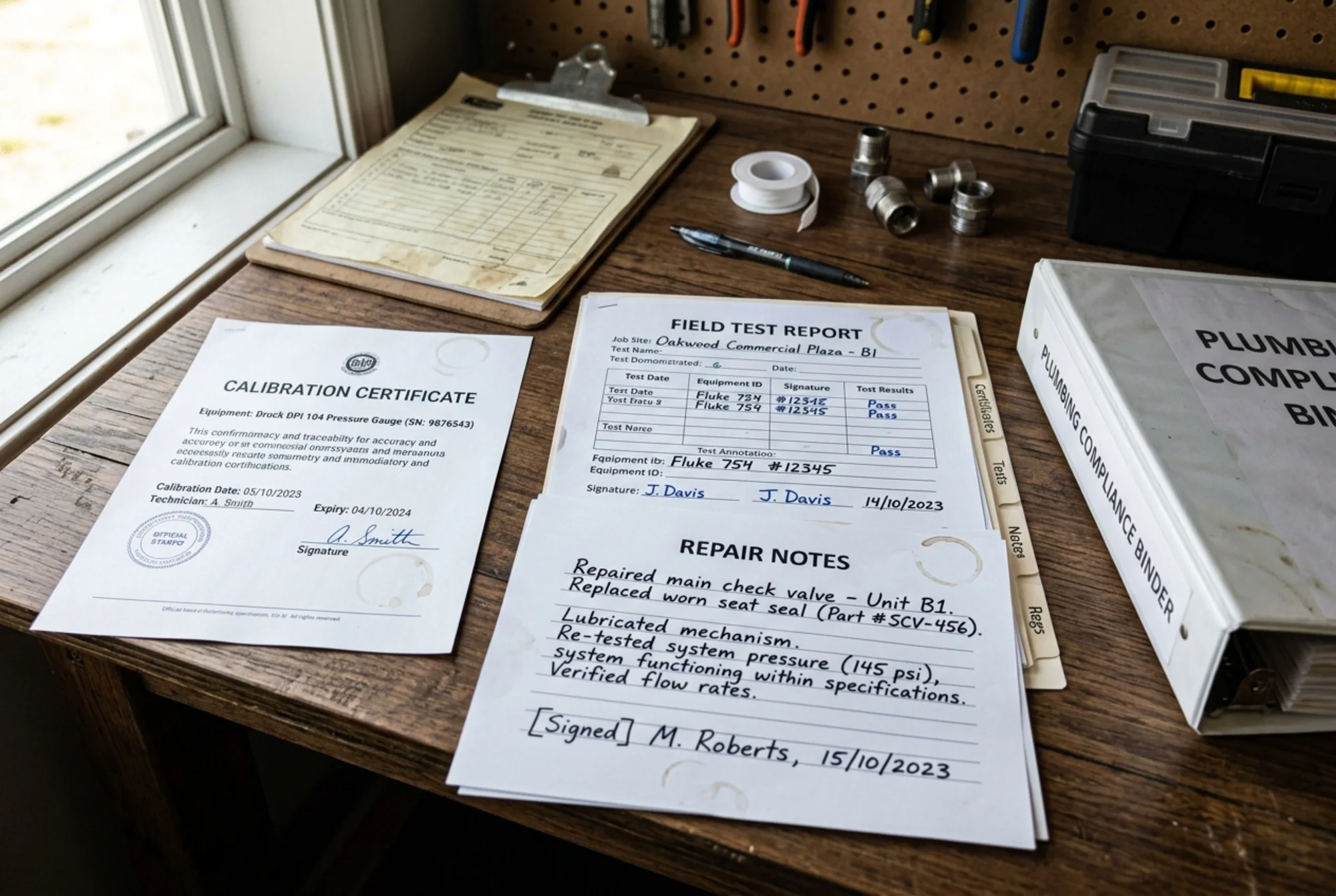 Documentation scene on a desk with a completed field test report, repair notes, calibration certificate, and compliance binder neatly organized
Why documentation and tester qualifications matter
Insurance and compliance both run on paper. The Washington State Department of Health cross-connection program publishes Backflow Assembly Tester duties, field test report content requirements, a sample field test report, BAT certification verification, a public BAT list, and a backflow incident report form. Seattle reinforces that test reports cannot even be submitted without the tester's certification and calibration documents in the system. Philadelphia maintains its own list of certified technicians and official forms.
Two practical implications for owners:
- Use a tester whose certification can actually be verified in the appropriate state or utility system. This is non-negotiable from a compliance standpoint and useful from a documentation standpoint.
- Keep the paperwork. Field test reports, repair invoices, retest reports, utility notices, and any incident reports together form the record you will lean on if a loss occurs or a renewal underwriter asks questions later.
The CDC's drinking water guidance reminds the public to contact their utility or health department if they have concerns about water quality, pressure drops, or changes in water. If a tenant or neighbor ever does that and it loops back to your property, a complete file is far better than a scramble to reconstruct history.
For a sense of how programs themselves track what you submit, see our piece on how utilities track backflow test compliance and the follow-up steps in what happens after a backflow test notice.
Practical steps property owners should take now
You do not need a complex program. You need a small, durable one.
- Inventory your assemblies. Know how many you have, where they are, and which utility program each belongs to. Commercial properties usually have more than one. Our overview of backflow testing requirements for commercial properties is a useful starting point.
- Confirm the testing cadence required by your utility. NYC DEP, for example, requires annual testing every 12 months by a certified tester. Local programs in Austin, Philadelphia, and Seattle each have their own submission rules and forms; matching their cadence and format is what keeps you in good standing. Program pages such as Austin Water backflow testing and the Philadelphia Water Department backflow program are good references for the local specifics.
- Budget for it. Annual testing is predictable; surprise repairs are not. Our guide on how to budget for annual backflow testing as a property manager walks through the line items.
- Have a plan for the deadline you almost missed. When a notice slips through, finding emergency backflow testing when your deadline is tomorrow is more useful than panic.
- Store every report and repair record in one place. Cloud folder, property management system, or a labeled binder; the format matters less than the consistency.
- Talk to your insurance broker about your maintenance posture in plain terms. You are not asking them to interpret coverage; you are giving them an accurate picture of how the property is run. Specific questions about your policy belong with your broker and carrier.
- Use the official channels for questions. Common questions about scheduling, requirements, and follow-up are covered in our FAQs.
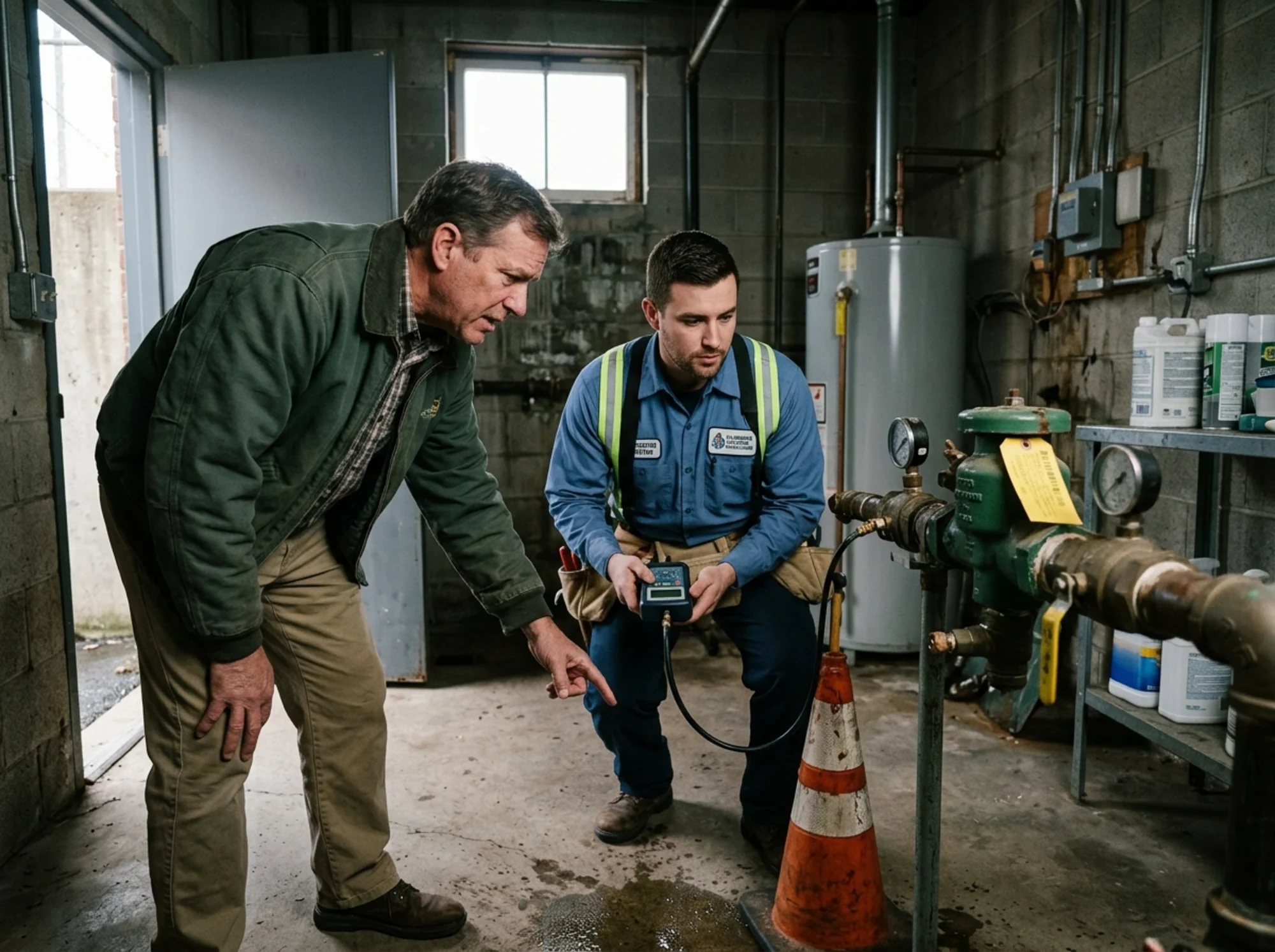 Property owner and a certified backflow tester reviewing an assembly together in a mechanical room or near a service entrance after a failed test or water incident
Bottom line
Insurance is not a substitute for compliance, and compliance is not a substitute for insurance. They do interact, though. A property with current tests, verifiable tester credentials, organized records, and a clear repair history is a property with fewer surprises in a claim file and a cleaner story at renewal. A property with overdue tests, missing reports, or known-failing assemblies has more failure modes when something goes wrong.
The good news is that the work to close the gap is mostly routine: keep the assemblies tested on the cadence your utility requires, use a certified tester whose credentials can be verified, fix what fails, and keep the paperwork. None of that guarantees any particular insurance outcome. All of it makes the next conversation easier.
Sources
This article references guidance and regulations from authoritative sources including:
- U.S. Environmental Protection Agency (EPA) - Overview of the Safe Drinking Water Act
- Centers for Disease Control and Prevention (CDC) - Preventing Drinking Water-Related Illnesses
- Washington State Department of Health - Cross-Connection Control and Backflow Prevention
- Seattle Public Utilities - Backflow Assembly Testing
- New York City Department of Environmental Protection - Backflow Prevention Frequently Asked Questions
- Philadelphia Water Department - Cross-Connection & Backflow Compliance
- Portland Water Bureau - How to choose and install a backflow prevention assembly
- American Water Works Association (AWWA) - Cross-Connection Control and Backflow Prevention resources
Last updated: May 5, 2026