How to Budget for Annual Backflow Testing as a Property Manager
How to Budget for Annual Backflow Testing as a Property Manager
A lot of backflow budgeting goes wrong before the first quote even comes in.
Managers treat it like a generic plumbing expense, put one vague number in the annual budget, and hope the rest sorts itself out. Then a utility notice lands, an assembly fails, access is messy, or the report needs follow-up, and suddenly a routine compliance task turns into an avoidable scramble.
A better approach is to budget backflow testing as a small operating system, not a one-time service call.
EPA says the Safe Drinking Water Act protects public health by regulating the nation’s public drinking water supply. Local cross-connection control and backflow programs are one of the ways utilities carry that responsibility down to the property level. Seattle Public Utilities is especially clear that annual testing is required to ensure assemblies are functioning properly, and that the water service owner is responsible for making sure testing happens on time.
So if you manage an office building, retail center, HOA, school, hotel, or mixed portfolio, the budgeting goal is simple: know what needs testing, know when it is due, know who will do it, and leave room for the paperwork and follow-up that come with it.
If you want the public-health background first, start with why backflow testing is required.
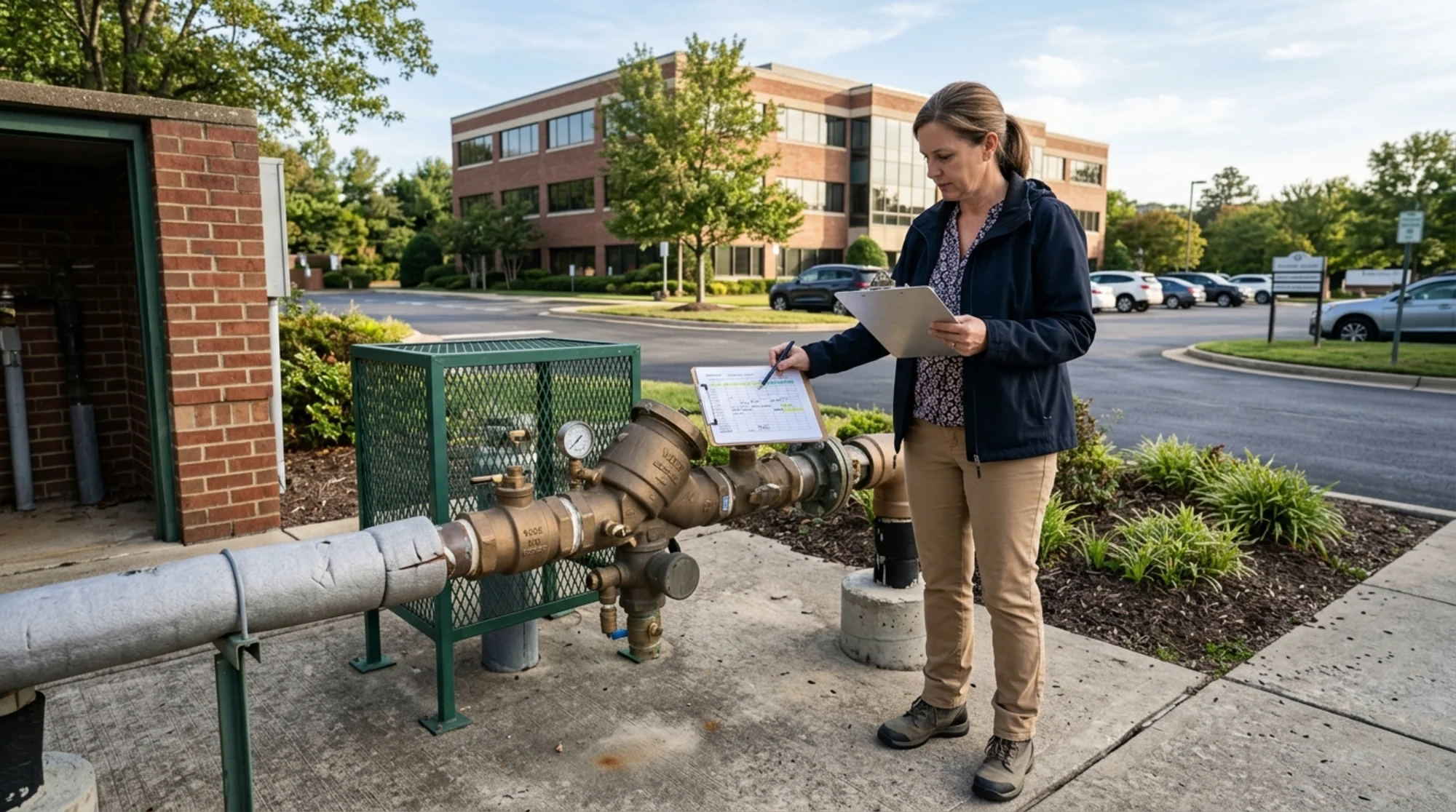
A property manager standing beside an outdoor commercial backflow prevention assembly while reviewing a budget spreadsheet and annual compliance calendar on a clipboard, natural daylight, realistic office park setting, no logos or text
Start with an assembly register, not an average price guess
The biggest budgeting mistake is asking, “What does annual backflow testing cost?” before you know exactly what you are paying to test.
Budgeting works much better when you build from an assembly register.
For each property, keep a simple record of:
- property name and address,
- utility or local backflow program,
- assembly location,
- assembly type,
- whether it serves domestic, irrigation, or fire protection,
- last passing test date,
- next due date,
- and the tester or vendor used last time.
That matters because utilities usually track compliance by the specific protected connection, not by your internal budget category.
Washington DOH publishes field test report requirements and Backflow Assembly Tester resources, which is a good reminder that the job is tied to a formal record. Philadelphia’s backflow program makes the same point from a utility angle by publishing approved technician resources and official test and maintenance forms. If your own records are fuzzy, your budget will be fuzzy too.
For managers covering more than one site, this is even more important. One property may only have an irrigation assembly. Another may have domestic, fire, and irrigation devices with different access needs and different paperwork paths. If you are coordinating several addresses, our guide on how to choose a qualified backflow tester helps with the vendor side of that process.
Budget the recurring core line items separately
Once you know which assemblies exist, break the annual budget into the pieces that actually recur.
1. Annual field testing
This is the obvious line item, the on-site visit where a qualified tester performs the annual test.
Seattle says owners can contact several certified testers to find one that fits their pricing and scheduling needs. That is a useful budgeting hint. Do not assume the first quote is the market rate, and do not assume every property needs the same vendor setup.
2. Report handling and compliance administration
Backflow budgets often ignore the admin side. That is a mistake.
Seattle tells customers to make sure they receive documentation confirming results were submitted. Washington DOH publishes minimum field-test report content rules. Philadelphia publishes official forms and maintenance records. All of that points to the same reality: the appointment is not the whole job.
If your team spends time collecting notices, forwarding prior reports, checking whether the tester submitted the results, or updating internal records, that is part of the annual backflow workload and should be budgeted like any other compliance admin task.
3. Access coordination
Some properties make testing easy. Others do not.
Locked gates, riser rooms, fenced irrigation yards, tenant suites, boiler rooms, or fire-control rooms can all create friction. Even if the tester’s invoice does not show “coordination” as a separate line, your operations time still has a cost.
4. Vendor qualification and jurisdiction matching
Different states and utilities handle credentials differently. Seattle requires a State of Washington Certified Backflow Assembly Tester. Philadelphia maintains city-certified technician resources. That means a multi-site manager should budget around the actual jurisdiction, not assume every local plumbing vendor can close the compliance loop.
This is why it helps to compare active markets such as Seattle, Austin, and Philadelphia, then review local program guides like Austin Water and the Philadelphia Water Department.
Add a repair and retest reserve before you need it
The second major budgeting mistake is funding the annual test but leaving no room for what happens if an assembly fails.
Assemblies do fail. Springs wear out. Checks stop holding. Relief valves discharge. Older devices need rebuild kits. Sometimes the property passes every year until suddenly it does not.
That is why a property manager should keep a separate reserve for:
- repair labor,
- replacement parts or rebuild kits,
- re-test visits,
- and urgent follow-up when a due date is close.
You do not need to invent a universal dollar amount for every market. That would be sloppy. Instead, ask your preferred tester or service vendor how they typically price these as separate categories and build a reserve that matches the age, count, and risk level of your installed assemblies.
If the site has more complex systems, that reserve matters even more. Philadelphia’s public materials distinguish between domestic water systems and fire sprinkler systems, which is a helpful reminder that not every failed assembly creates the same operational headache. Some failures are just a repair bill. Others can disrupt scheduling, tenant coordination, or broader building operations.
If you want a stronger screening checklist before putting a vendor under contract, compare this with our article on what insurance should a backflow tester carry.
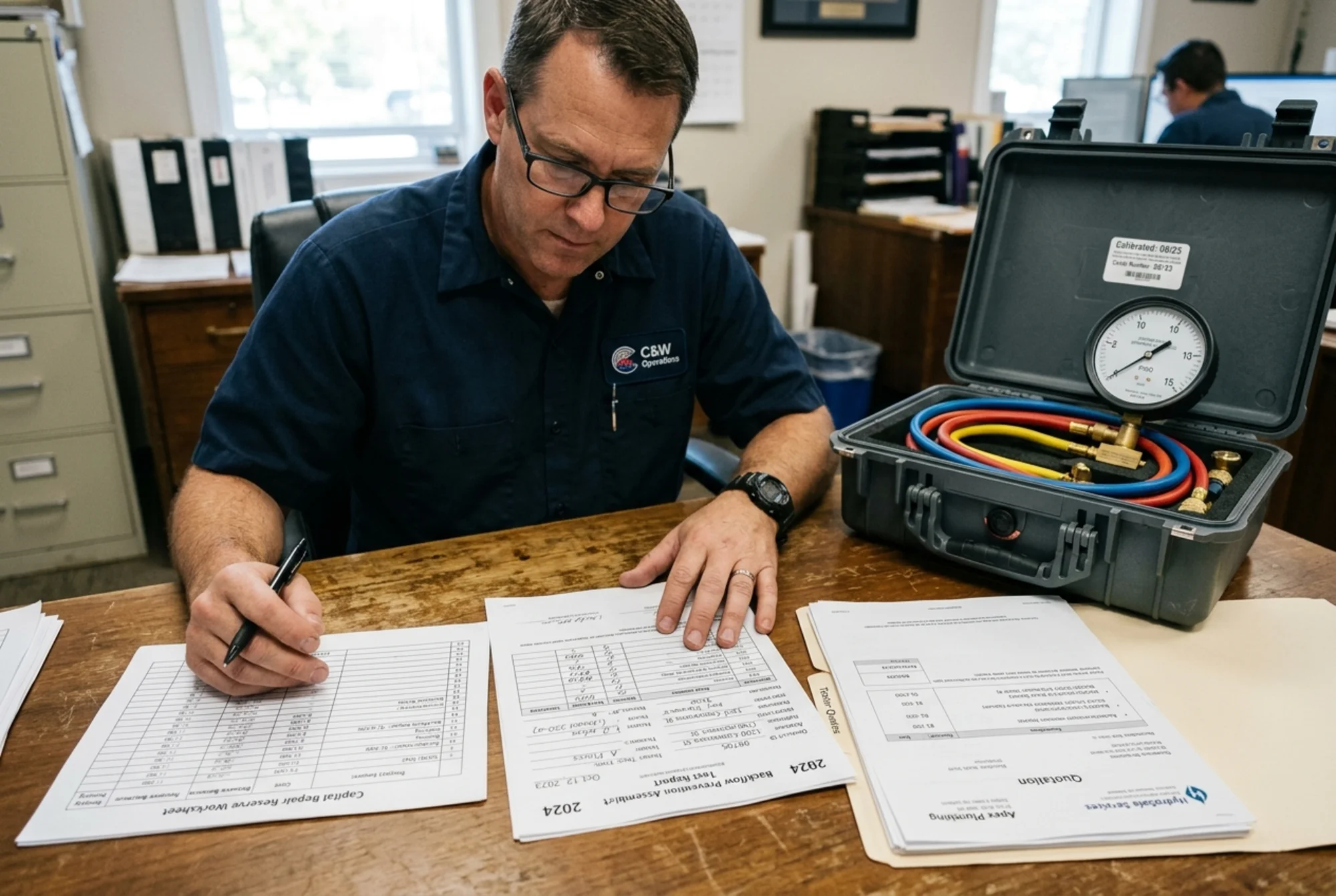 A property operations manager reviewing backflow test reports, a repair reserve worksheet, and tester quotes beside a calibrated differential pressure gauge case, natural indoor lighting, no text overlay
Budget by property complexity, not just property count
Ten small sites do not always cost more to manage than two complicated ones.
The real driver is complexity.
A straightforward office property with one accessible irrigation assembly may be easy to budget. A hotel, school, HOA, or mixed-use site may have multiple assemblies, tougher access, more stakeholders, and more chances for missed paperwork.
That is why a property manager should look at factors like:
- number of assemblies on site,
- whether the assemblies serve domestic, irrigation, or fire systems,
- whether access requires tenant coordination,
- whether the site has pools, boilers, laundry, kitchens, or other higher-risk systems,
- and whether the property is in a utility program with more formal submission requirements.
This is where related content can help frame the real workload. For example, backflow testing requirements for commercial properties and backflow prevention for HOAs and condo associations show why certain property types create more compliance moving parts than a simple standalone building.
The budget should reflect that operational reality, not just the number of addresses in your portfolio.
Build the annual calendar and paperwork workflow into the budget
Good backflow budgets are really calendar budgets.
Seattle says the owner is responsible for timely testing even when reminder notices are sent. That means the budget should support a repeatable internal workflow, not a last-minute reaction.
A simple version looks like this:
60 days out
- review assemblies coming due,
- confirm the vendor list,
- update access notes,
- and request scheduling windows.
30 days out
- lock the appointments,
- send internal or tenant notifications if needed,
- and gather prior reports or open repair notes.
After the test
- confirm the result,
- save the completed report,
- verify submission,
- update the next due date,
- and track any repair or retest follow-up.
Washington DOH’s report-content guidance and Philadelphia’s official forms both reinforce the same thing: paperwork is not optional fluff. It is part of compliance.
CDC’s drinking-water guidance also tells people to contact their utility or health department if they have concerns about water quality or notice a problem. From a management perspective, that is a useful rule. If a pressure event, unusual water issue, or assembly problem shows up, do not leave it floating in someone’s inbox. Put it into the same operating workflow as the annual test schedule.
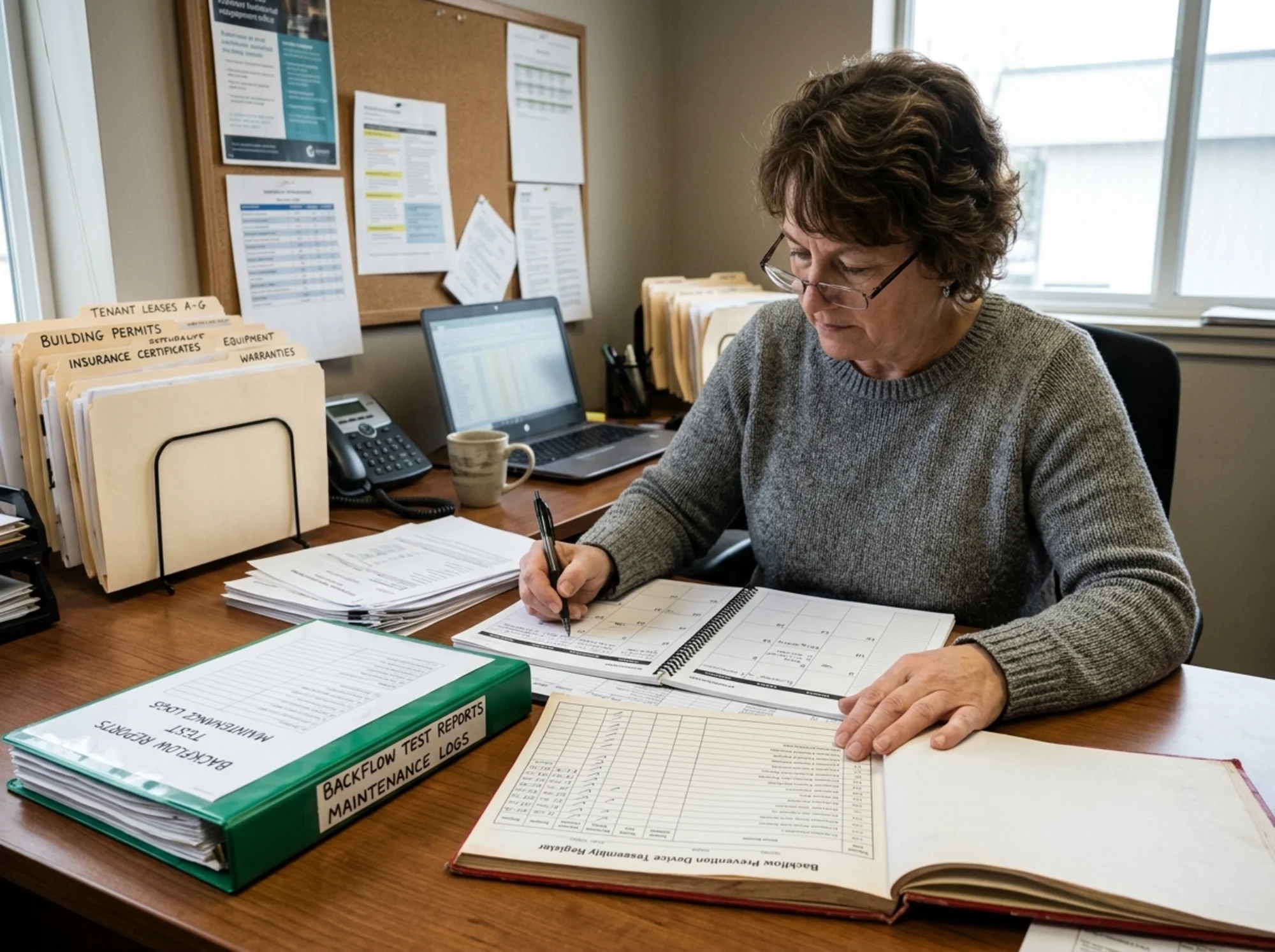 A property manager updating a compliance calendar and assembly register after a completed backflow test, with organized folders and a labeled report binder on a desk, natural office lighting, no logos or text
Common backflow budgeting mistakes property managers make
These are the patterns that create the most avoidable pain.
Using one flat line item for every property
That usually hides which sites are actually simple and which ones are operationally heavy.
Budgeting for the test, but not for follow-up
If the budget ignores repairs, retests, or report chasing, you are not really budgeting the whole process.
Choosing only on the lowest quote
The cheapest tester is not always the cheapest outcome if the report gets rejected, the vendor cannot handle repair follow-up, or the property manager has to clean up the paperwork later.
Letting records live in email only
When staff or vendors change, lost reports become expensive very quickly.
Waiting for the notice before acting
At that point, the property is already controlling your timeline instead of the other way around.
If you have ever had to scramble because a deadline was close, our article on finding emergency backflow testing when your deadline is tomorrow is the practical version of what happens when the budget and calendar were not ready in time.
A simple budget template that actually works
For each property or portfolio segment, use these buckets:
- Annual testing for each known assembly.
- Admin and compliance tracking for notices, reports, and submission follow-up.
- Access coordination for tenants, gates, locked rooms, or site staff.
- Repair and retest reserve for failed assemblies.
- Vendor review or rebid if the current provider is no longer the best fit.
- Recordkeeping tools if your team needs a cleaner assembly register or compliance calendar.
It does not need to be fancy. It just needs to reflect how the work actually happens.
For baseline owner questions, keep our FAQs handy. They help when site teams or clients are new to the process.
Bottom line
The best backflow budget for a property manager is not built from a national average. It is built from your actual assemblies, your actual jurisdictions, and your actual workflow.
Inventory the devices, separate testing from admin, carry a repair reserve, and run the work on a calendar instead of on panic. Do that, and annual backflow testing becomes a predictable operating expense instead of a recurring surprise.
If you are ready to line up service, start by browsing testers in your market and comparing program expectations city by city.
Sources
This article references guidance and regulations from authoritative sources including:
- U.S. Environmental Protection Agency (EPA) - Overview of the Safe Drinking Water Act
- American Water Works Association (AWWA) - Cross-Connection Control and Backflow Prevention resources
- Washington State Department of Health - Cross-Connection Control and Backflow Prevention
- Seattle Public Utilities - Backflow Assembly Testing
- Philadelphia Water Department - Cross-Connection & Backflow Compliance
- Centers for Disease Control and Prevention (CDC) - Preventing Drinking Water-Related Illnesses
Last updated: May 2, 2026