What to Do If Your Utility Requires a New Backflow Test After a Repair
If your backflow assembly was just repaired, it is easy to assume the compliance problem is over.
But many utilities do not close the record just because the device was repaired. They want a new passing test after the repair, and they usually want that retest documented on the same official reporting path they use for annual compliance.
That can feel redundant when you already paid for a repair visit. But from the utility’s perspective, the repair changes the device and the retest proves it now works within the required standard.
For related context, keep why backflow testing is required, why your backflow test report was rejected, and our FAQs handy while you sort it out.
A repair and a passing retest are usually two different compliance steps
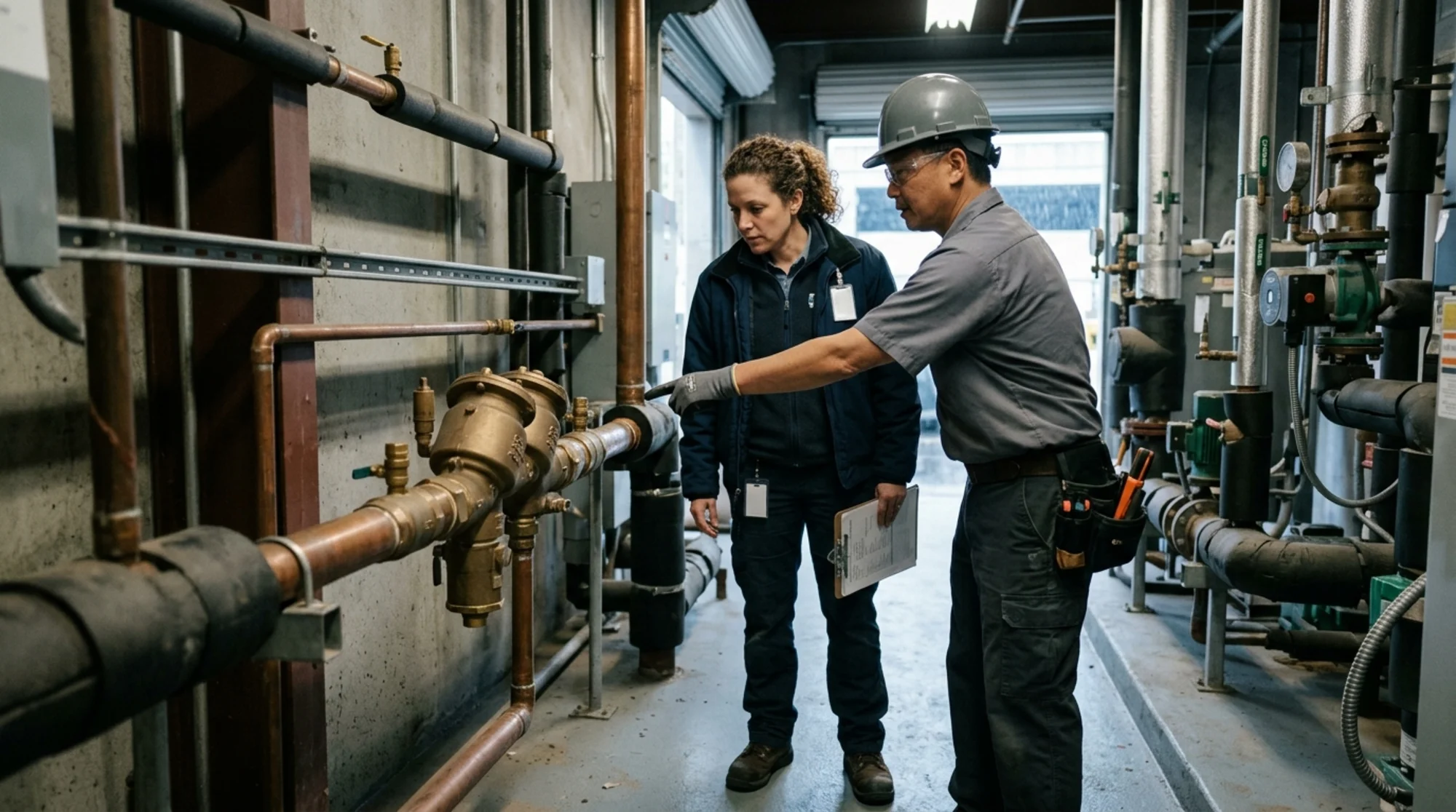
Property manager and licensed tester reviewing a repaired backflow assembly in a commercial mechanical room before a required retest
A lot of owners hear “the device was repaired” and translate that into “the utility should mark me compliant now.” That is usually not how cross-connection programs work.
A repair addresses the mechanical issue. A retest verifies that the repaired assembly now passes. Utilities need the second step because a device can be worked on without ending up in an acceptable operating condition, or the paperwork can miss the details the program requires.
Phoenix’s backflow program says assemblies must be tested at the time of installation, repair or relocation and that an assembly shall not be placed in service unless it has been tested and is functioning as designed. Austin Water makes the same distinction in its reporting rules by requiring each Test and Maintenance Report to include a description of repairs, if applicable, and retest results after repairs. Philadelphia Water’s FAQ is even more direct: assemblies that fail performance standards must be repaired or replaced and retested within fourteen (14) days from the initial test.
That is why a utility can legitimately say, “Yes, the repair happened — but we still need the passing retest on file.”
If you want local context while comparing requirements, look at our city pages for Austin, Texas, Phoenix, Arizona, and Philadelphia, Pennsylvania.
What official programs are actually looking for
Utilities are usually trying to confirm four things at once: the tester was qualified, the repair details were captured, the repaired assembly produced passing readings, and the updated report was submitted through the right channel on time.
Austin Water
Austin requires a complete and legible Test and Maintenance Report within five calendar days, submitted through the WEIRS database. Its tester guidance says every TMR must include the assembly address and serial information, operational test results, and the description of repairs, if applicable, and retest results after repairs.
Philadelphia Water Department
Philadelphia’s FAQ states that assemblies failing PWD performance standards must be repaired or replaced and retested within fourteen (14) days from the initial test. That means a repair alone does not close the file.
City of Phoenix
Phoenix’s tester requirements say devices must be tested at the time of repair, alteration or relocation of assembly. Its tester instructions also warn that incomplete or inaccurate reports will not be accepted.
State licensing still matters
In Texas, TCEQ says a person who repairs or tests the installation or operation of backflow prevention assemblies must hold a BPAT license. So if the utility wants a new test after repair, that retest still has to come from someone who is actually authorized to do it.
For program-specific pages, compare Austin Water and Philadelphia Water Department alongside your own utility’s instructions.
What to do right away when the utility asks for a new test
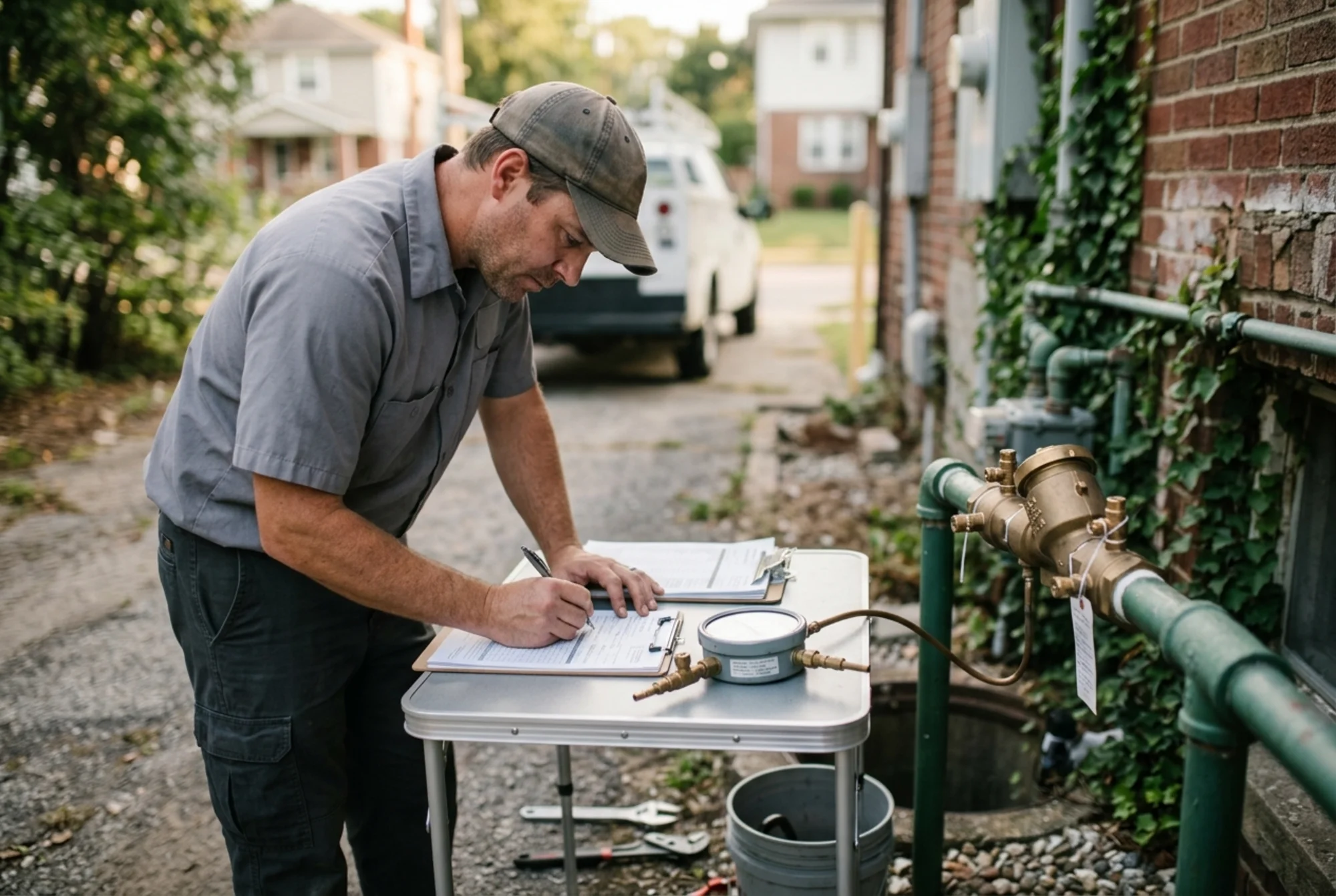 Certified backflow tester completing retest paperwork with a calibrated gauge and repaired backflow assembly nearby
Move in this order.
1. Ask whether the utility is missing the retest itself or just the paperwork
Use direct wording:
“Do you need a new field test after the repair, or was the retest already done and the corrected report just was not accepted or not received?”
That helps you separate a real scheduling problem from a filing problem.
2. Get the full repair-and-retest packet from the tester
Ask for:
- the original failed test report
- the repair invoice or repair notes
- the retest report showing passing results
- the assembly manufacturer, model, and serial number
- the test gauge serial number
- proof of submission, if the tester says they filed it
- the tester’s license or certification number
If the tester says “we repaired it, so you’re good,” but cannot produce a passing retest report, assume the utility will keep the property open.
3. Compare the dates carefully
Check whether the retest happened:
- on the same day as the repair,
- after the repair but within the utility’s deadline,
- or not at all.
Philadelphia’s fourteen-day repair/retest window shows why date order matters. A repair with no timely retest can still leave you noncompliant.
4. Confirm the submission path
Some utilities want portal submission, some want a tester-upload workflow, and some still use specific forms or internal review staff. Austin, for example, requires TMR submission through WEIRS rather than paper copies.
If the tester used the wrong channel, the utility may treat the retest as if it never happened.
5. Ask the utility what will close the record
Do not stop at “we need a new test.” Ask:
“What exact document or portal status will mark this assembly compliant again?”
That answer tells you whether you need a brand-new field visit, a corrected report, or proof that a passing retest was already filed.
If you are also dealing with submission confusion, read what to do if your utility says it never received your backflow test report and who submits the backflow test report: property owner or tester?.
When you probably do need a brand-new retest
You likely need a real new test — not just a document cleanup — when:
- the repair was completed but no passing readings were taken afterward,
- the utility says the retest report is incomplete or inaccurate,
- the tester used expired or unacceptable test equipment,
- the tester was not approved, registered, or properly licensed for that jurisdiction,
- the retest happened before the repair was fully completed,
- or the utility has no acceptable record showing the assembly passed after the repair.
In those cases, arguing that the assembly was “already fixed” usually wastes time.
The utility is not really debating whether parts were replaced. It is asking for proof that the repaired assembly now passes the required field test.
If the original contractor created the problem, it may be faster to book another qualified provider. Our guide on what to do if your backflow tester is not on your utility’s approved list can help if that becomes part of the issue.
Questions to ask before paying for another visit
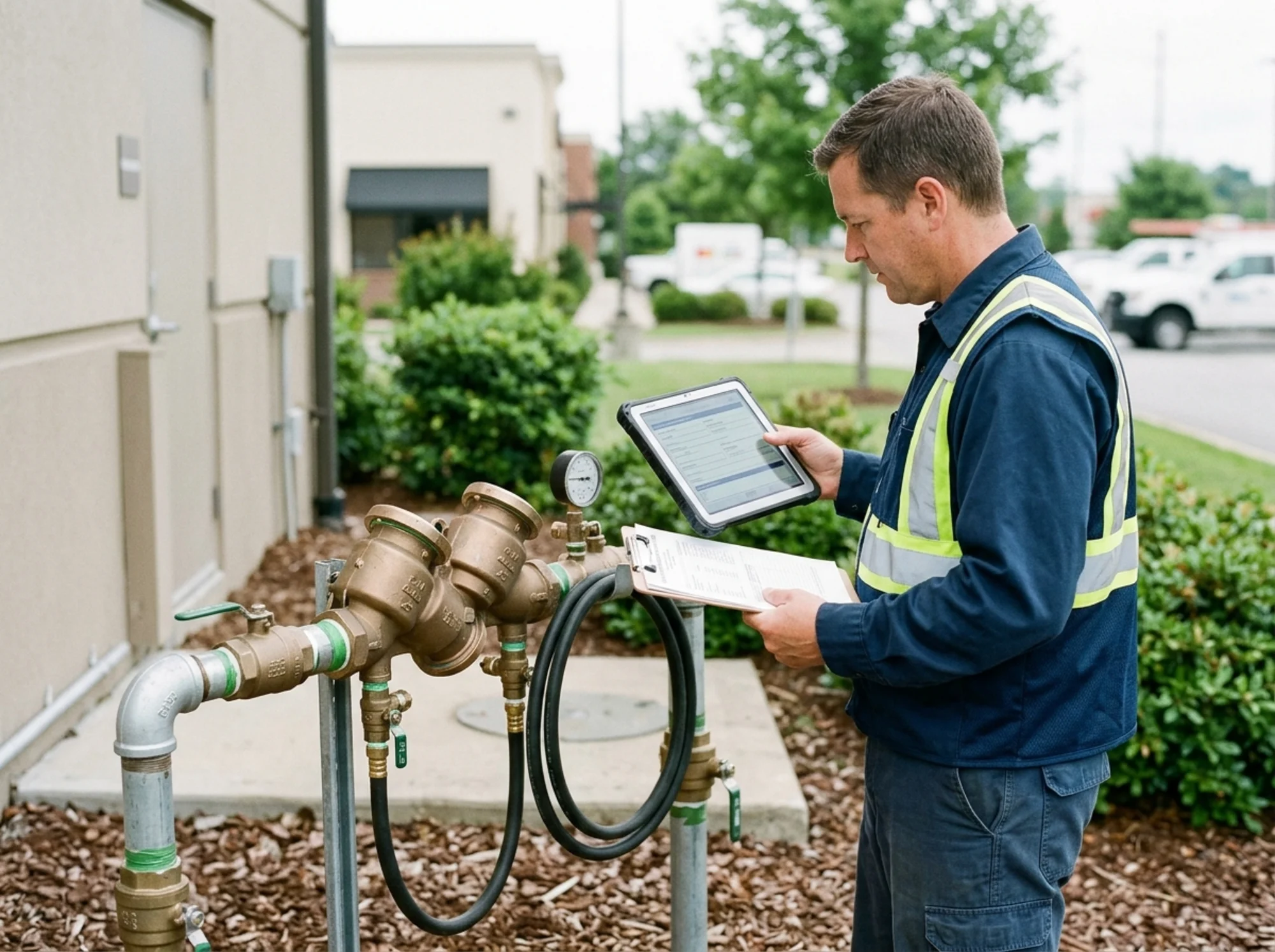 Utility compliance reviewer checking a passing retest report and online submission beside an outdoor backflow assembly
Before authorizing a follow-up appointment, ask these questions plainly:
- Was the repair already followed by a certified retest, or not?
- Do you have the passing report with the repair details included?
- Was it submitted through the utility’s required portal or form?
- Is your tester currently licensed or approved for this utility?
- Can you send me the exact filed report and proof of submission today?
- If the utility still rejects it, will you correct the paperwork or repeat the test?
How to avoid this problem next time
A few habits prevent most repair-to-retest confusion:
- schedule repair and retest as one bundled compliance event whenever possible,
- ask whether the same technician can repair and immediately retest,
- get the final passing report the same day,
- confirm the report includes repair details and final readings,
- save submission proof,
- and check your utility account or confirmation email before the deadline passes.
That sounds administrative, but utilities and regulators treat backflow compliance as a documented public-health control. EPA says the Safe Drinking Water Act protects public health by regulating the nation’s public drinking water supply, and CDC notes that harmful germs or chemicals can get into drinking water while it is being piped to homes and businesses.
The bottom line
If your utility requires a new backflow test after a repair, do not assume it is a duplicate charge with no purpose behind it.
In many programs, the repair fixes the assembly, but the passing retest closes the compliance record. Get the full packet, verify the dates, confirm the submission channel, and ask the utility exactly what document or portal status they need to mark the assembly compliant.
That approach is much faster than arguing about the repair in the abstract and gives you the best chance of ending the violation before it turns into a bigger enforcement problem.
Sources
This article references guidance and regulations from authoritative sources including:
- U.S. Environmental Protection Agency (EPA) - Overview of the Safe Drinking Water Act
- American Water Works Association (AWWA) - Cross-Connection Control & Backflow Prevention resources
- Texas Commission on Environmental Quality (TCEQ) - Occupational Licenses: Backflow Prevention Assembly Tester (BPAT)
- Washington State Department of Health - Cross-Connection Control and Backflow Prevention
- Austin Water - Backflow Prevention Assembly Tester Information
- Austin Water - Water Protection Forms, Applications and Reports
- Philadelphia Water Department - Cross-Connection Control FAQ (PDF)
- City of Phoenix - Backflow Prevention Program
- City of Phoenix - Backflow Prevention Assembly Test Report Instructions (PDF)
- City of Phoenix - Backflow Tester Requirements / Customer Responsibilities (PDF)
- Centers for Disease Control and Prevention (CDC) - About Drinking Water
Last updated: June 2, 2026