What to Do If You Bought a Property and Inherited Missing Backflow Test Records
Buying a property is paperwork-heavy. Then someone asks for the backflow records and the file is thin, incomplete, or missing entirely.
Ownership changes and vendor turnover are exactly how backflow paperwork disappears.
The bigger risk is assuming missing records are only an internal filing problem. They can become a utility compliance problem fast if the water system has a device on file, expects annual testing, or needs ownership details updated.
EPA explains the broader reason these programs exist: public water systems are expected to protect drinking water from contamination under the Safe Drinking Water Act. Local programs turn that public-health duty into specific rules for assemblies, testing, reports, and recordkeeping. So when you inherit a property with incomplete backflow files, the goal is simple: confirm the utility record, rebuild enough documentation to stay compliant, and close any gaps before they trigger fees or service problems.
Start with the utility record, not the seller’s memory
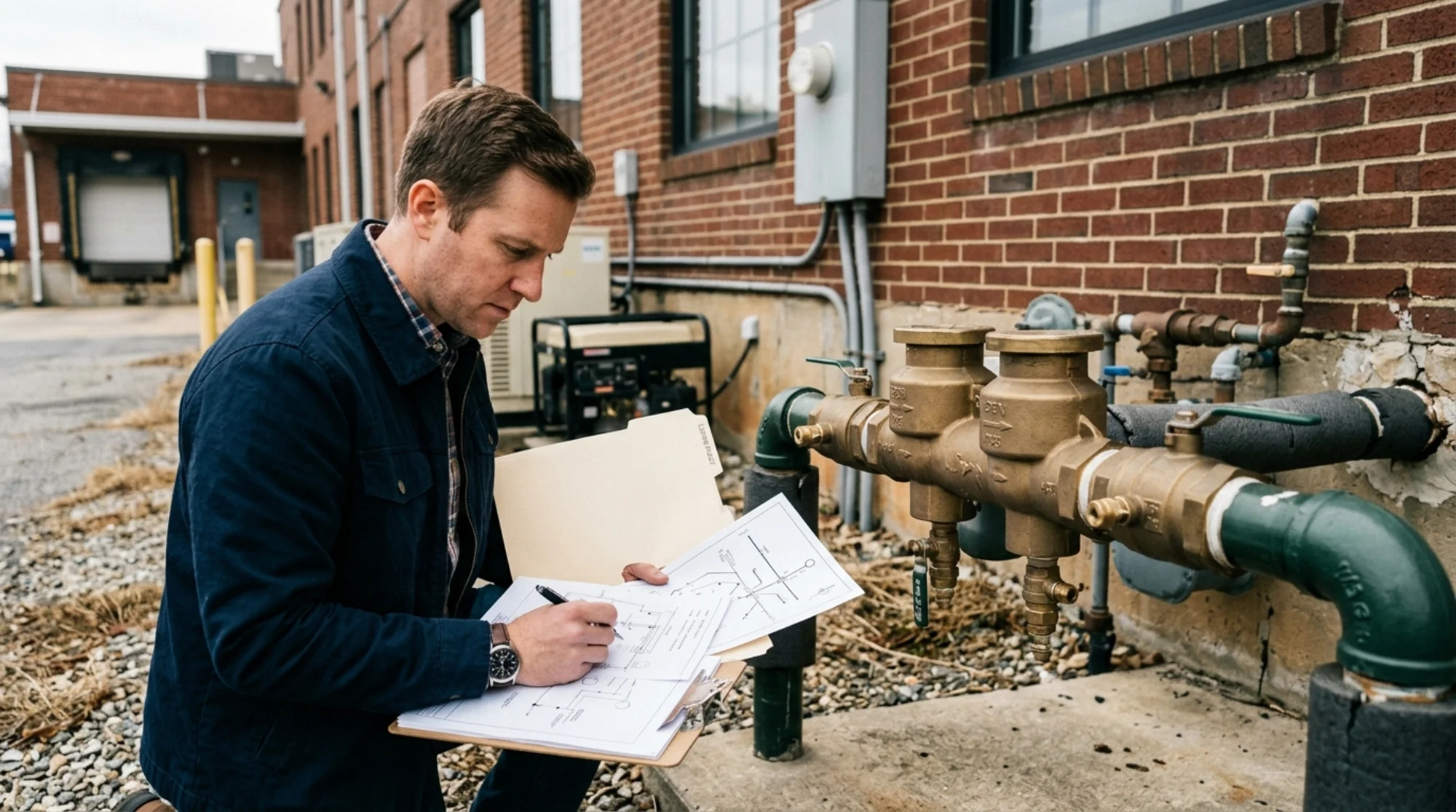
Property owner reviewing utility paperwork beside an outdoor backflow assembly
If the closing packet is incomplete, do not rely on verbal reassurance.
Start by asking the water utility or cross-connection office a direct question:
“Do you have any backflow assemblies on file for this address, and what is the current compliance status for each one?”
Common problems include an overdue annual test, an old serial number still on file, a removed assembly record that was never closed correctly, or notices still going to the wrong person.
Los Angeles County’s public-health FAQ shows how administrative this can get. It publishes a dedicated account-change form for corrections to names, addresses, assembly information, and even the case where someone “no longer control[s], manage[s] or own[s]” the assembly at that property. That is a useful reminder that ownership and contact data are part of compliance.
If you need local context while you sort that out, compare the city pages for Austin, Texas, Seattle, Washington, and Philadelphia, Pennsylvania, plus our FAQs.
Figure out whether the problem is missing records, a wrong record, or no record at all
Missing paperwork usually means one of three things:
1. The utility has the right assembly on file, but you do not have the reports
2. The utility has a record, but it may be outdated or wrong
Maybe the assembly was replaced, moved, or removed years ago, and the serial number was never updated.
3. Nobody seems to have a clean record
You may have a visible assembly on site, but no passing report and no certainty about who last tested it.
If the record is merely missing from your files, you are mostly rebuilding documentation. If it is wrong, you may need corrected inventory details. If the utility record is broken altogether, you may need a fresh test and a more complete account update.
If you suspect the issue is actually a device mismatch, read how to update utility records after replacing a backflow preventer and what to do if your utility notice lists a backflow assembly that was already removed.
Rebuild the minimum documentation packet first
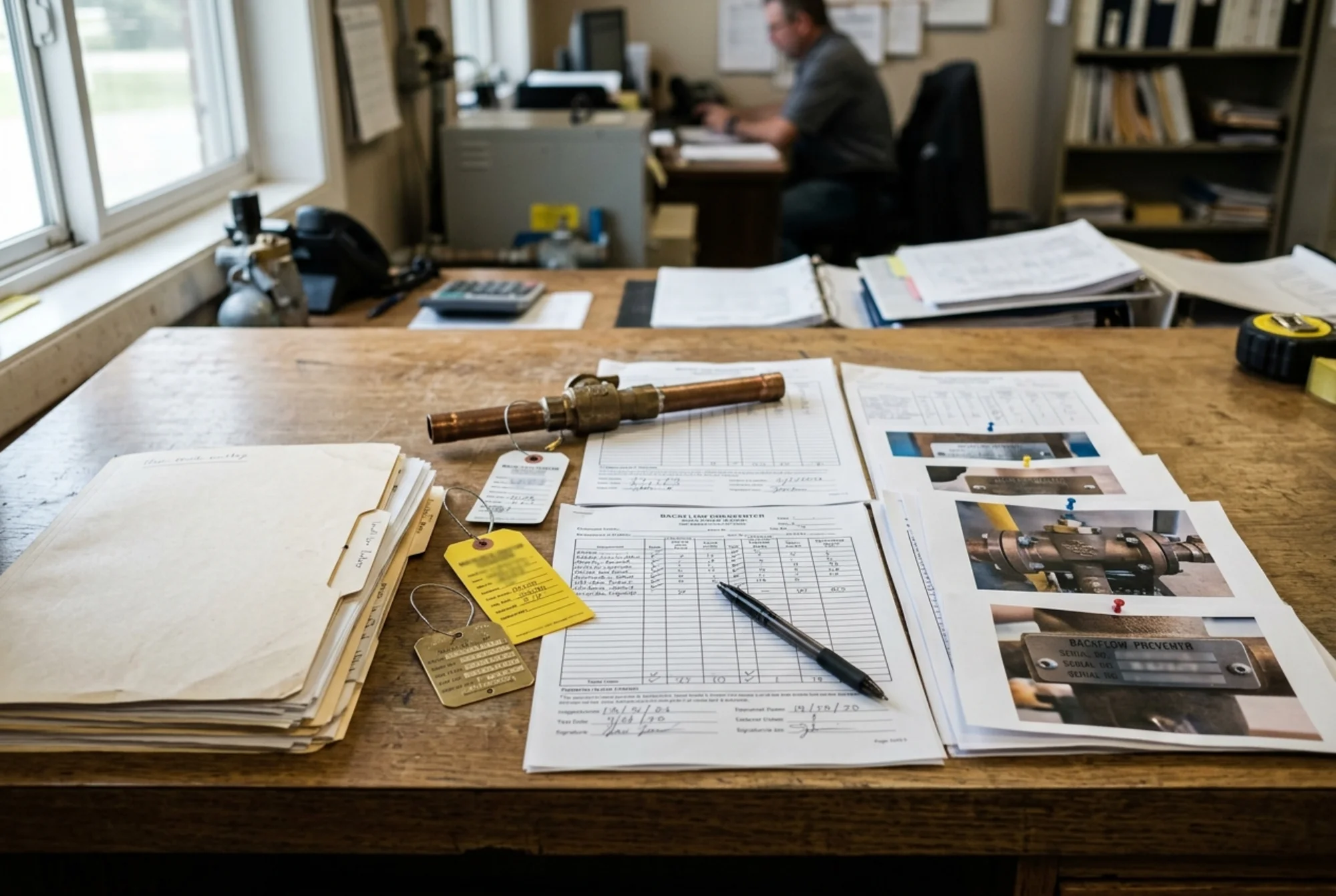 Backflow compliance paperwork, valve tags, and serial number photos on a desk
Assemble the minimum packet that helps the utility or tester identify the property correctly.
Try to collect:
- service address and utility account information
- any old utility notice or invoice mentioning backflow
- device type, size, manufacturer, model, and serial number if visible
- current photos of the assembly and its location
- any prior test tag attached to the device
- plumbing, irrigation, or fire-system invoices mentioning replacement or testing
- contact info for the last known tester or maintenance company
- a short written note explaining the ownership or management transition
Washington State’s operator certification rule spells out minimum field test report content. Austin Water is even more concrete: its Test and Maintenance Report requirements include the physical address, location on the premises, cause requiring backflow protection, manufacturer, model, serial number, test results, repair notes, and owner information.
Utilities need enough detail to connect the right property to the right assembly.
Ask for copies in the right order
The fastest recovery path is usually:
First: ask the utility what it already has
Some utilities can confirm test status, resend notices, or tell you which assembly is in their database. Los Angeles County explicitly says owners can request a copy of a test notice. Philadelphia Water Department publishes both a Facility Update on Backflow Prevention form and a Backflow Prevention Assembly Test and Maintenance Record, suggesting that inventory updates and annual test documentation may be separate paperwork.
Second: contact the last known tester or service company
If you have a sticker, tag, invoice, or email thread, start there. Many testers retain old reports and can resend them quickly.
Third: ask whether an ownership/contact update form is required
If the utility still has notices pointed at the old owner or manager, the problem may repeat even after you find the reports.
Fourth: confirm who submits the next report
Seattle Public Utilities says all installed assemblies must be tested annually by a certified tester and a copy of the test report must be provided directly to SPU. Austin Water says each BPAT must submit a complete Test and Maintenance Report within five calendar days through the WEIRS database. Do not assume “the test happened” and “the utility accepted the report” are the same thing.
If you are comparing how programs work in practice, the utility pages for Austin Water backflow testing and Philadelphia Water Department backflow testing are useful starting points.
When scheduling a new test is the smartest move
If the annual deadline is near and the old paperwork is still missing, a fresh test is often the fastest way to stabilize the file.
It can do three important things:
- confirm the assembly is still present and functional
- create a current report with the right serial number and location
- give the utility a clean new record to work from
Seattle’s guidance makes the ongoing duty clear: after installation, the customer is required to have the assembly tested annually, and copies of the reports must be provided. So if the inherited file is a mess, current compliance still matters.
A new test is especially helpful when:
- you cannot confirm the last test date
- the device tag is unreadable or inconsistent with old paperwork
- you are unsure whether the assembly protects irrigation, domestic, or fire service
- you inherited the property mid-cycle and do not know whether a notice deadline already passed
If you are still looking for the right contractor, compare local options through Austin, Texas, Seattle, Washington, and Philadelphia, Pennsylvania, then review how to choose a qualified backflow tester.
Do not ignore signs that the utility record itself may need correction
Missing records sometimes hide a deeper issue: the utility may still be tracking the wrong assembly.
That can happen when a device was replaced without a clean update or when an old hazard was removed without telling the water program. Portland Water Bureau says owners must contact the utility before installing, removing, replacing, or relocating a premises-isolation assembly, and if they want to remove it, an inspector must verify the property no longer poses a backflow risk.
So if the inherited paperwork does not match what is physically on site, do not just upload the closest report you can find. Slow down and verify whether the record needs correction first. That is the better path than creating another year of bad data or getting the next report rejected.
Our guides on how utilities track backflow test compliance and why your backflow test report was rejected are helpful if the database and the field reality do not line up.
Build a cleaner file for next year before you move on
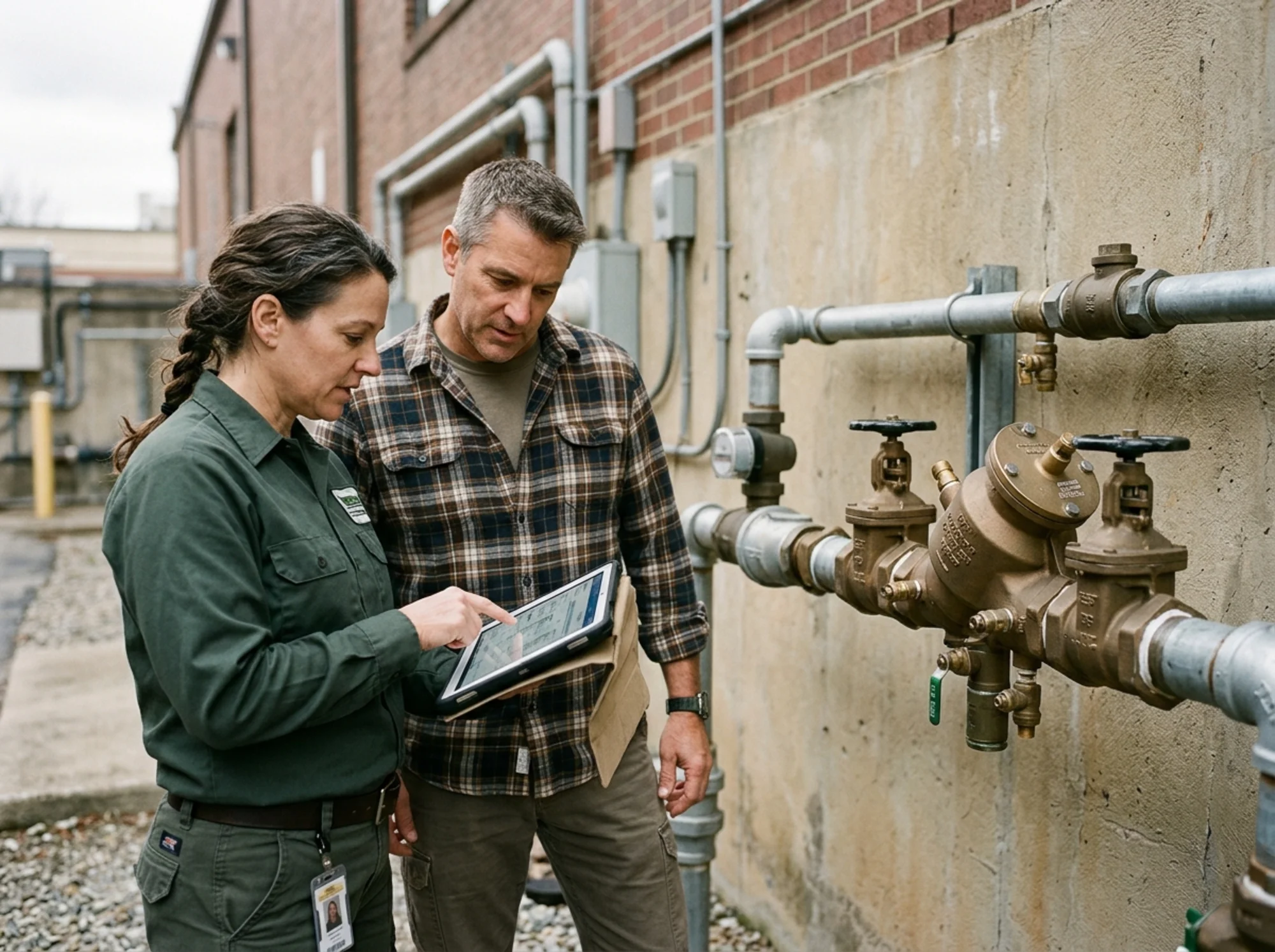 Property owner and certified tester reviewing updated backflow records beside an assembly
Once you recover the file, keep the next cycle from turning into the same scramble.
Create one folder with the accepted test report, utility confirmation, ownership/contact update forms, serial-number photos, and any repair or replacement invoices.
If the property is part of a portfolio, keep a simple per-site register: address, device type, serial number, last test date, next due date, tester, and utility contact.
The bottom line
If you bought a property and inherited missing backflow test records, the best move is to treat it as a record-recovery and compliance-verification project, not a passive paperwork annoyance.
Start with the utility record. Confirm what assembly is on file, who receives notices, and whether anything is already overdue. Rebuild the minimum documentation packet. Request copies from the utility and the last tester. If the deadline is getting close, schedule a new test so you have a clean current report tied to the right device.
That approach will not recover every detail, but it will restore control — and that is what matters most when the water utility is part of the equation.
Sources
This article references guidance and regulations from authoritative sources including:
- U.S. Environmental Protection Agency (EPA) - Overview of the Safe Drinking Water Act
- American Water Works Association (AWWA) - Cross-Connection Control & Backflow Prevention resources
- Washington State Department of Health - Cross-Connection Control and Backflow Prevention
- Seattle Public Utilities - Requirements & Types of Backflow Prevention
- Seattle Public Utilities - Backflow Assembly Testing
- Austin Water - Backflow Prevention Assembly Tester Information
- Austin Water - Water Protection Forms, Applications and Reports
- Philadelphia Water Department - Cross-Connection & Backflow Compliance
- Los Angeles County Department of Public Health - Backflow Prevention Device Frequently Asked Questions
- Portland Water Bureau - Backflow assembly installation requirements
- Centers for Disease Control and Prevention (CDC) - About Drinking Water
Last updated: June 1, 2026