What to Do If Your Utility Notice Lists a Backflow Assembly That Was Already Removed
You open a backflow test notice and the first reaction is confusion: the assembly it references is not even there anymore. Maybe the irrigation system was removed or the device was replaced years ago.
That is usually a records problem with compliance consequences, not a free pass to ignore the notice.
Utilities track backflow assemblies because public water systems are expected to protect drinking water from contamination. If the utility still shows a device on file, it may keep sending annual notices until someone proves what changed and whether the original hazard still exists.
Short answer: do not ignore the notice just because the assembly is gone
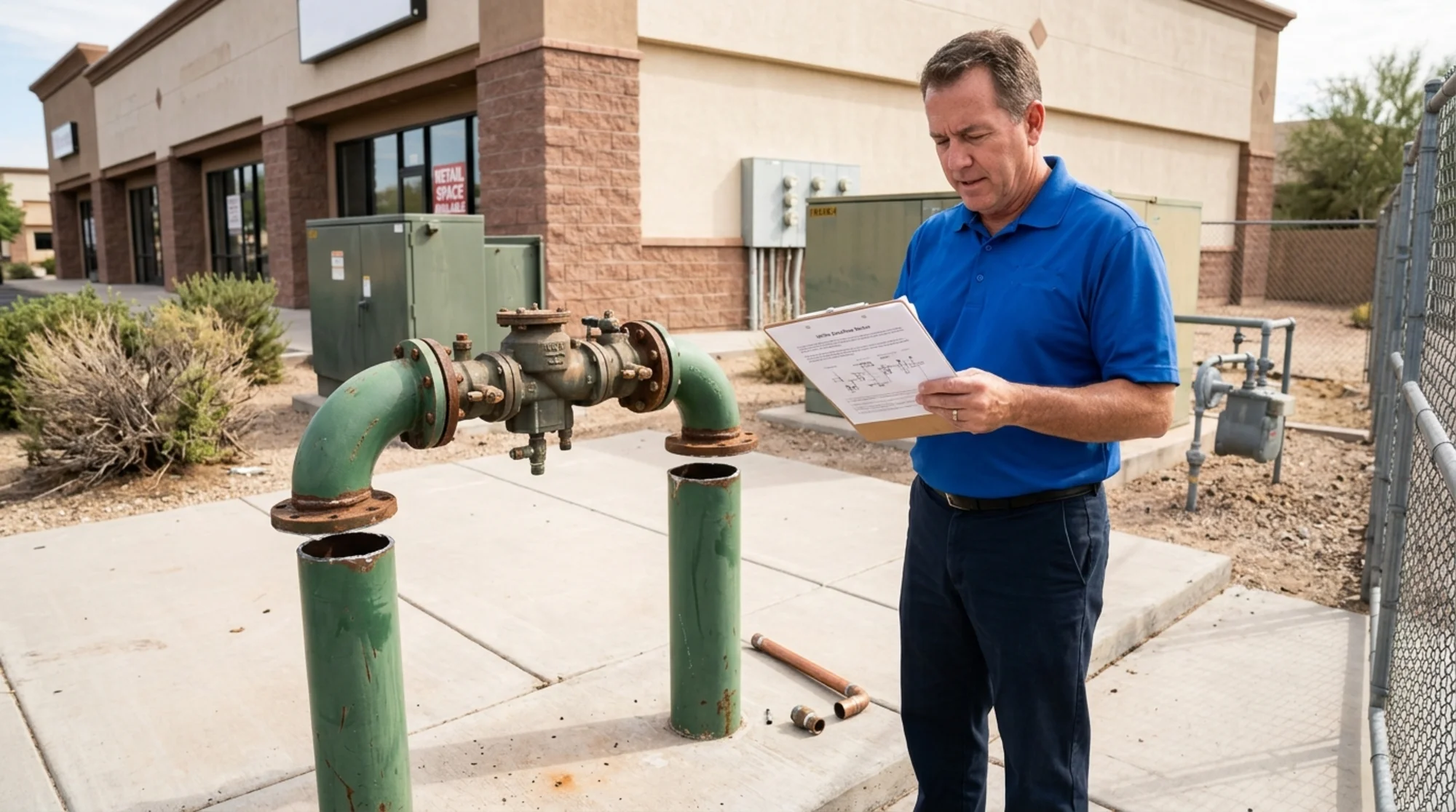
Property manager reviewing a utility backflow notice beside an outdoor service line where a backflow assembly was already removed, realistic commercial setting, no readable text
If the utility is still sending notices, the compliance record is probably still open in some form. It means the utility has not yet received enough information to close, replace, or reclassify the old device record.
A few different realities can produce the same notice:
- the assembly was removed, but the utility was never told
- the assembly was replaced, but the old serial number is still on file
- the hazard was eliminated, but the out-of-service or removal status was never recorded
- the property changed hands and the paperwork trail got lost
- the device is still there, just hidden, mislabeled, or confused with another line
So the goal is not to argue with the notice in the abstract. The goal is to identify which record mismatch happened and what the utility wants to resolve it.
If you already suspect the issue is a replacement mismatch, our guide on how to update utility records after replacing a backflow preventer is the closest companion article.
First figure out whether the assembly was removed, replaced, or just no longer obvious
Before you tell the utility the device is gone, make sure you can support that claim.
Start with the practical evidence:
- old test reports
- utility notices with serial numbers or location notes
- plumbing or irrigation invoices
- permit paperwork
- photos from past repairs or replacement jobs
- site photos showing the current piping condition
- notes from the current owner, manager, or maintenance vendor
This matters because “removed” gets used loosely. Sometimes a device was truly removed because the downstream hazard no longer exists. Sometimes it was replaced with a new assembly. Sometimes a line was abandoned in place but never formally disconnected. And sometimes the assembly is still present, just not where the current staff expected it.
If you manage multiple sites or inherited the property recently, compare the notice against the physical service type. Is it tied to irrigation, domestic service, or fire protection? That clue helps narrow what probably changed. Our city pages for Austin, Texas, Seattle, Washington, and Philadelphia, Pennsylvania can help before you start calling around.
The real compliance question is whether the hazard still exists
A removed assembly does not always mean the backflow obligation disappeared.
Austin Water is unusually clear on this point. It says that when a backflow prevention assembly is removed, the tester must submit a Test and Maintenance Report showing the assembly was removed or replaced. It also says that if the hazard has not been eliminated, the assembly must be replaced to maintain uninterrupted backflow protection. If the hazard has been eliminated, that change still needs to be reported so the out-of-service status can be recorded and testing requirements removed.
Portland Water Bureau takes a similar approach from the approval side. Portland says owners must contact the utility before installing, removing, replacing, or relocating a premises-isolation assembly, and if an owner wants to remove an assembly, a Water Quality Inspector must verify that the property no longer poses a backflow risk.
That gives you a simple decision tree:
- hazard still exists → the property probably still needs protection
- assembly was replaced → the utility likely needs the new device details
- hazard was eliminated → the utility still needs documentation to remove the testing obligation
Ask the utility what record it still has and what document closes it
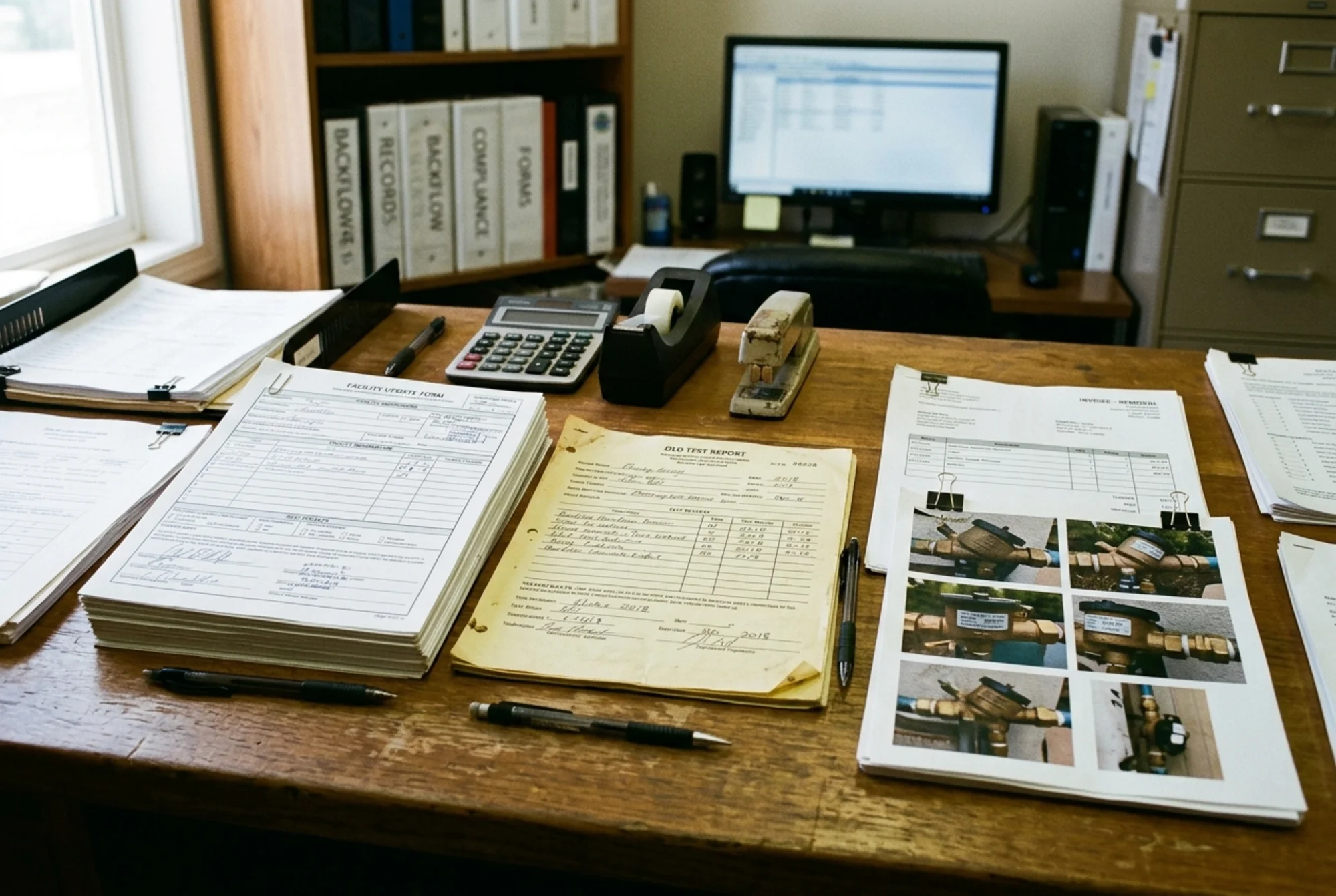 Organized backflow compliance paperwork on a desk with an old test report, removal invoice, serial number photos, and a facility update form, realistic office scene, no readable text
Once you have basic facts, call or email the utility with a narrow question:
“Your notice shows a backflow assembly for this address, but we believe that device was removed or changed. What assembly details do you still have on file, and what exact documentation do you need to update or close the record?”
Official programs show why. Philadelphia Water Department publishes multiple separate backflow forms, including Form CU-100 – Facility Update on Backflow Prevention and Form 79-770 – Backflow Prevention Assembly Test and Maintenance Record. That is a strong clue that some jurisdictions treat inventory updates separately from annual testing paperwork.
Austin emphasizes the tester-submitted report path through its backflow program. Seattle Public Utilities says the tester submits the report directly and tells owners to keep documentation confirming results were submitted. The utility may want:
- a removal or replacement report
- a facility or account update form
- a corrected serial number
- proof that the hazard was eliminated
- a new passing report if a replacement device is actually in service
What documents usually help resolve this fastest
A solid documentation packet can include:
- the utility notice
- service address and account reference
- old assembly type, make, model, and serial number if known
- current site photos showing the location now
- removal or replacement invoice
- test report or maintenance record tied to the removal or replacement
- permit reference, if one applied
- a short note explaining whether the hazard still exists
If the assembly was removed because irrigation was abandoned, say that clearly. If a fire or domestic assembly was replaced, say what replaced it. If you are not sure whether the hazard still exists, do not bluff. It also helps to compare your paperwork to utility-specific pages such as Austin Water backflow testing and Philadelphia Water Department backflow testing.
When a new test or site review may still be required
Do not assume a removal story automatically closes the issue.
A new test, reinspection, or utility review may still be needed when:
- the hazard may still be present
- nobody can prove what happened to the old assembly
- the utility record shows a different service or device type than you expected
- the property has multiple assemblies and the wrong one may have been removed
- the original work may have happened without required approval
Portland’s approval-first language is a good reminder here: removal is not just a field decision if the utility still considers the property at risk. Austin makes the same point from another angle: if the hazard was not eliminated, protection has to continue.
So if the notice points to an unresolved irrigation, fire, or domestic-service risk, the utility may want more than an email saying “we took it out.” It may want inspection proof, updated records, or a replacement device on file.
How to prevent the same notice next year
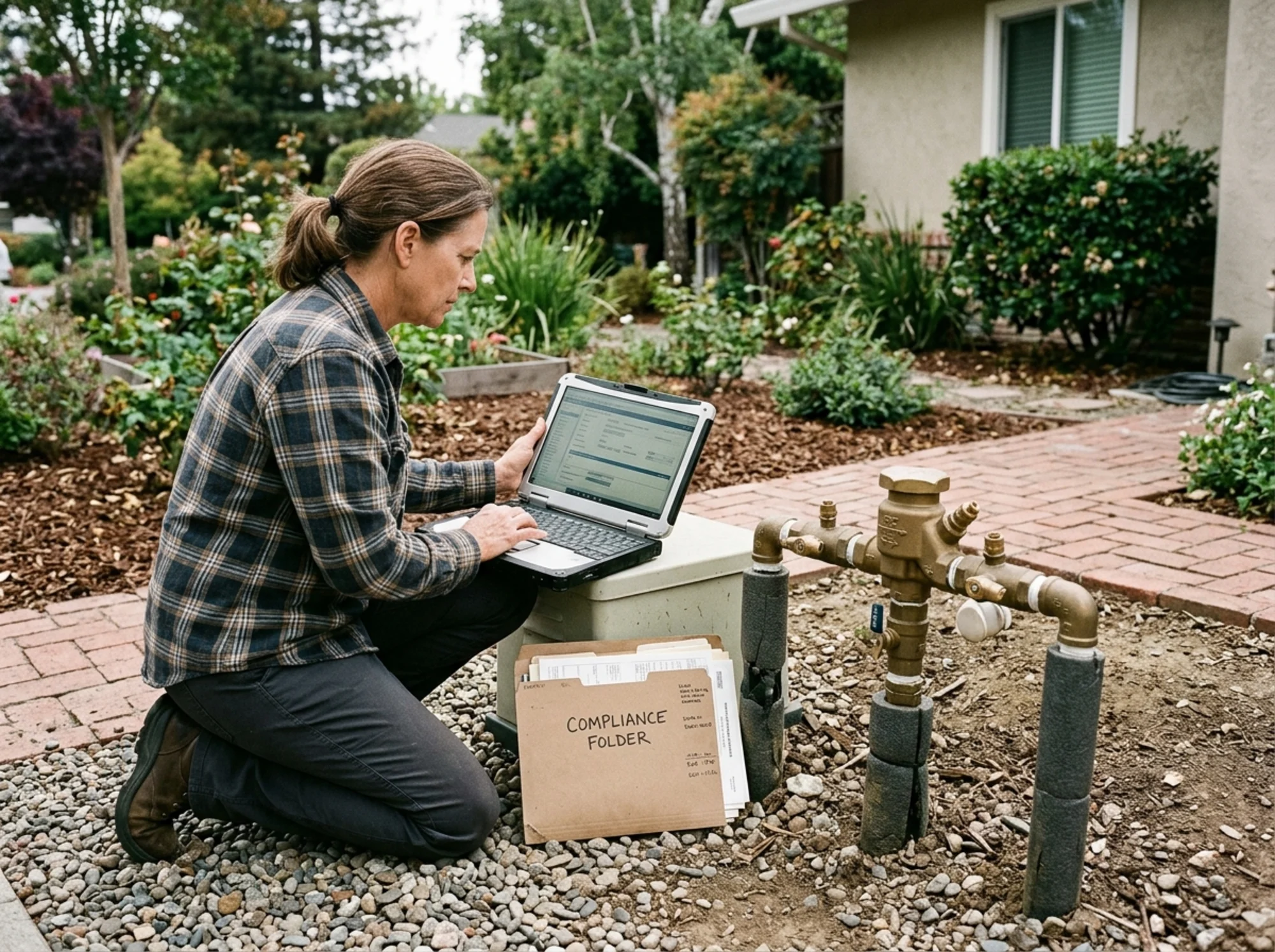 Property owner confirming updated utility backflow records on a laptop beside capped irrigation piping and a labeled compliance folder, realistic natural lighting, no readable text
Once the utility confirms the record is fixed, save proof immediately.
Keep:
- the utility’s confirmation email or case number
- the final accepted report or update form
- photos showing the current site condition
- serial-number photos if a new device replaced the old one
- any permit or inspection reference
- the date the testing requirement was removed or transferred
Seattle’s guidance to keep documentation confirming submission is a smart universal habit. If the account ever drifts again, your backup file can save hours.
For portfolios and inherited properties, keep a simple assembly register listing which devices are active, removed, replaced, or out of service at each address.
The bottom line
If your utility notice lists a backflow assembly that was already removed, the safest move is not to ignore the notice and hope the next cycle fixes itself.
Treat it as a compliance-record problem that needs a documented answer:
- Was the assembly truly removed?
- Was it replaced instead?
- Does the hazard still exist?
- What form, report, or proof does the utility need to update the file?
Answer those four questions with real documentation, and most of these cases become manageable. If you cannot answer them yet, slow down, gather records, and get the utility involved before an old device record turns into a fresh compliance problem.
Sources
This article references guidance and regulations from authoritative sources including:
- U.S. Environmental Protection Agency (EPA) - Overview of the Safe Drinking Water Act
- U.S. Environmental Protection Agency (EPA) - Cross-Connection Control and Backflow Prevention Fact Sheet (PDF)
- American Water Works Association (AWWA) - Cross-Connection Control & Backflow Prevention resources
- Texas Commission on Environmental Quality (TCEQ) - Cross-Connection Control and Backflow Prevention
- Austin Water - Backflow Prevention Assembly Tester Information
- Portland Water Bureau - Backflow assembly installation requirements
- Philadelphia Water Department - Cross-Connection & Backflow Compliance
- Philadelphia Water Department - Form CU-100 – Facility Update on Backflow Prevention (PDF)
- Seattle Public Utilities - Backflow Assembly Testing
- Centers for Disease Control and Prevention (CDC) - About Drinking Water
Last updated: May 31, 2026