How to Update Utility Records After Replacing a Backflow Preventer
Replacing a backflow preventer feels like the hard part. The old assembly is out, the new one is in, the plumber or tester says the device is ready, and everyone wants to move on.
But from a utility-compliance standpoint, the replacement is not finished until the records are right.
Utilities track backflow assemblies by details like location, type, manufacturer, model, and serial number. If those records still point to the old device, the next annual test report may be rejected, the wrong assembly may stay on file, or the property may keep receiving notices that no longer match reality.
That paperwork burden is not arbitrary. EPA explains that the Safe Drinking Water Act exists to protect public health by regulating the public drinking water supply, and local cross-connection programs turn that public-health duty into property-level testing, reporting, and recordkeeping. If you want the broader background first, start with why backflow testing is required, keep our FAQs handy, and if you already need field help, find a local backflow tester before the follow-up deadline gets tight.
A replacement changes more than the hardware
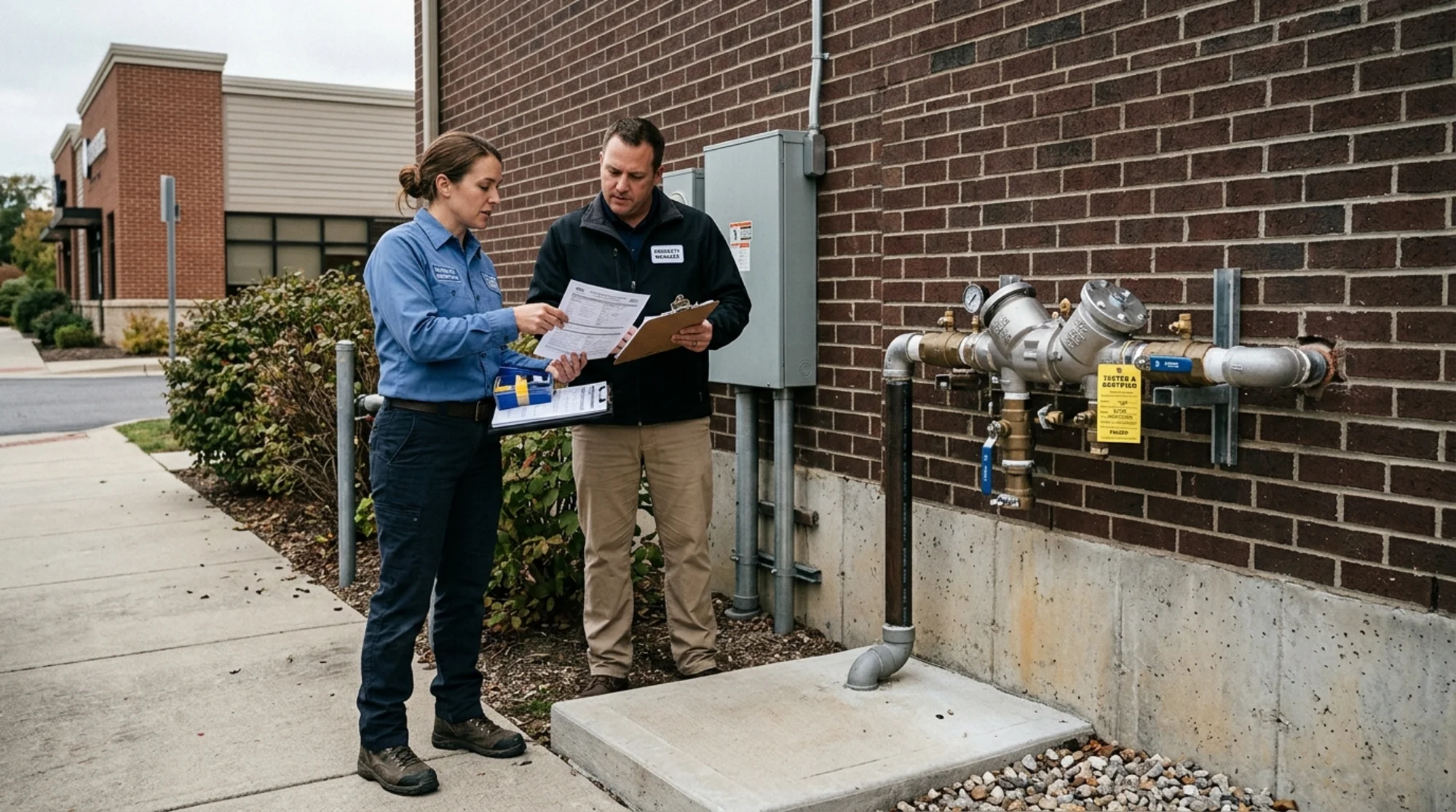
Certified backflow tester and property manager reviewing replacement paperwork beside a newly installed commercial backflow preventer outside a building
When a new assembly replaces an old one, several things may change at once:
- the serial number
- the manufacturer or model
- sometimes the assembly type
- sometimes the exact location or piping layout
- the testing record tied to that property
That matters because many utilities do not treat a replacement as just another annual test. They treat it as a records event.
Portland Water Bureau is very direct: premises-isolation assemblies must not be removed, replaced, or relocated without approval, and the utility must be contacted before installing, removing, replacing, or relocating the assembly. Philadelphia Water Department publishes separate forms for facility updates, installation permits, and test-and-maintenance records. Austin Water requires the tester to file a Test and Maintenance Report showing when an assembly was removed or replaced.
In plain English: if the utility still thinks your property has the old assembly, your compliance file is not clean yet.
What to gather before the old assembly disappears
The easiest time to prevent records trouble is before the replacement crew leaves.
Capture these details while both the old and new devices are still traceable:
- old assembly manufacturer, model, size, and serial number
- new assembly manufacturer, model, size, and serial number
- exact installation address and on-site location
- reason for replacement, if known
- installation date
- tester or contractor name
- photos of the old tag if readable
- photos of the new tag after installation
This is especially important when the replacement happened because of freeze damage, corrosion, a failed test, or an emergency repair. Those situations create the highest odds of rushed paperwork and wrong serial numbers.
If you need help locating or documenting those tags, our guide on how to find a backflow preventer serial number is a useful companion.
Ask the utility what counts as a replacement update in your program
A lot of owners make the mistake of assuming one passing test report automatically updates everything.
Sometimes it does. Sometimes it absolutely does not.
Official programs vary, but the categories are pretty consistent:
1. A test report or test-and-maintenance record
Austin Water requires a complete and legible Test and Maintenance Report within five calendar days, including the physical location, cause requiring protection, manufacturer, size, model, serial number, test results, repairs, tester information, and gauge serial number.
2. A facility or account update
Philadelphia publishes Form CU-100 – Facility Update on Backflow Prevention, which is a strong signal that assembly changes are tracked separately from ordinary testing paperwork.
3. A permit or pre-approval step
Portland requires notice and approval before replacing premises-isolation assemblies, along with required permits and inspection steps.
4. Tester credential and calibration support
Seattle Public Utilities says reports must be completed according to its guidelines and Washington WAC 246-292-036, and test reports cannot be submitted unless the tester's certification and test kit calibration information are already in the system.
That is why the smartest question to ask the utility is not just, "Do you need the passing test?" It is:
"What do you need to update the old assembly record to the new one in your system?"
For local context, compare your market pages for Austin, Texas, Seattle, Washington, and Philadelphia, Pennsylvania, then review utility-specific summaries like Austin Water backflow testing and Philadelphia Water Department backflow testing.
Do not assume hazard removal means the paperwork goes away
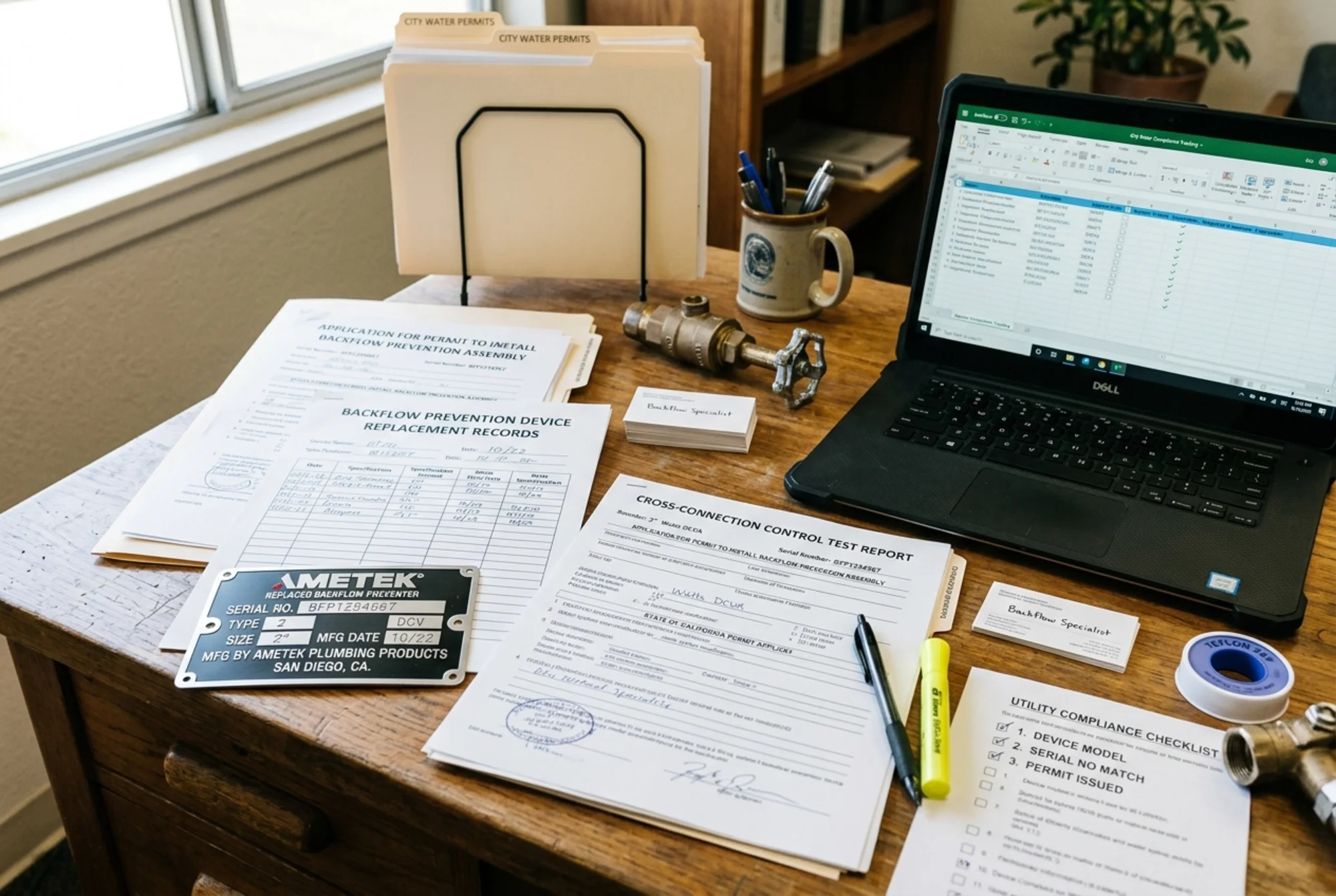 Backflow replacement documents, serial number plate photo, permit forms, and utility compliance checklist arranged on an office desk beside a laptop
A second common mistake is thinking that if the old hazard is gone, there is nothing left to report.
Austin Water says that when a BPA is removed, the tester must submit a Test and Maintenance Report indicating the assembly has been removed or replaced. If the hazard has not been eliminated, the BPA must be replaced to maintain uninterrupted protection. If the hazard has been eliminated, that change still needs to be reported so the out-of-service status can be recorded and testing requirements can be removed from the system.
Portland says something similar in a different way: if an owner wants to remove an assembly, the Water Bureau must verify that the property's water use no longer poses a backflow risk.
So the rule of thumb is simple:
- new hazard, same hazard, or changed hazard → update the utility
- replacement with same protection → update the utility
- hazard eliminated and device removed → still update the utility
No matter which version applies, silence is usually the wrong move.
The fastest way to create next year's rejection problem
A replacement that is not fully registered often stays hidden until the next test cycle.
That is when the property owner hears some version of:
- serial number does not match our records
- wrong assembly on file
- test report incomplete
- installation details missing
- replacement not recorded
Washington DOH publishes minimum field-test report content requirements for exactly this reason. Seattle likewise points owners back to the completed report and stresses keeping documentation that confirms results were submitted. Philadelphia's separate forms for installation, facility updates, and test records show the same operational reality: the utility wants a clean chain from device to paperwork.
If you have ever dealt with a rejected report before, you already know how annoying that becomes. Our related post on why your backflow test report was rejected walks through that side of the problem.
A practical post-replacement checklist
The calmest way to close out the job is to treat replacement as a short workflow instead of a single appointment.
Step 1: Confirm the new assembly details on site
Before anyone leaves, verify the new make, model, size, serial number, and exact location.
Step 2: Get the right completed paperwork
Ask for the final test record, replacement notes, and any utility-specific forms or permit references.
Step 3: Verify who submits what
Some jurisdictions expect the tester to submit everything. Others split the burden between tester, plumber, and owner. Do not guess. If needed, use our guide on how to submit your backflow test report to your water utility.
Step 4: Ask whether the old record has been replaced in the utility database
This is the key confirmation step. You want the utility to recognize the new device, not just acknowledge that work happened.
Step 5: Save proof of the update
Keep the accepted report, email confirmation, portal screenshot, permit reference, and photos of the new serial tag.
Step 6: Update your internal log
If you manage multiple properties, update the assembly register immediately so the next annual cycle starts from the correct device.
That internal log should connect naturally with the broader habits in our backflow testing documentation requirements guide and our post on how utilities track backflow test compliance.
When to slow down and call the utility directly
A direct call or email is worth it when:
- the new assembly is a different type than the old one
- the assembly was relocated
- the hazard classification may have changed
- the old device was removed and not replaced
- the tester is unsure which form closes out the old record
- you are inheriting a property with unclear historical paperwork
Portland's approval-first approach, Austin's required removal/replacement reporting, Philadelphia's facility-update form, and Seattle's report-content rules all point to the same practical lesson: record changes are compliance changes.
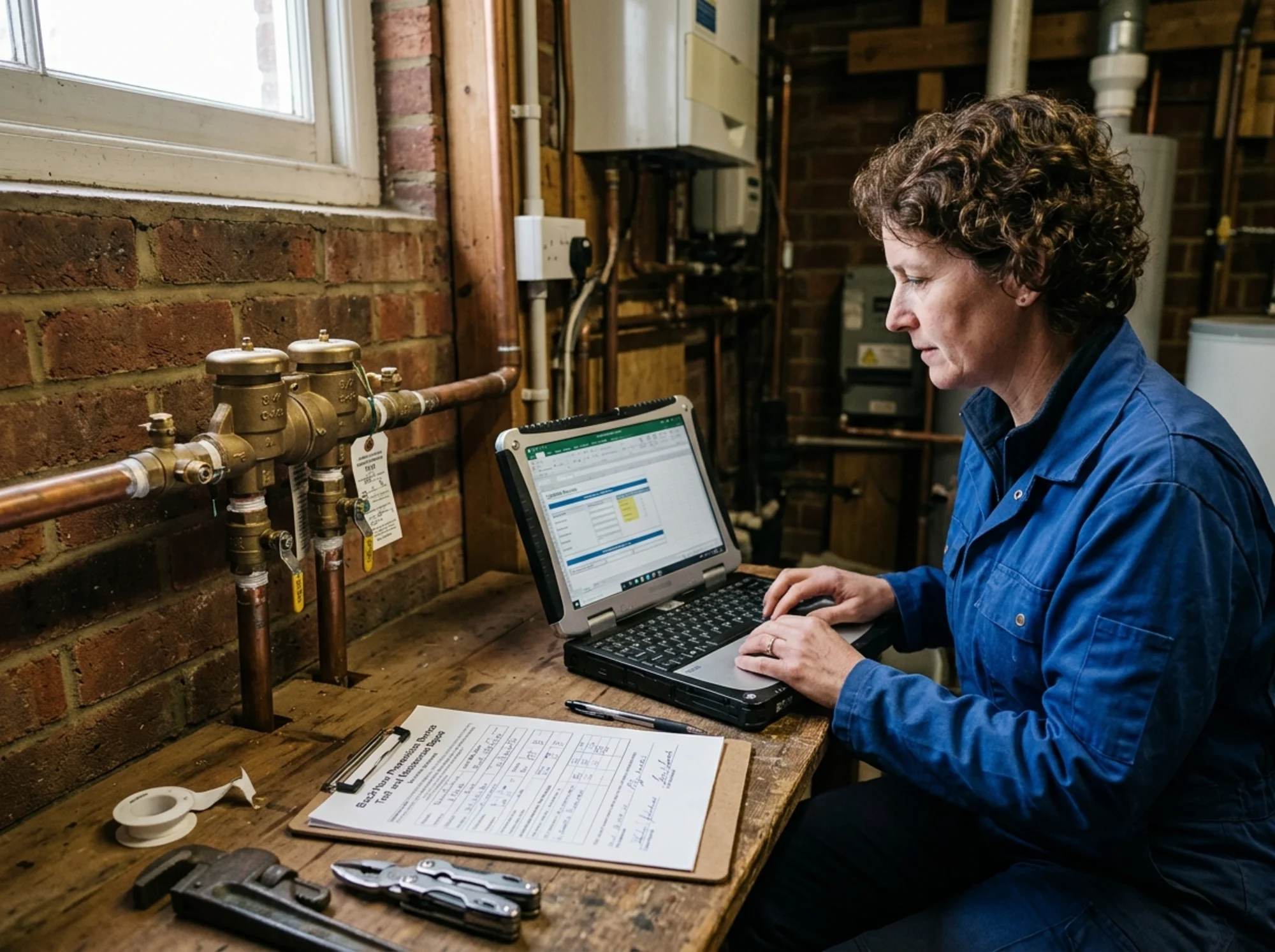 Property owner confirming updated utility records on a laptop while a newly installed backflow preventer and completed field paperwork sit nearby
The bottom line
Replacing a backflow preventer is not complete when the new assembly passes its first test. It is complete when the utility record reflects the new device accurately.
That usually means some combination of updated serial numbers, a complete test report, utility-specific forms, permit or approval follow-up, and proof that the new assembly is now the one on file.
Do that well, and next year's test cycle is routine. Skip it, and the replacement can turn into a paperwork mess that surfaces months later.
If you want the safest closeout path, document both devices, confirm who is submitting the update, and get explicit confirmation that the utility file now matches the new assembly.
Sources
This article references guidance and regulations from authoritative sources including:
- U.S. Environmental Protection Agency (EPA) - Overview of the Safe Drinking Water Act
- American Water Works Association (AWWA) - Cross-Connection Control & Backflow Prevention resources
- Washington State Department of Health - Cross-Connection Control and Backflow Prevention
- Seattle Public Utilities - Backflow Assembly Testing
- Austin Water - Backflow Prevention Assembly Tester Information
- Portland Water Bureau - Backflow assembly installation requirements
- Philadelphia Water Department - Cross-Connection & Backflow Compliance
- Centers for Disease Control and Prevention (CDC) - Preventing Drinking Water-Related Illnesses
Last updated: May 29, 2026