What to Do If Your Utility Says the Backflow Test Report Was Filed Under the Wrong Address
If your utility says your backflow test report was filed under the wrong address, the problem is usually not the field test itself. It is a record-assignment problem.
Utilities track which exact property, service line, meter account, and assembly location the report belongs to. If the report lands on the wrong address, the utility may treat your property as still noncompliant even when the assembly was tested properly.
That is frustrating, but it is usually fixable if you compare the utility record, the submitted report, and the actual assembly on site.
For broader context, keep why backflow testing is required, why your backflow test report was rejected, and our FAQs open while you work through it.
Why utilities care so much about the address and location fields
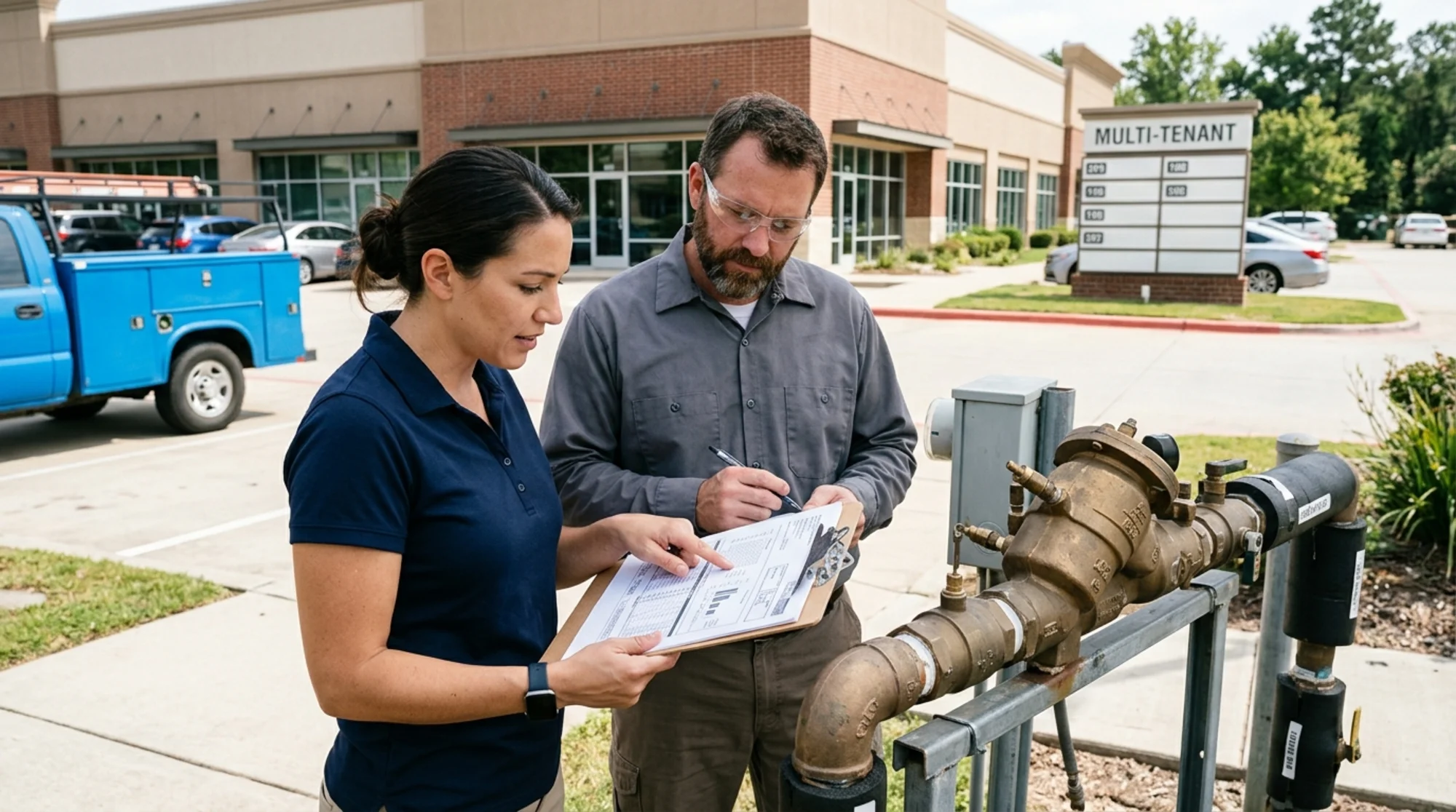
Property manager and certified backflow tester comparing a backflow test report, service address record, and brass backflow assembly at a multi-tenant commercial property, realistic natural lighting, no readable text
A report filed under the wrong address can sound like a minor office mistake. EPA says the Safe Drinking Water Act protects public health by regulating the nation’s public drinking water supply, and CDC notes that harmful germs or chemicals can get into drinking water while it is being piped to homes and businesses. Cross-connection programs use backflow test records to prove that the right assembly at the right property was inspected and is still protecting the public system.
Austin Water requires the assembly’s physical address and location on the premises. Seattle’s test report form includes Service Address and Preventer Physical Location. Philadelphia’s official record asks for the facility Address, Account or Meter #, and Location of Assembly. Phoenix requires the assembly address and on-site location of assembly.
Utilities are not just matching a device to a city. They are matching it to one exact compliance record.
If you want local orientation while you compare programs, our city pages for Austin, Texas, Phoenix, Arizona, and Philadelphia, Pennsylvania are useful starting points.
How a report ends up under the wrong address
Most of the time, this is not fraud. It is paperwork drift.
Common causes include:
1. The tester used an old address from a prior job
This happens more than owners expect, especially when a tester services multiple sites for the same customer.
2. The property has multiple buildings, suites, or service lines
An HOA, shopping center, apartment complex, school campus, or industrial site may have more than one meter account or more than one backflow assembly. A report can get attached to Building B when the tested device actually serves Building A.
3. The utility record and the mailing address are not the same
The correct compliance record may be tied to a service address, meter account, parcel, or facility name that does not match the address the owner normally uses for mail.
4. The assembly was replaced, relocated, or reassigned without a facility update
Philadelphia keeps a separate Facility Update on Backflow Prevention form in addition to its annual test form. If the underlying record was never updated, even an accurate new test report can still land in the wrong place.
5. A report was incomplete and got kicked back
Phoenix says inaccurate or incomplete reports will not be accepted. When a tester reworks paperwork later, details can get mixed up.
If the utility also says the report never appeared in the right account, read what to do if your utility says it never received your backflow test report.
What to do immediately when the utility flags the wrong address
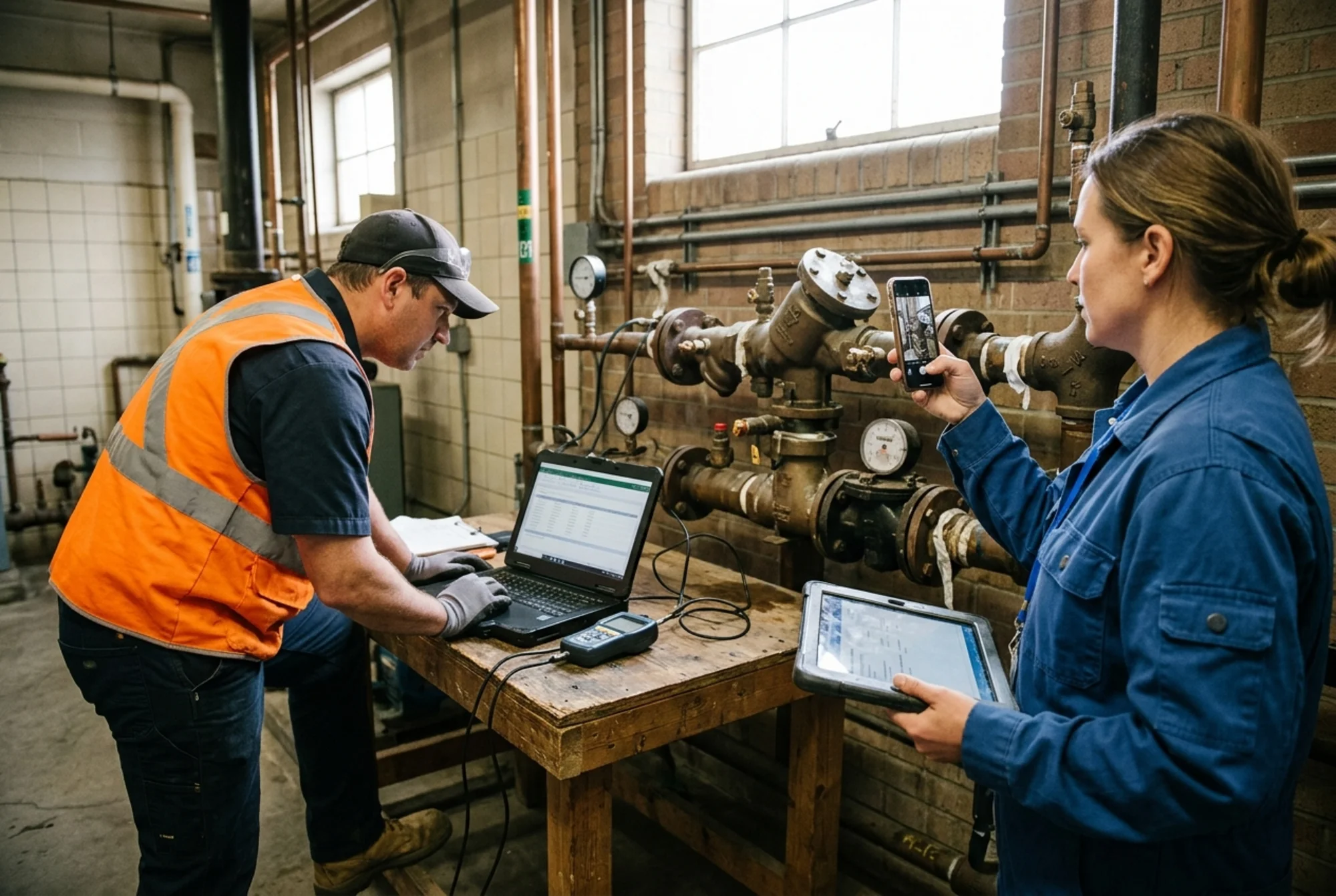 Close-up of a certified backflow tester reviewing a submitted report on a laptop while a property manager checks a meter account record and photographs the assembly location, documentary style, no readable text
Move in this order.
1. Ask the utility which address or account the report was matched to
Use plain wording:
“Can you tell me the exact service address, meter account, assembly location, and any identifying details you have on file for the report you received?”
Do not settle for “wrong address” as the full explanation. You need to know whether the mismatch involves the mailing address, service address, suite or unit number, meter account, assembly location, or the wrong property entirely.
2. Get the exact report that was submitted
Ask the tester for the filed copy, not a retyped summary. Confirm:
- service address used on the report
- physical location of the assembly
- owner or site contact information
- manufacturer, model, and serial number
- test date
- meter or account identifiers, if shown
- proof of submission
If the tester used a portal, ask for the PDF export or screenshot of what was actually submitted.
3. Verify the assembly on site
Take clear photos of the full assembly, the serial tag, the surrounding location, and any room number, wall label, meter marking, or riser description that proves where the device sits.
That evidence matters because many wrong-address disputes are really wrong-location disputes wearing a different label.
4. Ask whether the utility needs a corrected report, a facility update, or both
Do not assume a corrected PDF closes the file. Ask:
“Do you need the tester to resubmit the test under the correct address, or do you also need the property record updated first?”
Philadelphia separates the annual test and maintenance record from the facility update form. If the utility’s core record is wrong, the test report alone may not fix it.
5. Confirm who owns the follow-up
Seattle says the tester submits the report directly to the utility, and Austin requires online TMR submission through WEIRS. That means the owner often cannot fully fix the problem alone. Make sure you know whether the utility expects action from the tester, the owner, the plumber or installer, or all three.
If the utility is also questioning whether the right assembly was tested, what to do if your utility says the serial number on your backflow test report does not match their records is the right companion read.
When a corrected report is probably enough
A corrected report may be enough when:
- the physical assembly on site is clearly the right one,
- the serial number and model match,
- the only problem is a bad address or suite field,
- the utility can identify the right account once the tester resubmits,
- and there is no sign that the facility record itself is outdated.
In those cases, the fastest closeout is often:
- the tester resubmits the corrected report,
- the utility confirms it is attached to the right property record,
- and you save a copy of that confirmation.
If the issue is just bad paperwork, clean paperwork may solve it.
When the problem is bigger than a clerical fix
A corrected report may not be enough when:
- the utility record is tied to an old facility name or address,
- the assembly was relocated or replaced without notice,
- the site has multiple assemblies and the wrong one was tested,
- the wrong meter account or service line was used,
- the test belongs to another building in the same complex,
- or the property changed ownership and the compliance record never got cleaned up.
That is when utilities may ask for more than a corrected report. They may want a facility update form, supporting photos, replacement details, proof of which assembly serves which line, or even a brand-new test under the corrected record.
Philadelphia’s forms make this distinction especially clear because the city publishes both a backflow test record and a separate facility update form.
If you are dealing with a complicated site, review Austin Water backflow testing and Philadelphia Water Department backflow testing before you push for a quick resubmission.
A simple checklist to stop this from happening next year
 Organized compliance desk with labeled property files, assembly photos, meter account notes, and a property manager confirming accepted utility records on a laptop, realistic office lighting, no readable text
The easiest prevention strategy is to treat property identification as part of the test, not as back-office cleanup.
Before the tester leaves, confirm the exact service address, suite or building name, assembly location description, manufacturer, model, serial number, correct owner or facility contact, who is submitting the report, and how you will confirm acceptance.
For larger properties, keep a simple assembly log with the utility name, service address, meter account, exact device location, make, model, serial number, last passing test date, and any related facility-update paperwork.
It is the cheapest way to avoid repeat compliance headaches on multi-building or high-turnover properties.
The bottom line
If your utility says the backflow test report was filed under the wrong address, do not brush it off as a harmless typo.
Treat it like a record-matching problem:
- find out which address or account the utility used,
- compare that against the submitted report,
- verify the actual assembly on site,
- and ask whether the utility needs a corrected report, a facility update, or both.
Sometimes the fix is simple. Sometimes the wrong address is just a symptom of a bigger record problem. Either way, the fastest path is getting the utility record, the report, and the physical assembly to point to the same place.
Sources
This article references guidance and regulations from authoritative sources including:
- U.S. Environmental Protection Agency (EPA) - Overview of the Safe Drinking Water Act
- American Water Works Association (AWWA) - Cross-Connection Control & Backflow Prevention resources
- Washington State Department of Health - Cross-Connection Control and Backflow Prevention
- Washington State Department of Health - Sample Backflow Preventer Inspection and Field Test Report
- Seattle Public Utilities - Backflow Assembly Testing
- Austin Water - Backflow Prevention Assembly Tester Information
- Philadelphia Water Department - Cross-Connection & Backflow Compliance
- Philadelphia Water Department - Form CU-100 Facility Update on Backflow Prevention (PDF)
- Philadelphia Water Department - Form 79-770 Backflow Prevention Assembly Test and Maintenance Record (PDF)
- City of Phoenix - Backflow Prevention Program
- City of Phoenix - Backflow Prevention Assembly Test Report Instructions (PDF)
- Centers for Disease Control and Prevention (CDC) - About Drinking Water
Last updated: June 3, 2026