Backflow Prevention for Schools and Educational Facilities
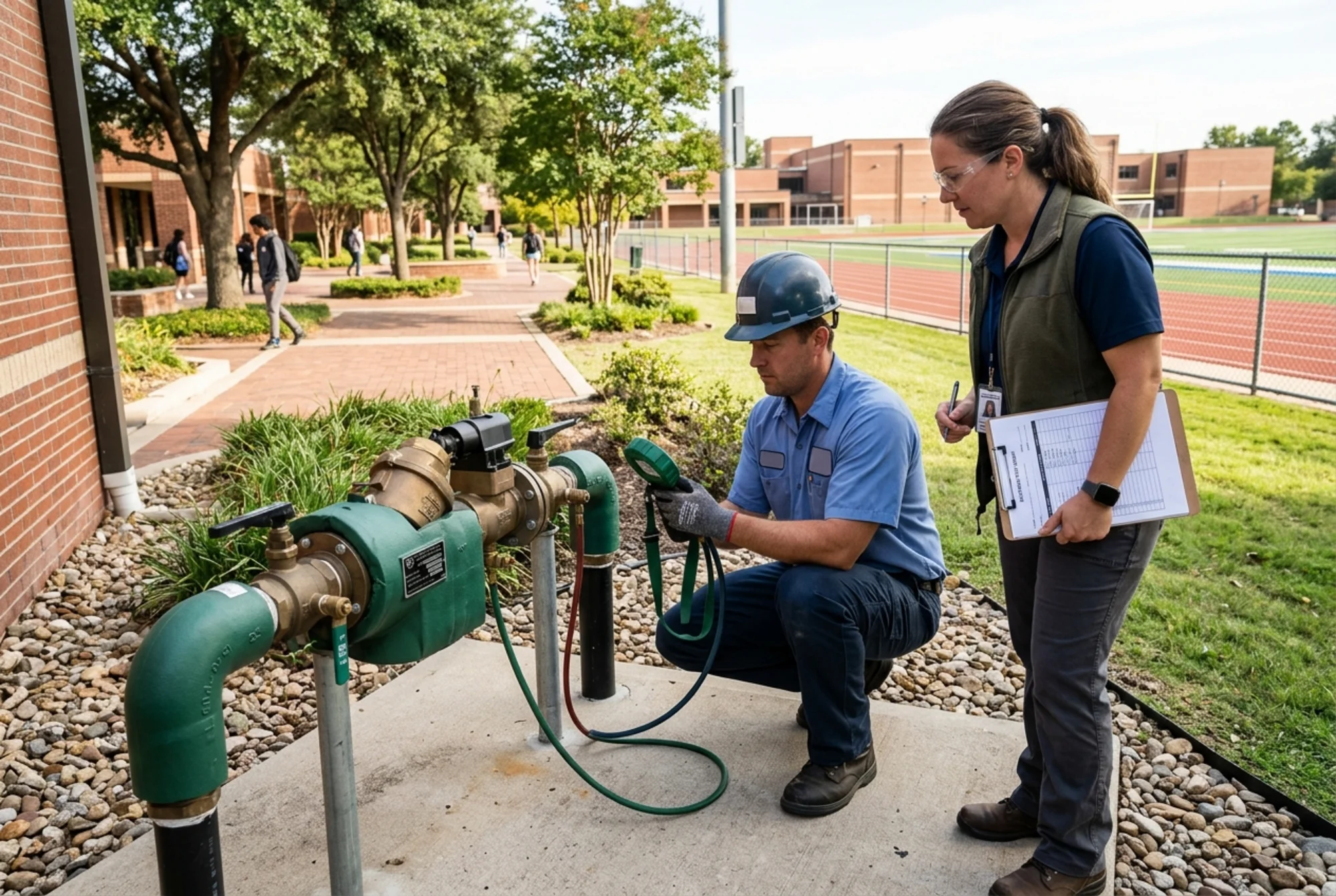
Backflow Prevention for Schools and Educational Facilities
Schools and educational facilities often have more moving parts in their water systems than people expect: irrigation, fire lines, cafeterias, mechanical rooms, labs, athletic fields, and seasonal shutdowns. That does not mean every school follows one identical rulebook. Backflow requirements usually depend on your local water utility, the hazard level of the connection, and the exact way the campus is plumbed.
The public-health goal is consistent, though. EPA says the Safe Drinking Water Act protects public health by regulating the nation’s public drinking water supply, and local cross-connection control programs help carry that protection down to the property level.
For school administrators and facilities teams, the real question is whether the campus has the right assemblies, whether they are being tested and documented, and whether someone clearly owns the compliance process.
If you want the broader public-health background first, our Learning Center guide on why backflow testing is required is a good starting point.
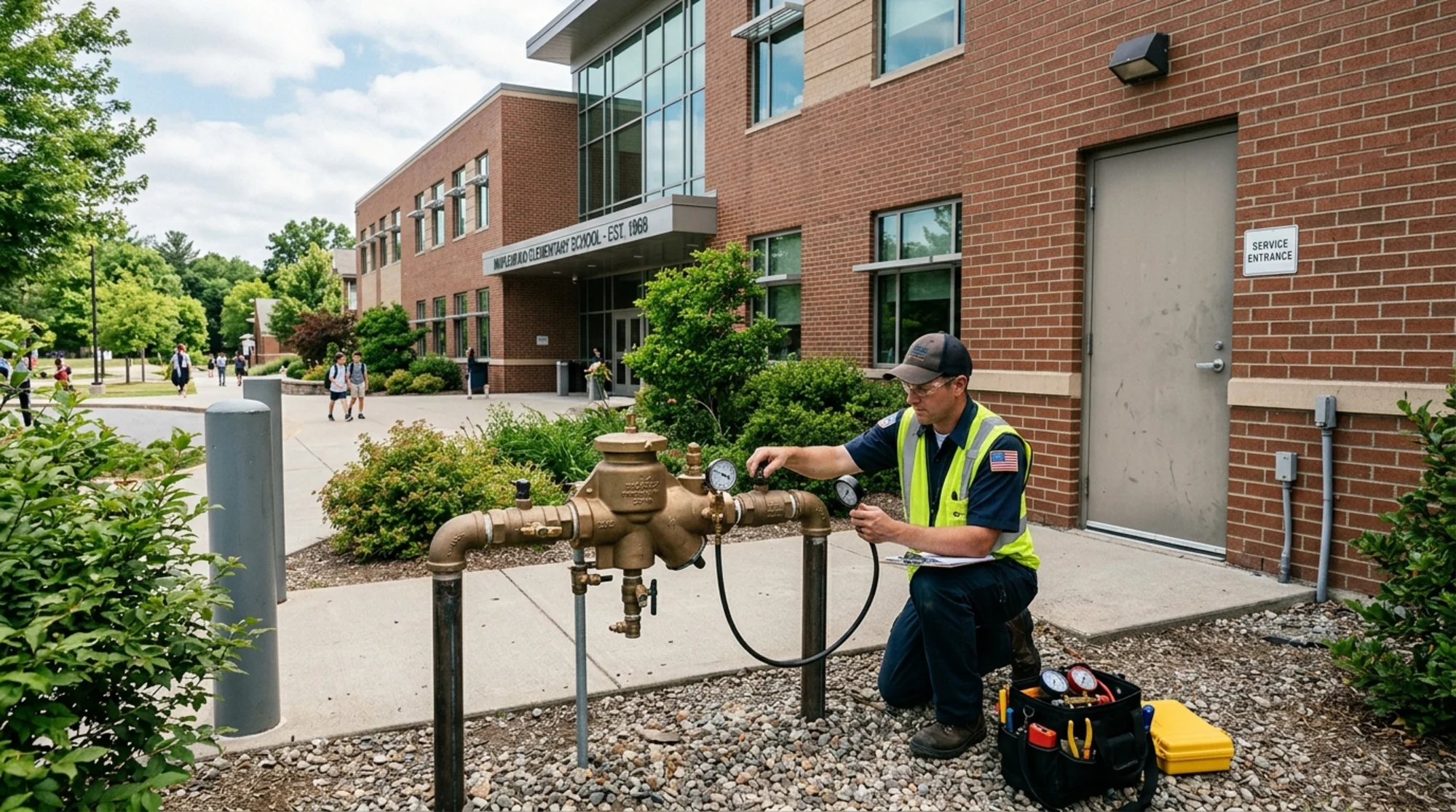 School campus service area with a certified tester inspecting an exterior backflow prevention assembly near the service entrance
Why schools get flagged for backflow protection more often than a typical home
A single-family home may only have a hose bib vacuum breaker or one irrigation assembly. Schools often operate several different water-using systems on one property, and each one can create its own cross-connection risk.
Common campus examples include:
- Irrigation systems for lawns, athletic fields, medians, or landscaping
- Dedicated fire sprinkler lines that use detector-style assemblies
- Boilers or hydronic systems in mechanical rooms
- Cafeterias or commercial-style kitchens
- Science labs, art rooms, or shop areas where chemicals or specialized equipment may be present
- Maintenance buildings with hoses, mop sinks, washdown areas, or treatment chemicals
Portland Water Bureau’s backflow guidance is useful because it shows how commercial water services often use different assemblies and locations: reduced pressure assemblies at the service entrance or water riser, double check assemblies inside buildings, and detector assemblies on fire services. Schools are not automatically identical to every commercial property, but many campuses have the same kind of system complexity.
That is why a school may have more than one assembly to track, often across irrigation, domestic service, and fire lines.
For comparison, our post on backflow testing requirements for commercial properties explains why larger properties so often end up in utility-managed compliance programs.
Which campus systems most often matter
Not every school has every one of these systems, but these are the places that most often drive backflow requirements.
Irrigation and athletic fields
Irrigation is one of the most common reasons a property has a testable backflow assembly. Portland says residential irrigation systems commonly use DCVAs and PVBAs, and its broader commercial examples show how assembly type and location depend on hazard and service layout. On a school campus, irrigation often serves not just lawn areas but athletic fields, courtyards, medians, and decorative landscaping.
That matters because irrigation lines can be exposed to fertilizer, soil, standing water, and treatment chemicals. Even if the school building itself seems straightforward, the grounds may still create a real cross-connection concern.
Fire sprinkler service lines
Schools and colleges commonly have dedicated fire protection systems. Portland’s fire-service examples describe detector-style assemblies used to protect potable supply lines from stagnant fire-system water, backpressure, and potential unauthorized connections. A campus may have separate fire-service protection for multiple buildings, not just one main line.
Mechanical rooms, boilers, and specialty equipment
Educational facilities often have central mechanical rooms, boiler systems, or specialized equipment that a house does not. Depending on the utility and hazard assessment, those systems may be part of why a premises-isolation assembly or another level of protection is required.
Cafeterias, labs, and maintenance spaces
Not every school has the same kitchen or lab setup, and we do not want to overstate that. But it is common for educational facilities to have sinks, equipment, chemical storage, cleaning systems, or hose-connected devices outside the normal residential pattern. The more varied the campus plumbing, the more important it is to confirm what the utility expects.
If your facilities team is still trying to locate everything on site, our related guide on how to find the backflow preventer on your property is a practical companion.
Annual testing is a common part of school compliance
Once a testable assembly is installed, annual testing is a very common expectation.
Seattle Public Utilities says backflow prevention assemblies must be tested every year and that annual testing is the only way to ensure they are functioning properly. It also makes clear that the water service owner is responsible for making sure testing happens on time. Washington’s Department of Health supports the same framework by publishing backflow assembly tester duties, field test report content requirements, and public resources for verifying approved assemblies and tester status.
For a school or college, that means backflow compliance should be handled like any other recurring facilities obligation.
A few practical points matter here:
- The campus may have multiple assemblies with different due dates.
- The school may need to coordinate access to locked yards, vaults, riser rooms, or mechanical spaces.
- Someone should confirm whether the tester submits the report directly or whether the school must follow up.
- A passing test is not enough if the paperwork never reaches the utility.
If you need help choosing a provider, our guide on how to choose a qualified backflow tester explains what to verify before you book.
Summer break and long shutdowns create an extra layer of risk
Schools have one operational pattern that many other properties do not: long periods of reduced occupancy.
CDC’s drinking-water prevention guidance says harmful germs can grow in water pipes and water-using devices when water sits for a while, and it recommends flushing faucets and maintaining equipment after extended low-use periods. That is especially relevant for schools after summer break, holiday closures, or building renovations.
Backflow testing and seasonal reopening are not the exact same task, but they intersect in a practical way. If a campus is reopening after low occupancy, facilities teams should think about:
- whether any required backflow tests are coming due,
- whether unused fixtures or low-use wings should be flushed,
- whether irrigation or athletic-field systems were modified during the break,
- and whether any device locations were blocked, damaged, or missed during other maintenance work.
If the school has concerns about drinking water quality or notices unusual changes, CDC recommends contacting the water utility or health department.
Recordkeeping matters more than most schools expect
One of the easiest ways for a school to fall out of compliance is not mechanical failure. It is poor recordkeeping.
Philadelphia Water Department’s public program page shows how formal these programs can be. It publishes approved assembly information, installation forms, technician resources, and official test and maintenance records. Seattle and Washington DOH add the same message from another angle: utilities want documentation they can track, not just a verbal assurance that “the plumber came out.”
A school should keep a simple register for every known assembly with:
- assembly type,
- location on campus,
- system served, such as irrigation, domestic, or fire,
- serial number if available,
- last passing test date,
- next due date,
- testing company and tester credential,
- and confirmation that the report was submitted.
This becomes even more important when staff or vendors change, or district and site records get split. Compliance failures often show up during those handoffs.
If you want a clearer picture of the utility side, our post on how utilities track backflow test compliance is worth reading.
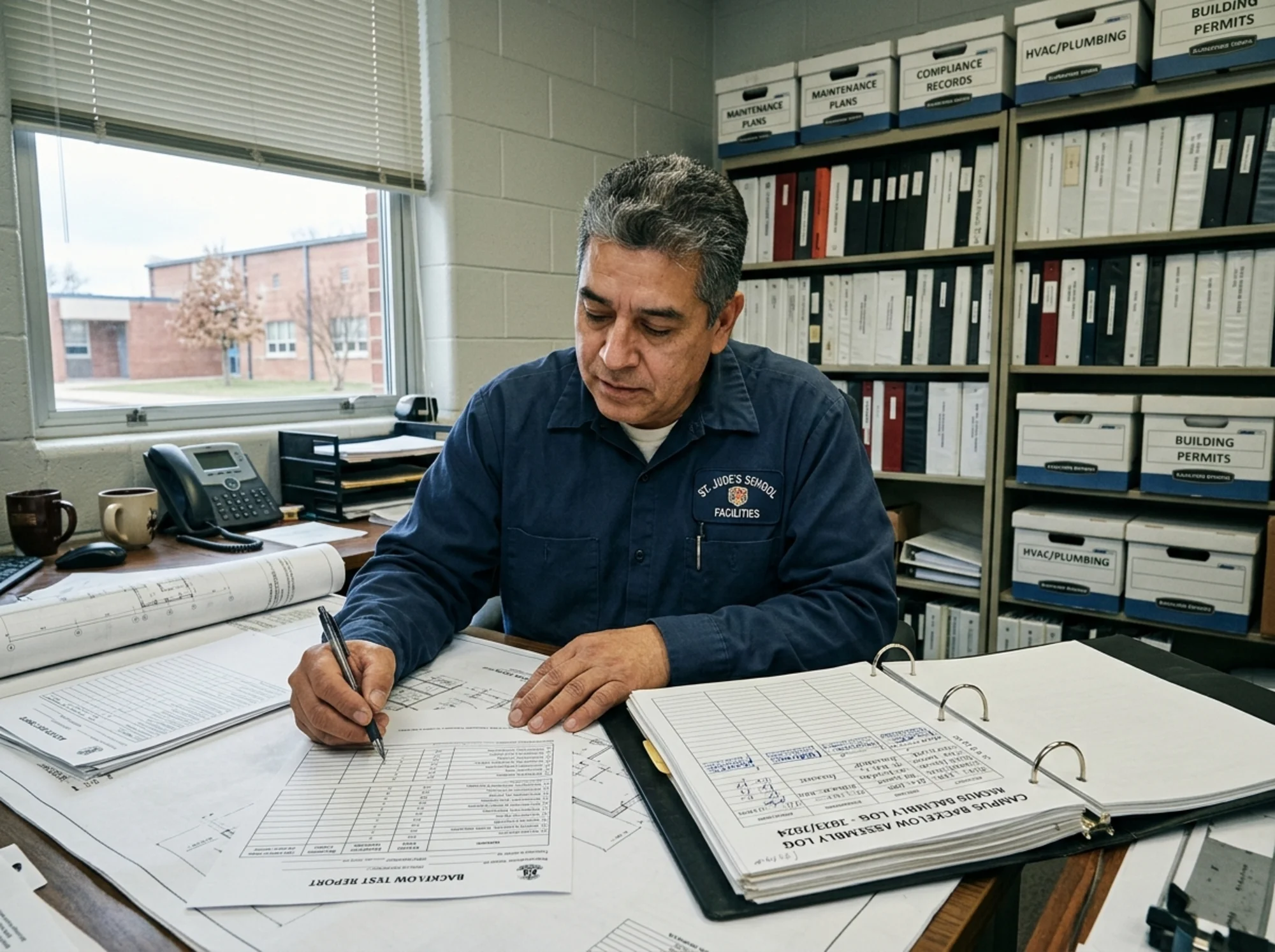 School facilities manager reviewing backflow test reports and a campus assembly log binder in an office with maintenance plans and compliance records
A practical checklist for schools and educational facilities
If you manage a school, college, daycare campus, or other educational property, this is the simple version of what to check next:
- Inventory every known backflow assembly on the campus.
- Match each assembly to the system it protects, such as irrigation, domestic service, or fire line.
- Confirm who owns the testing calendar and who follows up on report submission.
- Review summer-break and reopening procedures so low-use plumbing and water-quality steps do not get separated from compliance tasks.
- Ask the utility before assuming a change is minor, especially if a project touches irrigation, kitchens, labs, or mechanical systems.
- Keep all test reports in one place so the record survives staff turnover.
For local orientation, it can also help to review city pages like Austin, Texas, Charlotte, North Carolina, and Philadelphia, Pennsylvania, plus utility-specific guides such as our Austin Water backflow testing program page and Philadelphia Water Department backflow testing program page.
Bottom line
Schools and educational facilities often face backflow requirements because campuses tend to have the exact kinds of plumbing systems utilities monitor most closely: irrigation, fire protection, mechanical equipment, and varied water uses across one property.
The right approach is not to guess whether the campus probably needs testing. It is to know which assemblies are on site, know which systems they protect, test them on time, and keep the paperwork organized.
That makes backflow prevention less dramatic. It becomes what it should be: a routine part of protecting drinking water and running a campus responsibly.
If you need help now, start by finding a certified backflow tester near you or reviewing our FAQs.
Sources
This article references guidance and regulations from authoritative sources including:
- U.S. Environmental Protection Agency (EPA) - Safe Drinking Water Act overview
- American Water Works Association (AWWA) - Cross-Connection Control and Backflow Prevention resources
- Portland Water Bureau - How to choose and install a backflow prevention assembly
- Washington State Department of Health - Cross-Connection Control and Backflow Prevention
- Seattle Public Utilities - Backflow Assembly Testing
- Philadelphia Water Department - Cross-Connection & Backflow Compliance
- Centers for Disease Control and Prevention (CDC) - Preventing Drinking Water-Related Illnesses
- Centers for Disease Control and Prevention (CDC) - About Drinking Water
Last updated: April 29, 2026
Need backflow testing soon?
Send one qualified request with your service address, property type, and deadline so local testers have the context they need.