Backflow Prevention for Agricultural and Farm Properties
Backflow Prevention for Agricultural and Farm Properties
Agricultural properties often combine irrigation, hose connections, chemical injection, animal areas, washdown uses, storage tanks, or a mix of public water and private water sources. That can make compliance feel murkier than it really is.
There is no single national rule saying every farm must use the same device or follow one identical testing process. What is consistent is the reason these programs exist. EPA’s cross-connection guidance explains that backflow can pull contaminants into drinking water systems through unprotected cross-connections, and Florida DEP defines a cross-connection broadly enough to include connections to auxiliary water systems and irrigation systems.
That is why agricultural properties often get closer review, not because “farm” is a magic label, but because these plumbing setups are more likely to create the conditions utilities and regulators care about.
If you want the general public-health background first, start with why backflow testing is required. If you are already trying to line up help, you can also find a backflow tester near you.
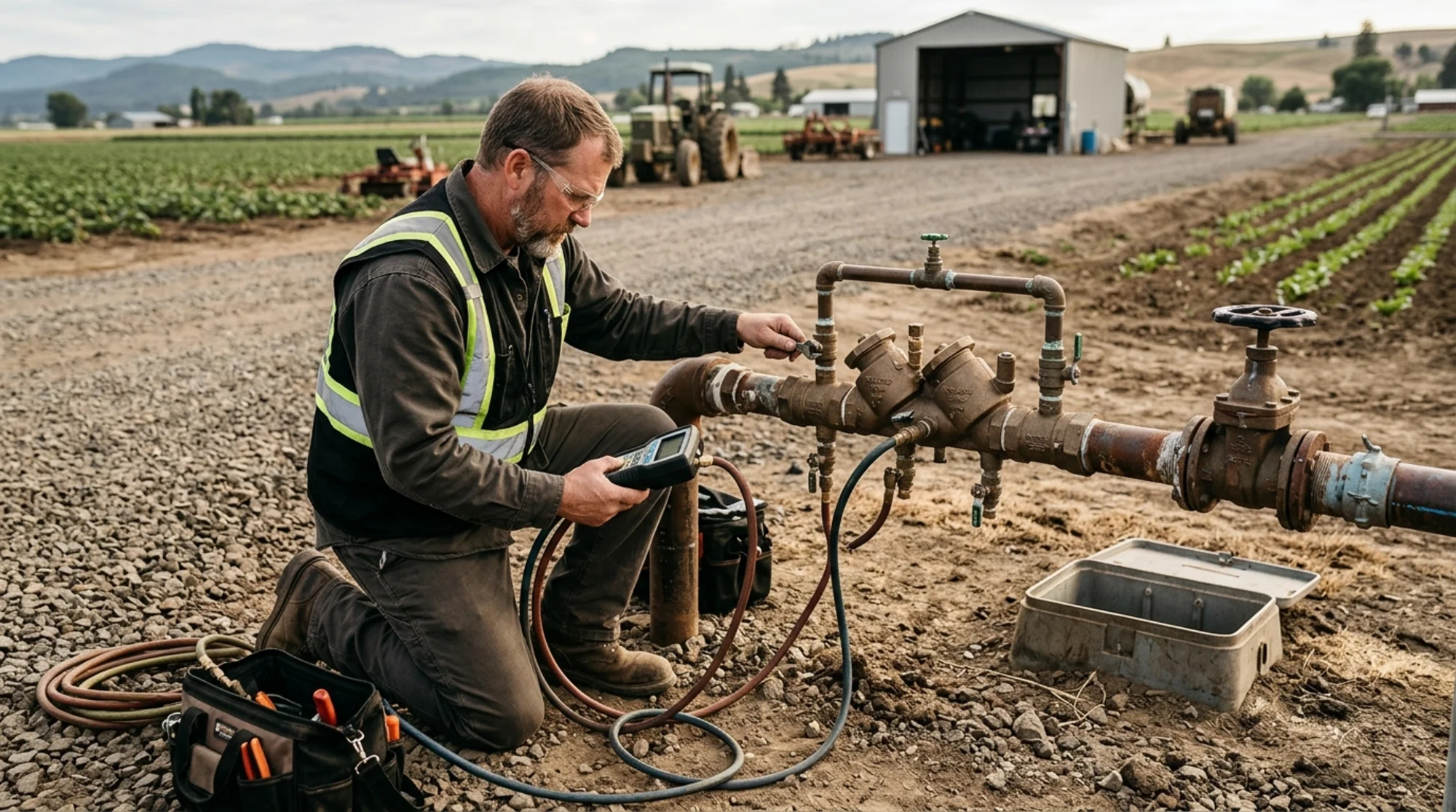
A certified backflow tester inspecting a reduced pressure backflow assembly beside an irrigation connection on a working farm property, natural daylight, realistic plumbing details, no logos or text overlay
Why farm properties get extra scrutiny
A basic office building may only need a utility to look at one straightforward water service connection. Farm properties are often different.
Florida DEP says utilities generally look for proper protection at irrigation piping systems and at premises with auxiliary or reclaimed water systems because those conditions can pose a significant hazard to the public water supply. That maps closely to real agricultural sites, where one property may have potable water for a residence or office, irrigation water for fields, and another source such as a well, pond, tank, or reclaimed-water connection somewhere else on site.
The risk is usually not theoretical. A backflow event can happen when pressure conditions change and water moves in the wrong direction. Florida DEP explains that backflow can happen through backpressure or backsiphonage. In a farm setting, that matters because pumps, elevated tanks, long irrigation runs, and chemical-injection setups can all change what a utility wants to protect against.
It also means two properties that both look like “farms” from the road may not be treated the same way. A small property with simple irrigation and no chemical injection may look very different from a larger site with chemigation, livestock areas, and mixed water sources.
The farm situations that usually change the answer
Most confusion comes from assuming there is one farm rule. In practice, a few specific conditions usually drive the compliance answer.
Irrigation tied to the potable supply
Irrigation is one of the most common triggers for backflow protection review. Florida DEP specifically calls out irrigation piping systems as the kind of connection that generally warrants proper backflow protection at the service connection.
If the same public water service feeds both drinking-water uses and irrigation, utilities often want assurance that irrigation water cannot reverse into the potable side during a pressure event. If you want the irrigation-specific version of this topic, our guide to backflow prevention for irrigation and lawn sprinkler systems is the closest companion read.
Chemigation or fertigation
The Idaho State Department of Agriculture says irrigation systems using a domestic or municipal water source for chemigation must install an approved backflow prevention device to prevent treated water from flowing back to the source. Idaho’s current guidance says approved protection for this use includes a reduced pressure backflow assembly or an air-gap configuration, and it also requires a functional system interlock so chemical injection shuts down when distribution is adversely affected.
Idaho also makes an important point owners often miss: double-check valves are not approved for chemigation in that program. That does not mean every state copies Idaho word for word, but it is a strong example of why owners should not assume that any testable device is automatically acceptable once chemicals are being injected.
Private wells or other auxiliary water on the same property
CDC says private well water is not regulated, treated, or monitored by public officials, and recommends testing private well water at least once a year. That is a water-quality issue, but it also matters for cross-connection control when a property has both a private well and a public water connection.
Once a farm has an auxiliary water source, utilities may pay closer attention to how the potable and nonpotable sides are separated. Florida DEP explicitly lists auxiliary water systems as a significant cross-connection concern. In practical terms, that means a farm owner should be ready to answer simple but important questions:
- Is the well or tank ever connected to plumbing that also touches public water?
- Are there valves, bypasses, or hose connections that could create an unintended cross-connection?
- Has the property added equipment over time that changed the original plumbing design?
Pesticide-handling or fill equipment drawing from outside water
California DPR says backflow prevention is required on service rigs and application equipment that handle pesticides and draw water from an outside source. Its guidance also says reservoir tanks must be separated from the original water source by an acceptable backflow prevention device.
That is a useful reminder that backflow compliance on farm sites is not only about the main building service. Mobile equipment, nurse tanks, and fill points can matter too when they are part of pesticide or chemical handling.
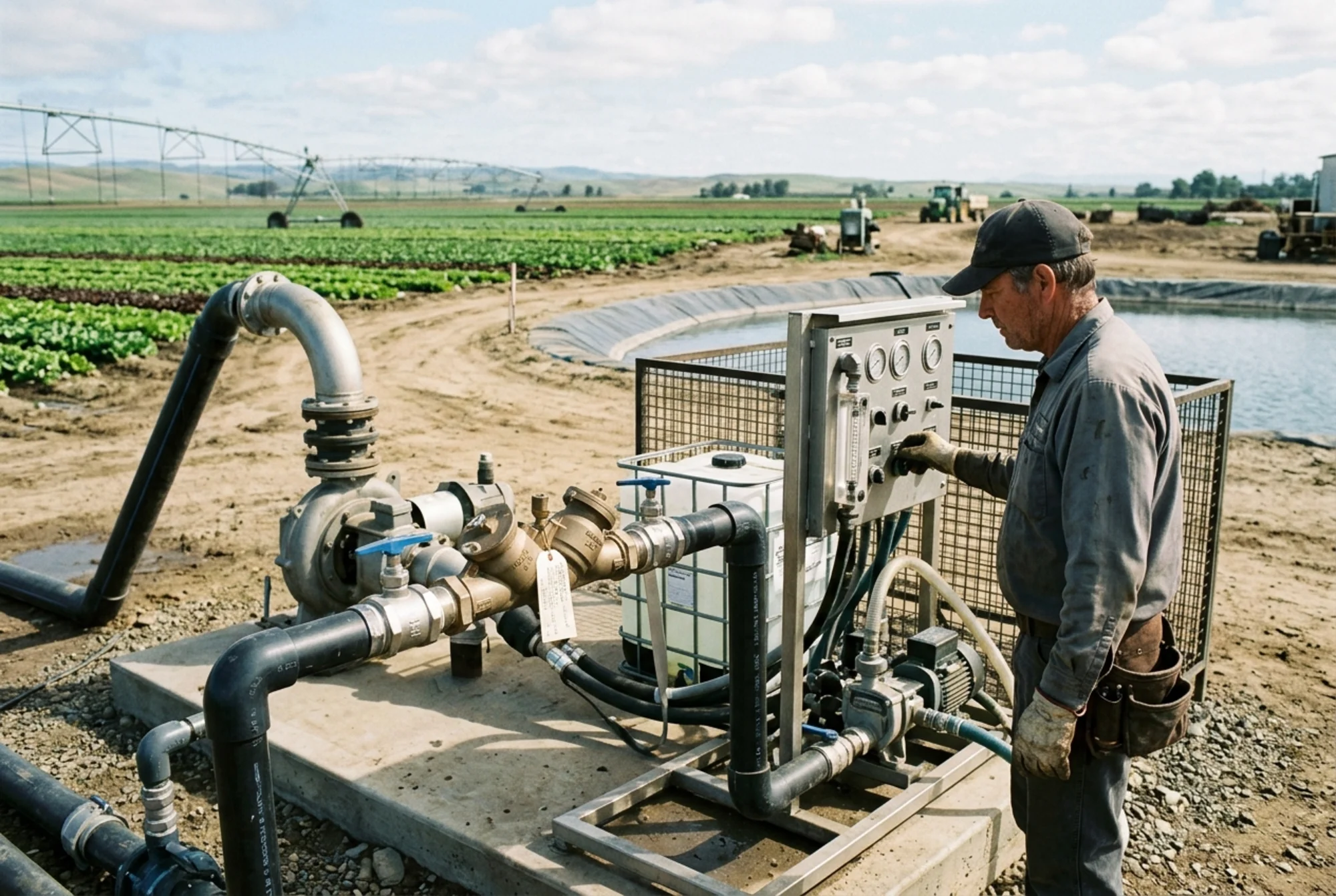 Realistic agricultural chemigation setup with irrigation piping, visible backflow prevention assembly, and a farm operator reviewing system controls near a water source, documentary style, natural light, no text overlay
What assembly and testing questions usually matter
One of the easiest ways to get into trouble is to reduce the whole conversation to “Do I have a backflow preventer?” The more useful question is whether the installed protection matches the hazard.
Florida DEP’s device descriptions are a good practical starting point:
- an RP can protect against backpressure and backsiphonage and may be used for health or nonhealth hazards,
- a PVB is effective against backsiphonage only,
- and a DC should be used only for nonhealth hazards.
Portland Water Bureau adds another helpful utility-level rule of thumb: the location of the assembly, service size, and hazard level of the connection help determine which assembly is appropriate. That is exactly why agricultural properties should avoid guessing based on what a neighbor installed years ago.
Testing expectations also matter. Seattle Public Utilities says annual testing is required for backflow assemblies in its program to ensure they continue functioning properly. Idaho’s chemigation guidance separately notes annual RP valve testing under the Idaho Plumbing Code. The exact workflow varies by jurisdiction, but the broad pattern is consistent: if you have a testable assembly, annual testing and complete records are often part of staying compliant.
A practical compliance workflow before irrigation season
If you manage a farm, ranch, orchard, nursery, or mixed agricultural site, the safest low-drama approach is to do a quick cross-connection review before the heavy-use season starts.
1. List every water source on the property
Separate public water, private well water, stored water, reclaimed water, and any other auxiliary sources. This alone often reveals where confusion starts.
2. Map where those sources can meet
Look at irrigation fill points, nurse tanks, animal areas, chemical-mixing locations, washdown stations, and hose connections. Backflow risk usually lives at the connection points, not in the abstract.
3. Identify the installed assembly and its last test date
Keep one record with the assembly type, size, location, serial number if available, and last passing report. If you operate in more than one market, pages like Boise, ID and Fresno, CA can help you start locating local tester options.
4. Confirm the local program’s expectations before making assumptions
A utility-specific page like Austin Water backflow testing is a good example of the kind of program resource worth checking, even if your property is elsewhere. Your own local utility, water district, or health department may have additional requirements for agricultural service connections, plan review, tester credentials, or report submission.
5. Treat unusual setups as a reason to ask, not guess
If the property uses chemigation, has both a well and public water, or has older plumbing that has been modified over time, ask for a site-specific answer. That is cheaper than installing the wrong protection and learning later that the assembly or reporting path is unacceptable.
For the basic next-step questions, our FAQs and how to find the backflow preventer on your property can help you get organized before you call.
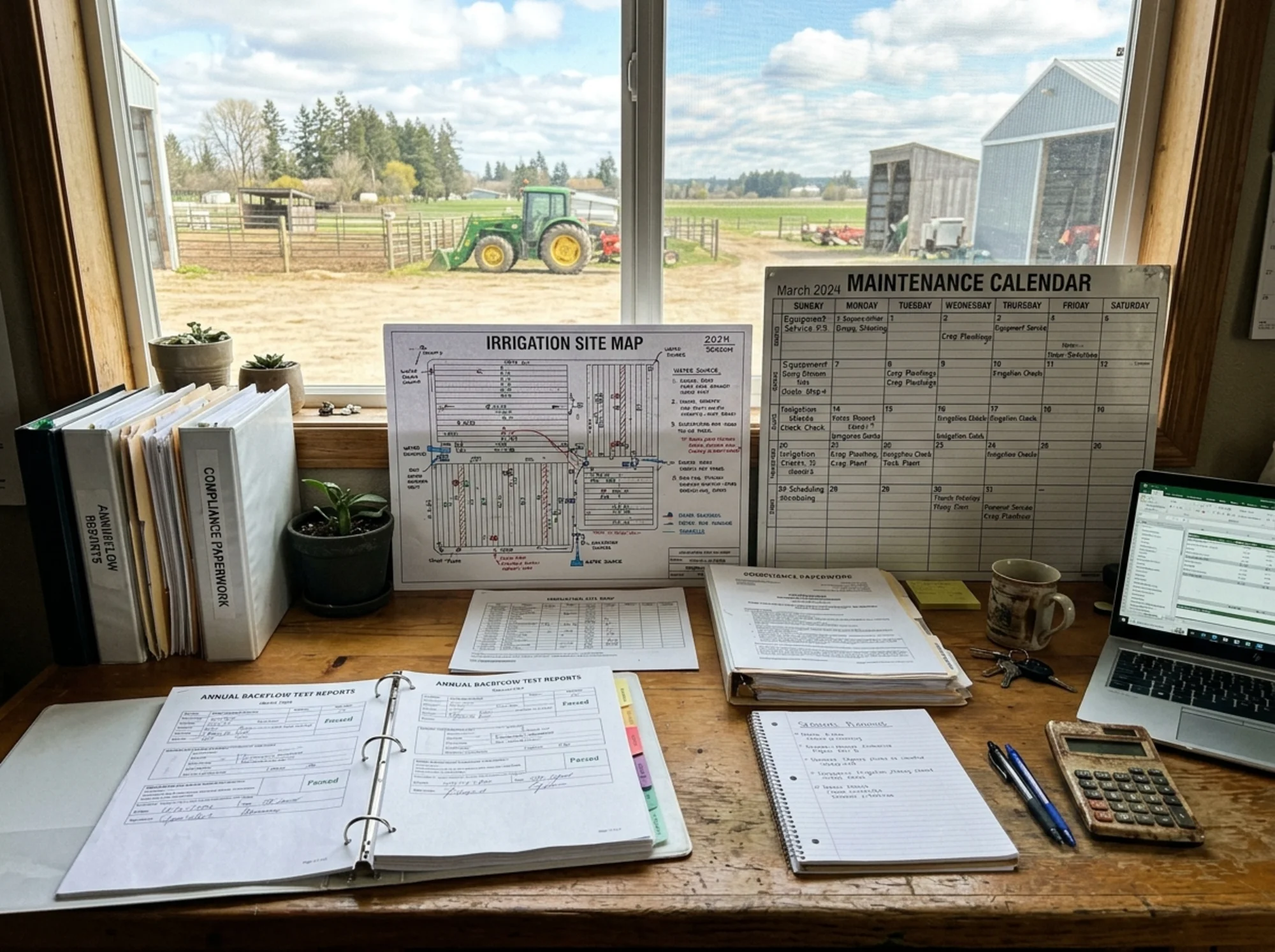 Realistic farm office desk with annual backflow test reports, irrigation site map, maintenance calendar, and compliance paperwork organized for seasonal planning, natural lighting, no logos or text overlay
Bottom line
Backflow prevention on farm properties is usually more about the plumbing situation than the property label.
If a site combines irrigation, chemigation, livestock or washdown uses, private wells, tanks, or other auxiliary water sources, utilities and regulators may expect stronger separation and clearer records than they would at a simpler property. Official guidance from Florida DEP, Idaho agriculture regulators, California DPR, CDC, and local utilities all point in the same direction: once water sources and hazards get mixed, assumptions become expensive.
The smart move is to inventory your water sources, confirm where cross-connections could occur, verify the assembly type on site, and get the local program’s answer before the next irrigation season or chemical-application cycle starts.
Sources
This article references guidance and regulations from authoritative sources including:
- U.S. Environmental Protection Agency (EPA) - Cross-Connection Control: A Best Practices Guide
- American Water Works Association (AWWA) - Cross-Connection Control / Backflow Prevention resources
- Florida Department of Environmental Protection - Cross Connection Control and Backflow Prevention Program
- Idaho State Department of Agriculture - Chemigation equipment and approved backflow prevention assemblies
- California Department of Pesticide Regulation - Backflow Prevention and Chemigation guidance (Appendix 3 PDF)
- Portland Water Bureau - How to choose and install a backflow prevention assembly
- Seattle Public Utilities - Backflow Assembly Testing
- Centers for Disease Control and Prevention (CDC) - Preventing Drinking Water-Related Illnesses
Last updated: May 4, 2026