What Happens During a Backflow Preventer Rebuild
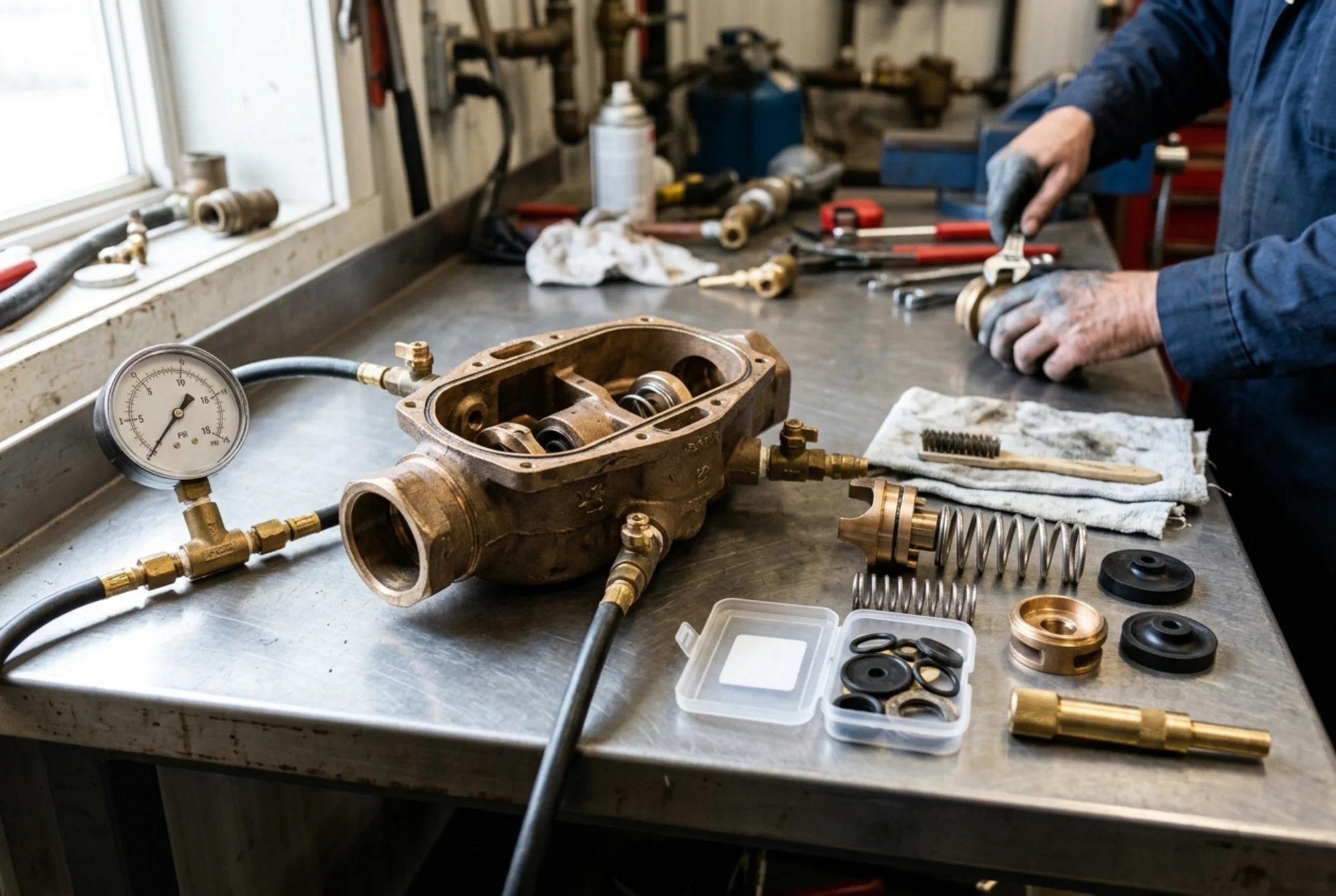
What Happens During a Backflow Preventer Rebuild
If a backflow preventer fails its annual test, one of the first terms property owners hear is rebuild. That word can sound bigger and scarier than it really is. In many cases, a rebuild means the assembly body stays in place while worn internal parts are cleaned, replaced, adjusted, and then tested again.
The important thing to understand is that a rebuild is not just a plumbing convenience. It sits inside a larger compliance system designed to protect the public drinking water supply. EPA guidance under the Safe Drinking Water Act sets the public-health framework, and state and local cross-connection control programs turn that framework into approved assemblies, tester requirements, field test reports, and maintenance records.
So when a tester says your device may need a rebuild, the real question is not just “Can it be fixed?” It is also:
- is the existing assembly still appropriate for the hazard,
- can it be restored to passing condition,
- who is qualified to do the work,
- and will the final paperwork satisfy the utility?
If you want the broader why first, our Learning Center guide on why backflow testing is required is a useful starting point.
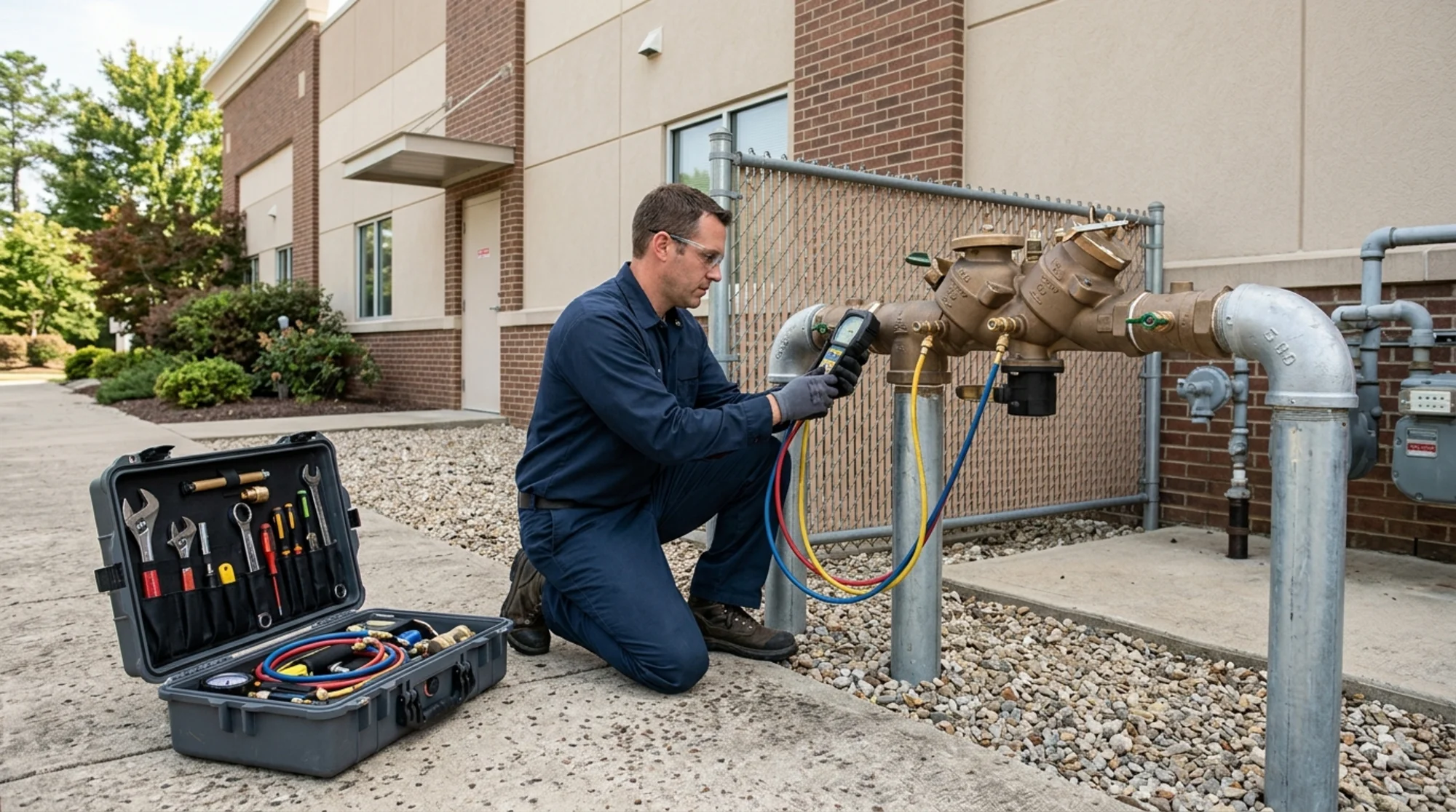 Wide realistic photo of a certified backflow technician working on an above-ground RPZ assembly outside a light commercial building, open tool case nearby, natural daylight, no logos or text
What “rebuild” usually means in practice
Utilities do not always publish consumer-facing pages that define the term rebuild in detail. They usually focus on approved assemblies, certified testers, annual tests, and official maintenance records. But in plain field language, a rebuild usually means servicing the internal working parts of an existing assembly rather than replacing the entire device body.
That often involves parts such as:
- check valve components
- rubber seals or discs
- springs
- relief valve components on an RPZ or RPBA
- O-rings, covers, and other serviceable internal pieces
Philadelphia Water Department’s program is a good example of how utilities frame this. The city publishes approved assembly resources, technician lists, and an official Backflow Prevention Assembly Test and Maintenance Record form. That tells you something important: from the utility’s perspective, maintenance is expected, but it still has to end with a documented and acceptable result.
A rebuild is also different from a full replacement. If the internal parts are the problem and the assembly body is still in good condition, rebuilding may be reasonable. If the assembly body is cracked, badly corroded, obsolete, or no longer acceptable for the application, replacement may be the better path.
If you are still sorting out how the internal parts work, our related guide on check valves and relief valves in a backflow preventer can make the rest of this process easier to follow.
Why assemblies end up needing a rebuild
Most rebuilds start with one of three situations.
1. The assembly failed its annual test
This is the most common trigger. Seattle Public Utilities says annual testing is the only way to ensure assemblies are functioning properly, and Washington rules spell out tester duties and required field test report content. When an assembly fails, the result is not just a mechanical note. It becomes a compliance issue that needs a real fix.
2. The assembly is leaking or discharging abnormally
Portland Water Bureau notes that a properly functioning reduced pressure backflow assembly can release small amounts of water because of pressure changes, but a clogged or malfunctioning assembly may discharge a large volume and need repair. That is a useful reminder that not every drip means catastrophe, but heavy or continuous discharge is something to evaluate, not ignore.
3. A tester finds wear, debris, or sticking components
Backflow assemblies live in real-world water conditions. Sediment, minerals, age, weather, and repeated pressure changes can all affect how well internal parts seal and move. Even when the outside of the assembly looks fine, the inside may tell a different story.
If you have already had test issues, our post on how backflow preventers are tested step by step shows how testers identify the components that are no longer performing correctly.
What the rebuild process usually looks like
The exact sequence varies by assembly type and local program, but property owners can usually expect a rebuild to follow this general pattern.
Close-up realistic photo of a backflow assembly opened for maintenance on a clean work surface, with internal check assemblies, springs, rubber kits, and test gauges visible, documentary style, no brand emphasis
1. Identify the assembly and confirm the problem
Before anyone opens the device, the technician confirms the make, model, size, and type of assembly and reviews the failed test result or observed symptom. This matters because rebuild parts have to match the exact assembly, and not every device should be repaired the same way.
Washington Department of Health also points people back to approved assembly resources, including USC-approved assemblies, which reinforces that backflow work is tied to recognized equipment and program rules, not improvisation.
2. Shut down and isolate the assembly
Water flow through the assembly is temporarily stopped so the device can be serviced safely. Depending on the location, this may cause a brief water interruption to the affected line or part of the property.
3. Open the assembly and inspect internal parts
The technician removes covers and internal check or relief components to inspect for wear, debris, damage, or failed seals. This is where the practical definition of rebuild becomes real. The goal is to determine whether the assembly can be returned to service with new internal components or whether the larger device is too compromised.
4. Clean and replace serviceable components
Debris may be removed, seats may be cleaned, and replacement kits may be installed for the worn internal parts. On an RPZ-style assembly, that may include relief-valve-related parts in addition to the check assemblies. On a DCVA, the focus is usually on the two check valves.
5. Reassemble and retest
This is the step owners should pay the most attention to. A rebuild is not finished when the bolts are tightened. It is finished when the assembly is retested and passes. Seattle’s guidance and Washington’s reporting rules both point back to the same principle: the test result and report are what prove the assembly is functioning correctly again.
6. Complete the paperwork
Utilities care about records. Philadelphia publishes a test and maintenance record form for exactly this reason. Depending on the jurisdiction, the tester or repair company may submit the passing report directly, or the owner may need to confirm it was submitted and accepted.
What a rebuild does not fix
A rebuild can restore many assemblies to working order, but it is not magic.
A rebuild does not automatically fix:
- an assembly that is the wrong type for the hazard level
- a device body that is cracked or structurally damaged
- an installation that violates local clearance, drainage, or placement requirements
- a device with unavailable or obsolete repair parts
- a property-side compliance problem caused by missing reports or unapproved changes downstream
That is why it helps to separate the mechanical problem from the program problem. The mechanical problem might be a failed check or relief component. The program problem is whether the property ends up with an approved assembly, a passing test, and acceptable documentation.
If your assembly is older, our guide on how long a backflow preventer lasts can help you think about whether repeated rebuilds are still worth it.
When replacement may make more sense than rebuilding
A good tester or plumber should be able to explain why they recommend a rebuild instead of a full replacement.
Replacement often becomes more likely when:
- the main body is cracked or heavily corroded
- the assembly has a history of repeated failures in a short period
- repair parts are hard to source
- the utility or program now requires a different assembly type
- the cost of rebuilding and retesting is close to the cost of installing a new approved device
This is especially important on commercial and multi-system properties where the hazard classification may be higher and the consequences of downtime or non-compliance are larger. If that sounds like your situation, compare this topic with our article on backflow testing requirements for commercial properties.
What property owners should ask during a rebuild
A rebuild visit goes more smoothly when the owner or manager asks a few simple questions up front:
- What exactly failed on the test?
- Is this a rebuildable issue or a replacement issue?
- Are the replacement parts correct for this exact assembly?
- Will the assembly be retested today after the repair?
- Who submits the passing test report, and how can I confirm it was received?
- If this assembly fails again, what would the next step be?
Those questions matter whether you are managing a small site or comparing providers in markets like Austin, Texas or Charlotte, North Carolina. It also helps to review a utility-specific page such as our Austin Water backflow testing guide so you know what kind of reporting process your local program may expect.
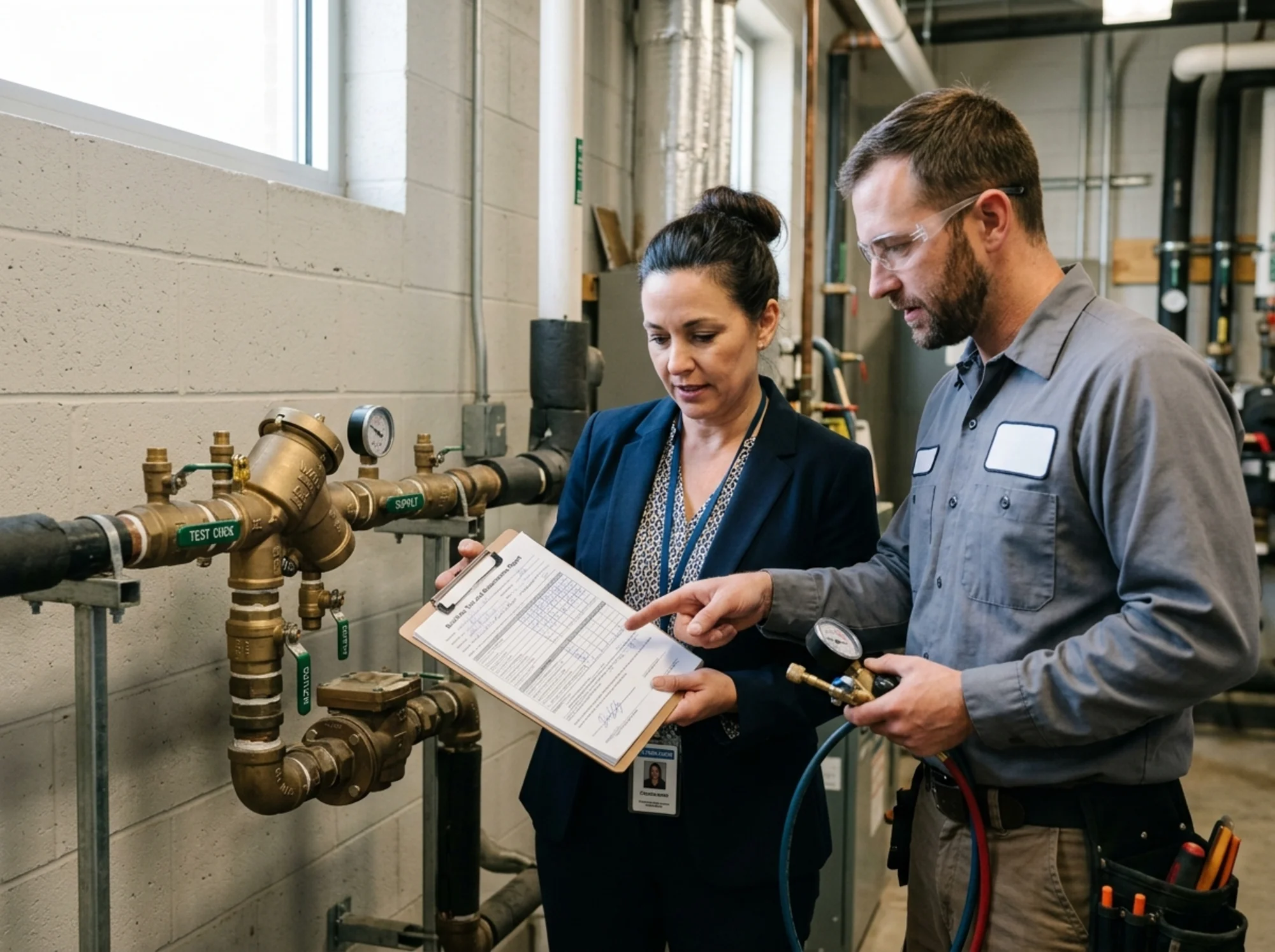 Realistic photo of a property manager reviewing a completed backflow test and maintenance report with a certified technician beside a rebuilt water assembly, natural lighting, no visible logos or text overlay
What happens after the rebuild is finished
From the owner’s perspective, the job is not truly done until three things are true:
- the assembly is back in service,
- the retest shows a passing result, and
- the report is on file where it needs to be.
That last step gets missed more often than it should. Seattle explicitly says owners should work with their tester or testing company to ensure documentation is provided and results are submitted. CDC drinking-water guidance also points people back to their utility or health department when they have concerns about water safety or water quality.
So after the technician leaves, keep a copy of:
- the failed test result if there was one,
- the repair or rebuild invoice,
- the passing retest report,
- and any utility submission confirmation.
For quick baseline questions about timing, paperwork, or who is responsible, our FAQs page is a good companion.
Bottom line
A backflow preventer rebuild usually means restoring the internal working parts of an existing approved assembly so it can pass its required test again. It is often a practical middle ground between doing nothing and replacing the entire device.
But the rebuild itself is only part of the story. What matters most is whether the assembly ends up passing, whether the work was done by the right person for your program, and whether the documentation is complete.
If you need help now, start by finding a backflow tester near you and ask whether they handle both repair and retest for your specific assembly type.
Sources
This article references guidance and regulations from authoritative sources including:
- U.S. Environmental Protection Agency (EPA) - Safe Drinking Water Act overview
- American Water Works Association (AWWA) - Cross-Connection Control and Backflow Prevention resources
- Philadelphia Water Department - Cross-Connection & Backflow Compliance
- Portland Water Bureau - How to choose and install a backflow prevention assembly
- Washington State Department of Health - Cross-Connection Control and Backflow Prevention
- Seattle Public Utilities - Backflow Assembly Testing
- Centers for Disease Control and Prevention (CDC) - Preventing drinking water-related illnesses
Last updated: April 26, 2026