Why Backflow Testing Documentation Matters More Than You Think
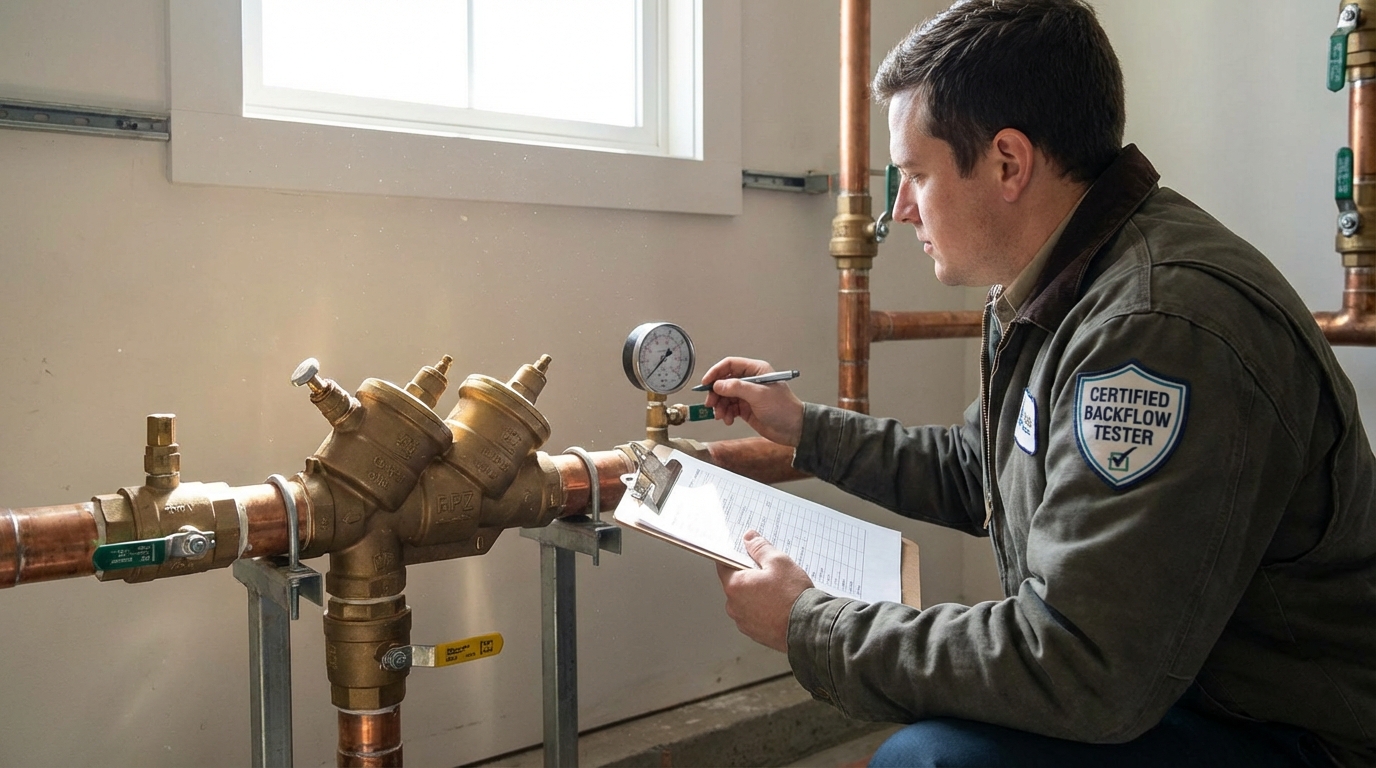
Why Backflow Testing Documentation Matters More Than You Think
Every year, thousands of property owners pass their backflow prevention tests only to face fines, re-testing orders, or compliance headaches — not because their devices failed, but because their paperwork did. Water utilities and health departments across the country have tightened record-keeping requirements, and in 2026, many jurisdictions now require digital submission of test reports within strict deadlines.
Whether you own a single rental property or manage a portfolio of commercial buildings, understanding what documentation you need, how long to keep it, and who is responsible for filing it can save you real money and prevent service disruptions.
What Gets Documented During a Backflow Test
A certified backflow tester does more than check whether your device works. They generate a formal test report that captures specific data points required by your local water authority. Here is what a standard test report includes:
- Device information — manufacturer, model number, serial number, size, and type (RPZ, DCVA, PVB, or other)
- Location details — physical address, meter number, and where the device is installed relative to the water main
- Test results — differential pressure readings for each check valve and relief valve, recorded in PSI
- Pass or fail determination — based on your jurisdiction's minimum thresholds (commonly 1.0 PSI for check valves on an RPZ)
- Repairs performed — if the device failed initial testing, what parts were replaced or serviced before a successful retest
- Tester credentials — the certified tester's name, license or certification number, and the date of testing
- Gauge calibration date — most jurisdictions require the test kit to have been calibrated within the past 12 months
This is not a formality. Each of these fields serves a regulatory purpose. A missing serial number can trigger a rejection from the water utility's compliance office, forcing you to schedule and pay for a re-inspection.
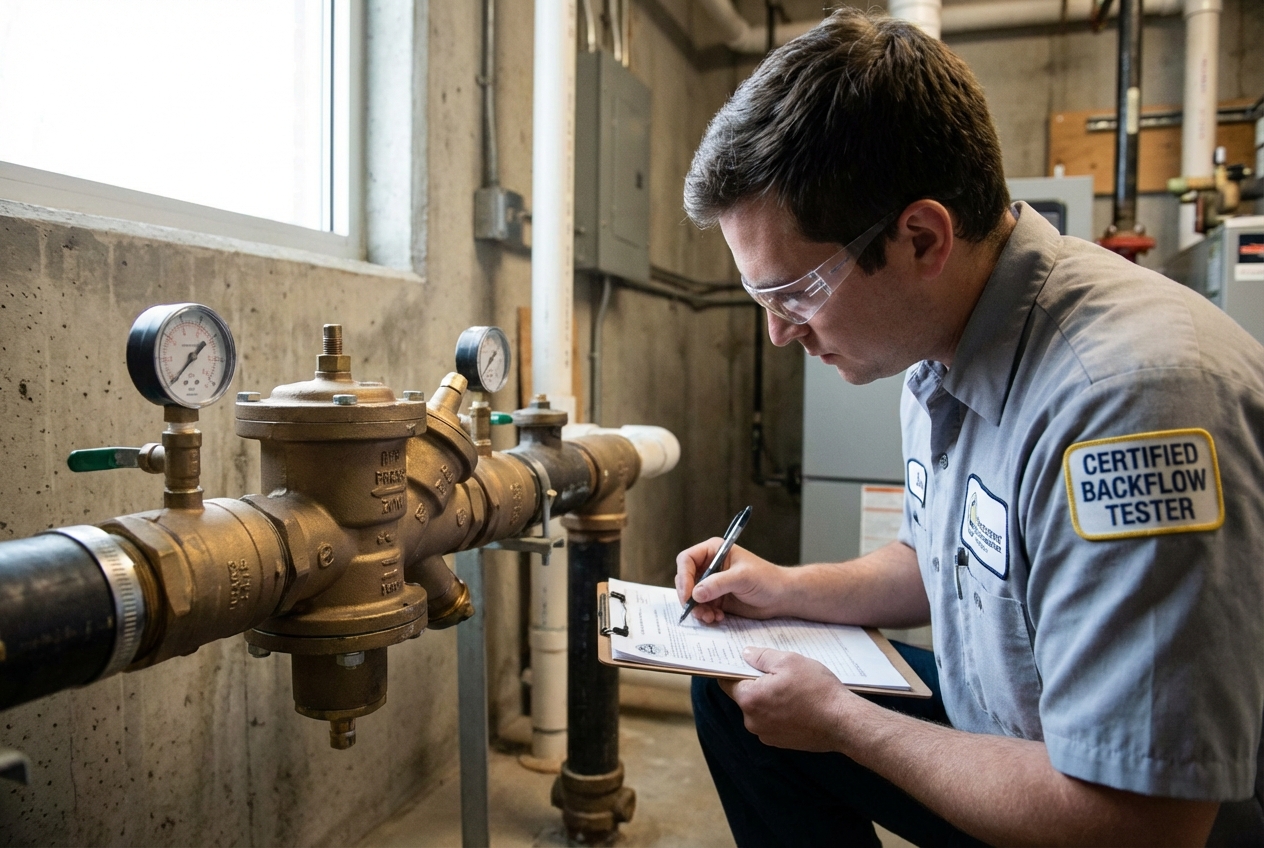 Certified backflow tester recording pressure gauge readings on a clipboard next to an RPZ valve assembly in a mechanical room
Who Is Responsible for Keeping Records
This is where confusion causes the most problems. Responsibility is split, and the split varies by jurisdiction.
The property owner is ultimately responsible for ensuring that backflow testing is completed on schedule and that documentation is filed with the appropriate authority. Even if you hire a plumber or backflow testing company to handle everything, the compliance obligation stays with you. If the report never reaches the water district, you are the one who gets the violation notice.
The certified tester is responsible for completing the test report accurately and, in many jurisdictions, submitting it directly to the water utility or health department. In some areas, testers submit electronically through portals like those managed by the state's department of environmental quality. In others, they mail or fax paper forms.
The water utility or municipality maintains the official record of compliance. They track which properties have active backflow devices, when those devices were last tested, and whether those properties are current on their testing schedule.
The practical takeaway: do not assume your tester filed the report. Always request a copy for your own records and confirm with your water provider that it was received.
How Long You Need to Keep Backflow Records
Retention requirements depend on where you are, but here are the general patterns:
| Jurisdiction Type | Typical Retention Period | Notes |
|---|---|---|
| Municipal water utilities | 3 to 5 years | Often tied to the device lifecycle |
| State health departments | 5 years minimum | Some states require records for the life of the device |
| Commercial properties (EPA-regulated) | 5 to 7 years | Facilities with industrial cross-connections may have longer requirements |
| Healthcare and food service | 7+ years | Accreditation bodies may impose stricter standards |
If you are unsure, default to keeping records for at least five years. Storage is cheap. Fines for missing records are not.
For property managers overseeing multiple locations, a centralized digital filing system is essential. More on that below.
Common Documentation Mistakes That Trigger Violations
After talking with dozens of water utility compliance officers and backflow testing professionals over the years, these are the errors that come up repeatedly:
1. Submitting reports late. Many jurisdictions give you 10 to 30 days after testing to file the report. Miss that window and the test may not count, even if the device passed. Some cities, including several in California and Texas, have moved to 10-day filing deadlines with no extensions.
2. Wrong or missing device serial numbers. If the serial number on your report does not match the one the utility has on file for your property, the report gets flagged. This often happens when a device is replaced but the utility's records are not updated.
3. Using a tester whose certification has lapsed. A test performed by someone with an expired certification is invalid in most jurisdictions. You will need to retest with a properly certified tester, on your dime.
4. Incomplete repair documentation. If your device fails and is repaired on-site, the report needs to document what was wrong, what was repaired or replaced, and the results of the post-repair retest. Skipping this detail is a common reason for report rejections.
5. Not updating the utility after device replacement. When you install a new backflow preventer, you need to register the new device with your water provider. Otherwise, their records still reference the old unit, and every future test report will have a serial number mismatch.
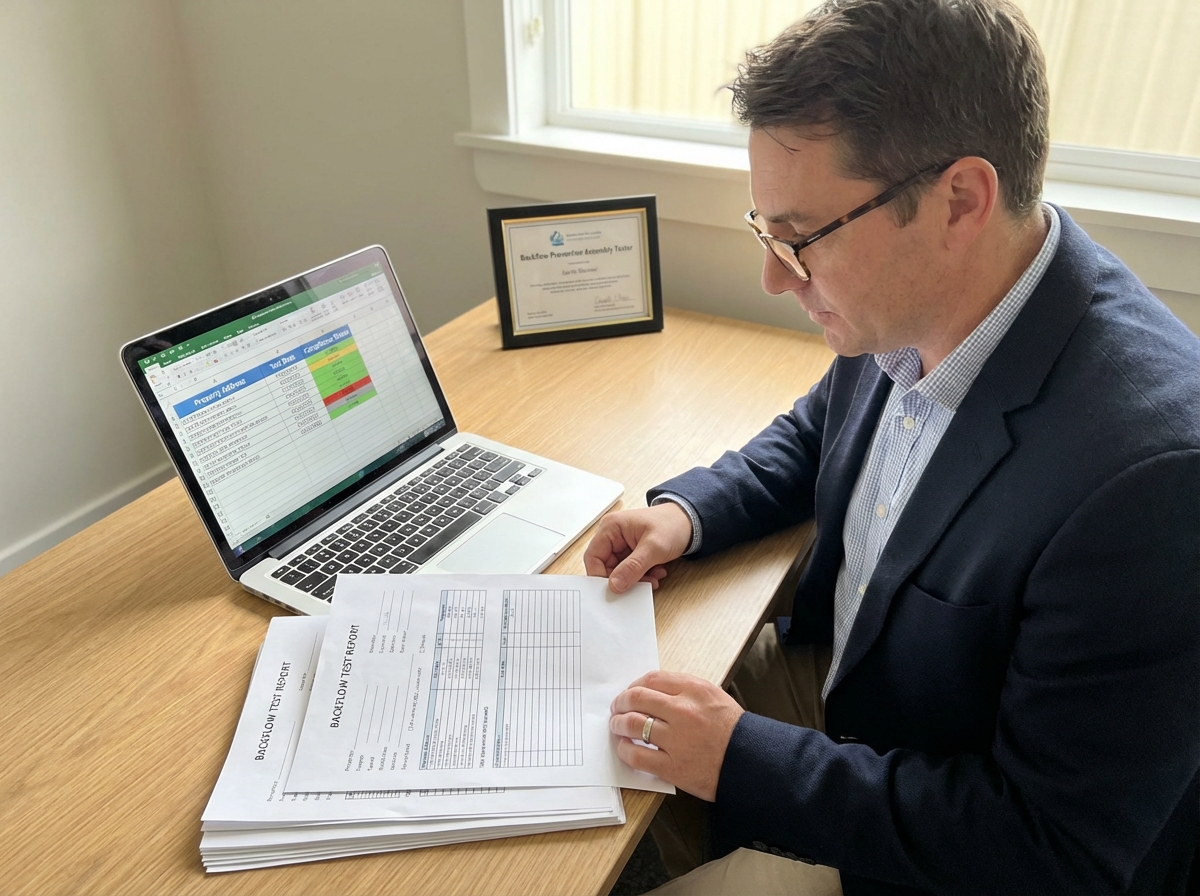 Property manager reviewing a stack of backflow test reports at a desk with a laptop showing a compliance tracking spreadsheet
Setting Up a Record-Keeping System That Actually Works
You do not need expensive compliance software to stay organized, though it exists and may be worth it for larger portfolios. Here is a practical system that works for most property owners and managers:
For Single Properties
Keep a dedicated folder — physical or digital — labeled with your property address. Inside, maintain:
- A copy of every annual test report, filed by date
- The original installation record for each backflow device, including the plumber's invoice and any permits
- Correspondence with your water utility regarding compliance (violation notices, confirmation letters, schedule reminders)
- Proof of any repairs, including parts receipts and the repair section of the test report
If you go digital, a simple folder structure in Google Drive, Dropbox, or any cloud storage works fine. Name files consistently: 2026-04-backflow-test-report-123-main-st.pdf is far more useful than scan001.pdf.
For Multiple Properties or Commercial Portfolios
At scale, you need a tracking layer on top of your document storage:
- A master spreadsheet or database that lists every property, its backflow device(s), the last test date, the next test due date, the tester used, and the filing status
- Calendar alerts set 60 and 30 days before each test deadline — this gives you time to schedule the tester and avoids last-minute scrambles
- A verification step where someone on your team confirms with the water utility that each filed report was accepted and logged
Some backflow testing companies offer client portals where you can access your historical reports. This is convenient, but treat it as a backup, not your primary system. If you switch providers, you may lose access.
For large commercial operations — hospitals, manufacturing plants, properties with multiple hazard-level connections — purpose-built compliance platforms exist that integrate with utility reporting systems and provide audit-ready documentation. If you manage more than 20 devices, this kind of tool starts paying for itself in avoided violations and staff time.
Digital Reporting Trends in 2026
The shift toward digital-only reporting has accelerated significantly. Several states now require electronic submission of backflow test reports, and many utilities have stopped accepting paper forms entirely.
What this means for you:
- Ask your tester about their submission process before hiring them. A tester who still relies on paper forms in a jurisdiction that requires electronic filing is going to create problems for you.
- Confirm your utility's portal or submission system. Some use third-party platforms like Tokay Software or BSI Online. Others have built their own. Know which system your utility uses and make sure your tester has access.
- Request digital copies of all reports. PDF is the standard. If your tester only provides handwritten carbon copies, that is a sign to find a different tester.
Some states are also beginning to link backflow compliance records to property title searches, meaning unresolved violations could surface during a real estate transaction. Keeping clean, accessible records protects your property value.
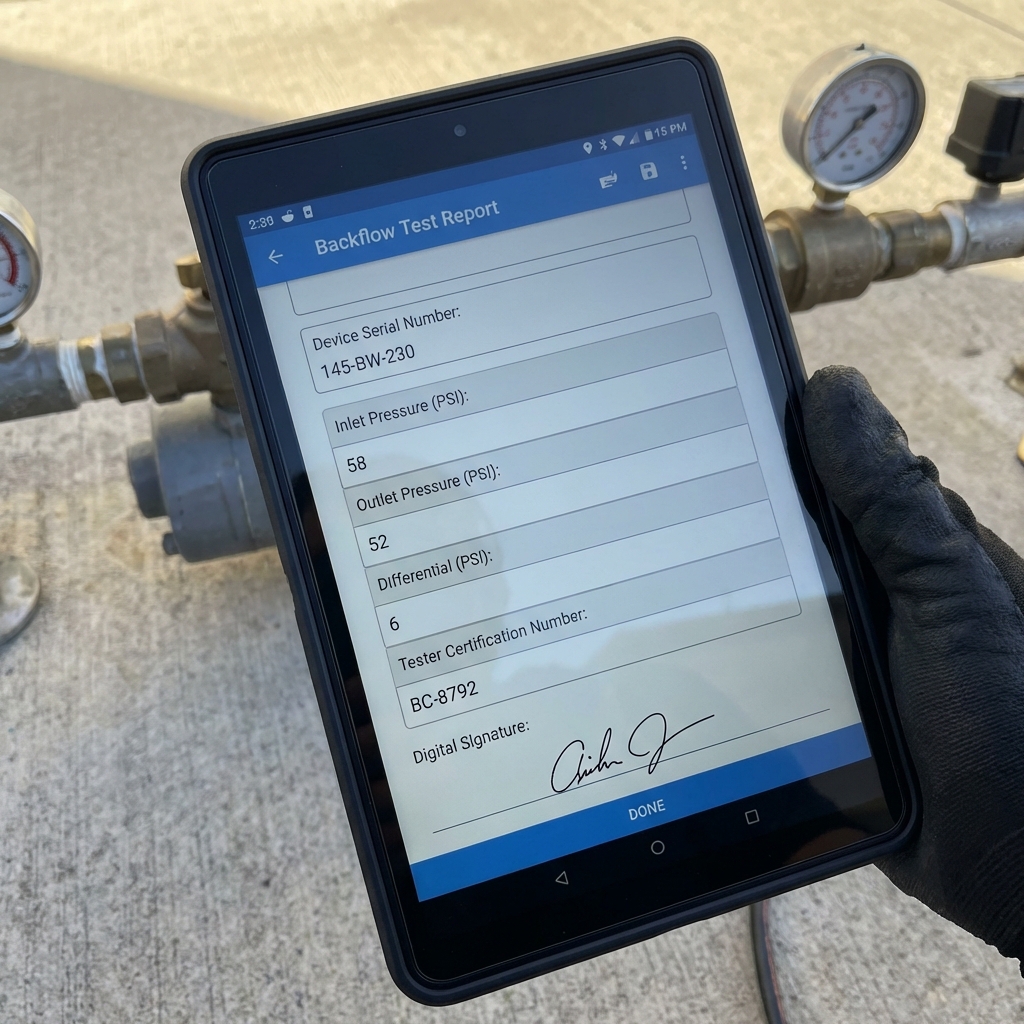 Close-up of a tablet screen showing a digital backflow test report form with fields for device serial number, test pressures, and tester certification number
What to Do If You Have Missing or Incomplete Records
If you have gaps in your backflow testing history, here is how to address them:
Contact your water utility first. They may have copies of past reports on file, even if you do not. Request your full compliance history in writing.
Reach out to previous testers. Certified backflow testers are generally required to maintain their own records for a set period (often three to five years). If you know who tested your device previously, they may be able to provide duplicate reports.
Schedule a current test immediately. If you cannot reconstruct past records, the most important thing is to get current. A fresh passing test report with complete documentation puts you back in compliance from that point forward.
Document the gap. If a utility asks about missing years, having a brief written explanation — new ownership, records lost in a transition, previous management company did not maintain files — is better than silence. Most compliance officers are reasonable when property owners are proactive about resolving gaps.
Next Steps to Get Your Documentation in Order
Start with these actions this week:
- Pull out your most recent backflow test report and verify it includes all required fields — device info, test results, tester credentials, and gauge calibration date.
- Call your water utility and confirm they have your latest report on file and that your property's backflow device records are accurate.
- Set up a basic filing system if you do not have one, even if it is just a clearly labeled folder.
- Check your testing deadline. If your annual test is due within the next 90 days, book a certified tester now. Waiting until the last week is how deadlines get missed.
- If you manage multiple properties, build or update your tracking spreadsheet this month. Include every device, every address, and every deadline.
Good documentation is not glamorous work, but it is the difference between a five-minute compliance check and a months-long headache involving fines, re-tests, and angry letters from the water department. The time you invest in organizing your records now pays off every single year your backflow devices are in service.