Backflow Prevention Maintenance Tips for Property Managers
Backflow Prevention Maintenance Tips for Property Managers
For property managers, backflow prevention is easy to treat like a once-a-year checkbox. The tester comes out, a form gets filed, and the issue disappears until the next notice.
That mindset creates avoidable problems.
Backflow assemblies live in the real world: access gets blocked, leaks get missed, freeze damage shows up late, and a simple failed test turns into a compliance fire drill. EPA frames cross-connection control as part of protecting public drinking water, and local utilities turn that into owner duties around testing, repairs, and documentation.
If you manage commercial or multifamily property, the safest approach is to treat backflow maintenance as an operating routine, not a surprise event.
Start with the public-health background in why backflow testing is required, and if a deadline is already looming, find a local backflow tester before the compliance window gets tight.
1. Build an assembly register before you try to manage deadlines
Good maintenance starts with knowing exactly what you own.
Many property teams have scattered records. That is not enough if a notice arrives or a site change affects the protected hazard.
For each property, keep one live record with the address, jurisdiction, assembly location, type, make/model/serial, protected system, last passing test date, next action date, and current report location.
This matters because larger sites often have more than one assembly. A property can have separate protection for irrigation, domestic service, fire lines, boilers, or specialty equipment. New York City DEP's public guidance is a good reminder that pools, irrigation, commercial kitchens, auto-related uses, boilers, and water reuse setups can all change the backflow risk picture.
If you need local orientation while building that register, compare pages for Austin, Seattle, and Philadelphia, then cross-check the utility-side rules on the Austin Water backflow testing program and the Philadelphia Water Department backflow testing program.
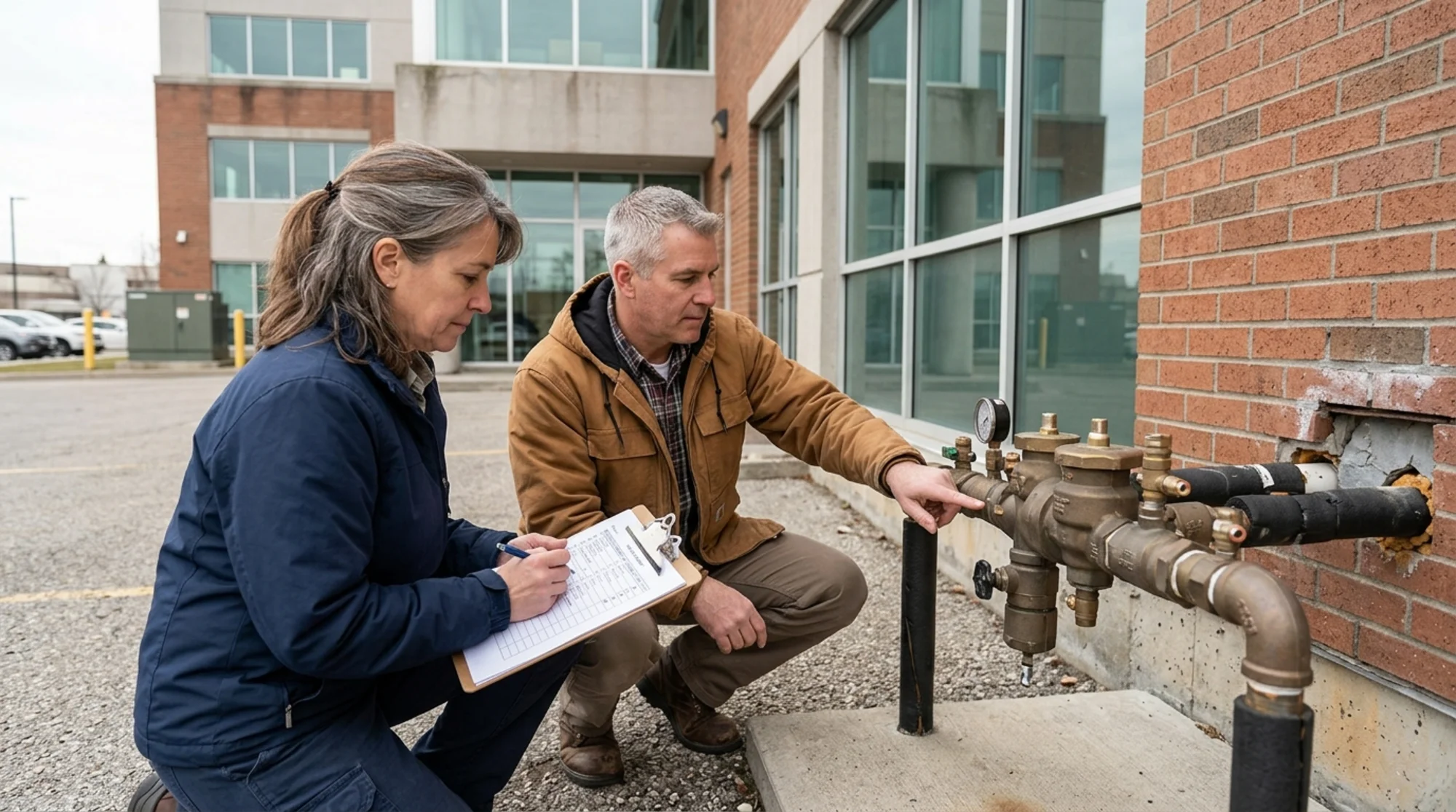
Property manager and maintenance supervisor inspecting an outdoor commercial reduced pressure backflow assembly with a clipboard checklist beside an office building, realistic daylight, no logos or text overlay
2. Keep assemblies accessible, visible, and protected from obvious damage
A lot of backflow trouble is not mechanical at first. It is logistical.
Assemblies get hidden behind shrubs, fenced into awkward corners, blocked by stored materials, parked over by contractors, or left sitting in wet, debris-filled areas. Then the annual tester arrives and cannot safely inspect the assembly, read the serial number, or connect to the test cocks without delay.
A quick monthly walk-by is often enough to catch the preventable issues. Check whether the assembly is easy to locate, easy to access, free of standing water or impact risk, not buried in vegetation, and not showing obvious leaks or corrosion.
Portland Water Bureau's owner guidance treats preparation and access as part of the owner's job. If the device cannot be reached and understood easily, it is not really maintenance-ready.
3. Treat between-test checks as part of routine property care
Annual testing matters, but it should not be the first time anyone looks closely at the assembly all year.
Your onsite team does not need to perform certified tests. They do need to recognize warning signs that deserve follow-up: continuous discharge, leaking shutoff valves or fittings, active corrosion, freeze damage, standing water, nearby piping changes, or impact damage.
Utilities generally care about whether the assembly is functioning, not just whether someone booked a test. Portland is especially direct that owners are responsible for keeping assemblies in working order and addressing failures promptly. That makes simple observation part of compliance, not just housekeeping.
If you oversee multiple sites, pair your field checks with how to schedule backflow testing for multiple properties so you are not discovering problems only when the due date is close.
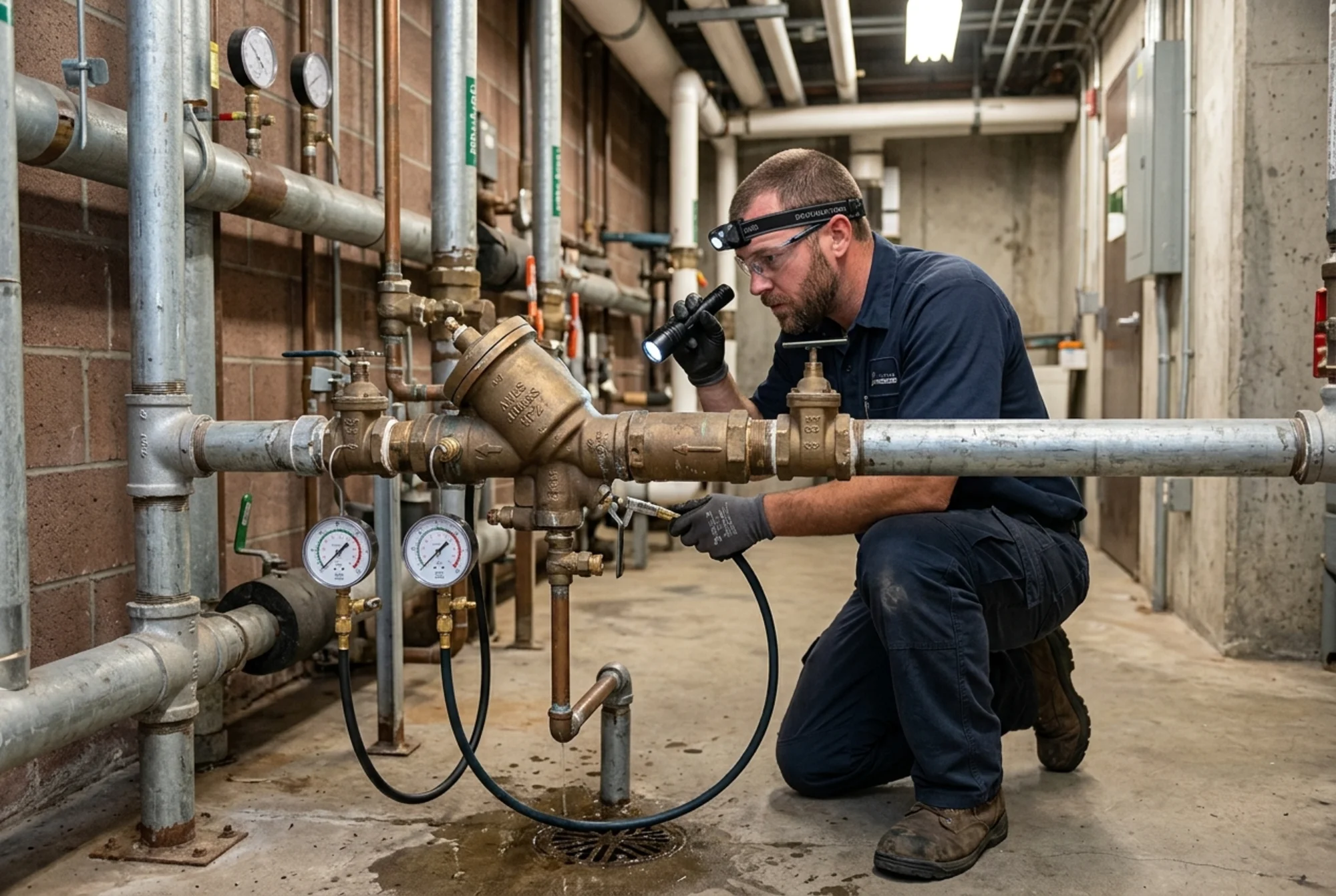 Certified backflow tester examining a commercial backflow preventer for leaks, corrosion, and relief valve drainage while connected gauges hang nearby, realistic plumbing setting, no logos or text overlay
4. Do not treat paperwork as separate from maintenance
A surprising amount of backflow pain is administrative.
The assembly was tested. The invoice was paid. But the report had the wrong serial number, the utility never matched it to the right account, or nobody kept proof that the submission was accepted.
That still leaves the property exposed.
Seattle Public Utilities makes the owner responsible for making sure annual testing happens and for keeping records. Washington State Department of Health publishes field-test reporting requirements and tester resources for exactly this reason. Austin Water is also clear that tester qualifications, calibrated gauges, and complete reporting matter. Philadelphia publishes technician and compliance resources because utilities need documentation they can track, not verbal assurances.
A simple closeout rule helps a lot:
The task is not complete until the report is accepted, stored, and the next action date is updated.
For every completed visit, keep the final test report, tester credential, assembly serial/location confirmation, any repair notes, proof of submission when available, and the next due date.
If you want a stronger system, connect this process to how to create a backflow compliance calendar for your business and how property management software can track backflow compliance.
5. Reverify tester qualification every cycle
Using the same vendor as last year is not enough by itself.
Credentials expire. Jurisdiction rules vary. Some utilities have their own expectations for registration, gauge calibration, or direct report submission. Seattle requires testing by a Washington-certified backflow assembly tester. Austin Water ties the process to state licensing and gauge requirements. Philadelphia also maintains formal public-facing compliance resources.
So before every cycle, confirm:
- the tester holds the right credential for that jurisdiction
- the tester regularly works on your assembly type
- the tester knows how the utility wants reports submitted
- the tester can coordinate repair and retest if the device fails
That five-minute check is cheap insurance. It reduces the odds that a "completed" visit turns into a rejected report or missed deadline.
If you want a quick screening framework for vendors, our FAQs and related posts on provider selection are useful to keep alongside your local program pages.
6. Move fast on failed tests and site changes
When a backflow assembly fails, or when contractors change the protected system, you lose the luxury of treating this as routine paperwork.
A failed test should immediately trigger a small, owned workflow:
- confirm what component failed
- approve repair or replacement responsibility
- coordinate site access
- schedule the retest
- confirm the final passing result was actually submitted
The same urgency applies to site changes. Irrigation modifications, tenant improvements, relocated piping, equipment additions, or removal of an assembly because "the hazard is gone" can all affect compliance status. Utilities do not want those decisions made casually. Portland and Philadelphia both publish guidance showing that changes to assemblies or related hazards belong in a documented process, not an informal field decision.
The safest rule for property managers is simple: nobody touches a backflow assembly or the hazard it protects without a review path.
Your team just needs a trigger to stop, verify, and route the issue before a hidden compliance problem gets created.
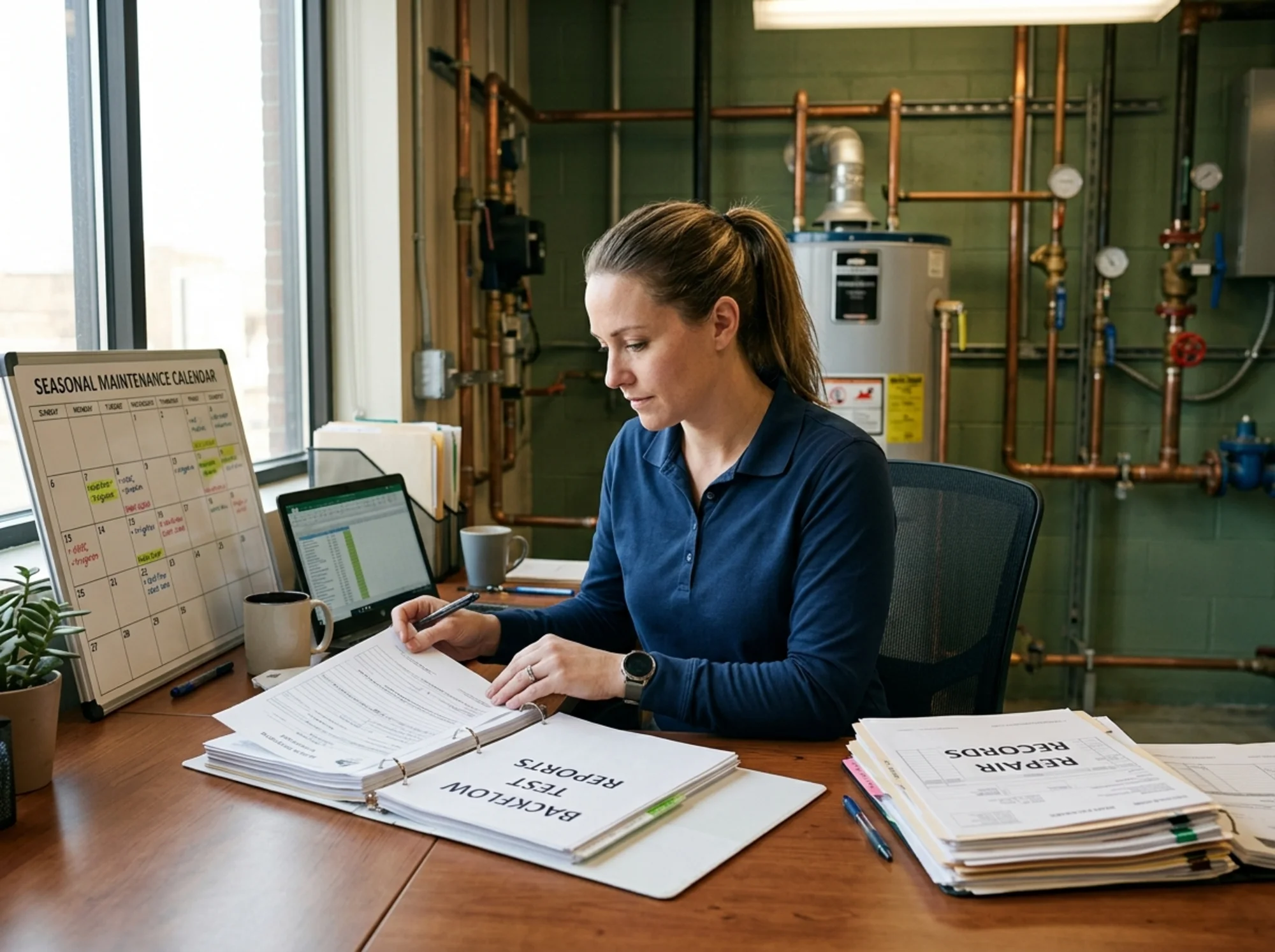 Property manager organizing backflow test reports, repair records, and a seasonal maintenance calendar on a desk while a mechanical room assembly is visible in the background, realistic office lighting, no logos or text overlay
7. Put backflow maintenance on the same calendar as everything else
The easiest way to stay compliant is to stop treating backflow as a special event.
Fold it into the same recurring operations rhythm you already use for inspections, seasonal startup, vendor coordination, and document reviews.
A practical rhythm looks like this:
Monthly
- confirm access is clear
- look for leaks or impact damage
- note contractor work near the assembly
Before annual testing
- pull the last report
- verify the serial number and location
- confirm the approved tester
After failed tests or repairs
- assign ownership
- schedule the retest immediately
- confirm the passing report was accepted
After pressure or water-quality concerns
CDC recommends paying attention to unusual water conditions and utility alerts. For larger properties, that is a good cue to review whether any assembly or recent plumbing change deserves attention too.
Bottom line
Strong backflow maintenance is not complicated. It is disciplined.
Know what assemblies you have. Keep them accessible. Catch obvious warning signs early. Use properly qualified testers. Treat report acceptance as part of the job. Move fast on failures and site changes. Put the whole process on a calendar your team actually uses.
Do that, and annual testing becomes a confirmation step instead of the first moment anyone realizes there is a problem.
If you need help now, find a local backflow tester, review your local utility program page, and keep the property record updated before the next notice arrives.
Sources
This article references guidance and regulations from authoritative sources including:
- U.S. Environmental Protection Agency (EPA) - Overview of the Safe Drinking Water Act
- American Water Works Association (AWWA) - Cross-Connection Control / Backflow Prevention Resources
- Washington State Department of Health - Cross-Connection Control and Backflow Prevention
- Seattle Public Utilities - Backflow Assembly Testing
- Austin Water - Backflow Prevention Assembly Tester Information
- Portland Water Bureau - Testing backflow prevention assemblies
- Philadelphia Water Department - Cross-Connection & Backflow Compliance
- New York City Department of Environmental Protection - Backflow Prevention Frequently Asked Questions
- Centers for Disease Control and Prevention (CDC) - Preventing Drinking Water-Related Illnesses
Last updated: May 28, 2026