Understanding Your Annual Backflow Prevention Assembly Test Report
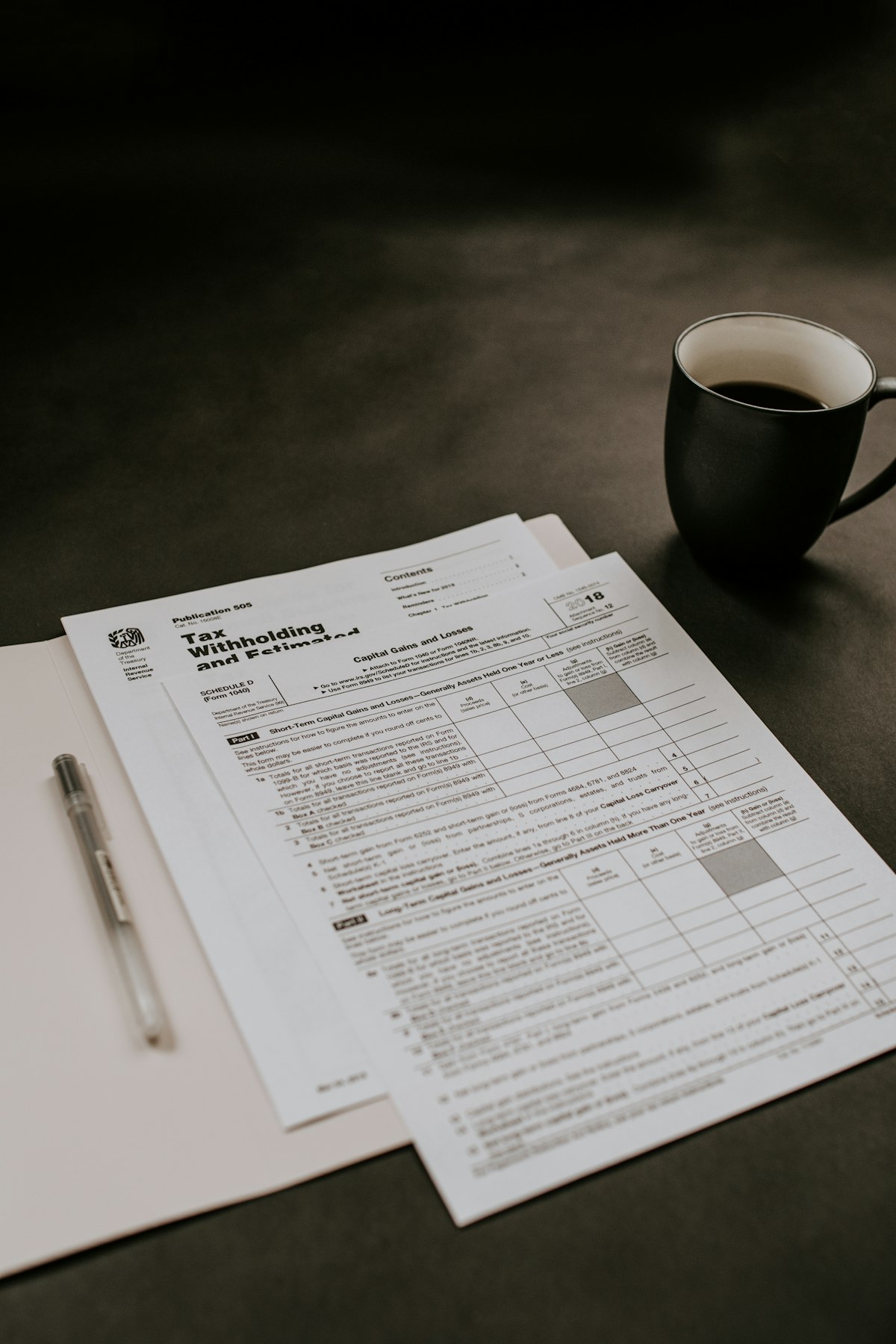
After your annual backflow test, your tester fills out a form that looks like it was designed for engineers — not property owners. It's full of pressure readings, component numbers, pass/fail checkboxes, and technical abbreviations that don't mean much if you're not a plumber.
But this report is important. It's your proof of compliance, your record of device performance over time, and the document your water utility uses to keep your property in good standing. Here's a plain-language breakdown of what every section means.
What Is a Backflow Test Report?
A backflow test report — sometimes called a Test and Maintenance Report or Backflow Prevention Assembly Test Report — is a standardized form that certified testers complete after testing a backflow prevention device. The form documents:
- What device was tested (type, manufacturer, model, serial number)
- When it was tested
- What the tester found (pressure readings for each internal component)
- Whether the device passed or failed
- What repairs were made (if any)
- Who performed the test (name, certification number)
Most utilities use a form based on the USC Foundation for Cross-Connection Control standard, though some states and utilities have their own versions. Regardless of format, the core information is the same.
The Header Section: Device Identification
The top of the report identifies the device and property. Here's what each field means:
Assembly Type: The type of backflow prevention device. Common types include:
- RPZ (Reduced Pressure Zone) — Used for high-hazard connections. Has two check valves and a relief valve.
- DCVA (Double Check Valve Assembly) — Used for low-to-moderate hazard connections. Has two check valves.
- PVB (Pressure Vacuum Breaker) — Used for irrigation and other above-grade applications.
- SVB (Spill-Resistant Vacuum Breaker) — Similar to PVB but designed not to discharge water during normal operation.
Size: The pipe diameter of the device, typically 3/4" to 2" for residential and up to 10" or larger for commercial.
Manufacturer and Model: The brand and specific model number (e.g., Watts 009, Wilkins 975XL, Febco 825Y).
Serial Number: The unique identifier stamped on the device body. This is how your utility tracks your specific device.
Location: Where the device is installed on your property (e.g., "front yard near meter," "mechanical room," "irrigation supply").
The Test Results Section: What the Numbers Mean
This is the section that confuses most property owners. The tester records pressure differential readings for each internal component, measured in pounds per square inch (psi). Here's what each test checks:
For RPZ Assemblies
Check Valve #1 (First Check): This measures the pressure differential across the first check valve — the one closest to the water supply. The tester closes test cocks and reads the gauge to determine if this valve is holding properly.
- Passing threshold: Typically 5.0 psi or greater
- What it means: The first check valve creates at least 5 psi of resistance to backward flow
Check Valve #2 (Second Check): Same test for the second check valve — the one closest to your property's plumbing.
- Passing threshold: Typically 1.0 psi or greater
- What it means: The second check valve is holding and providing a backup layer of protection
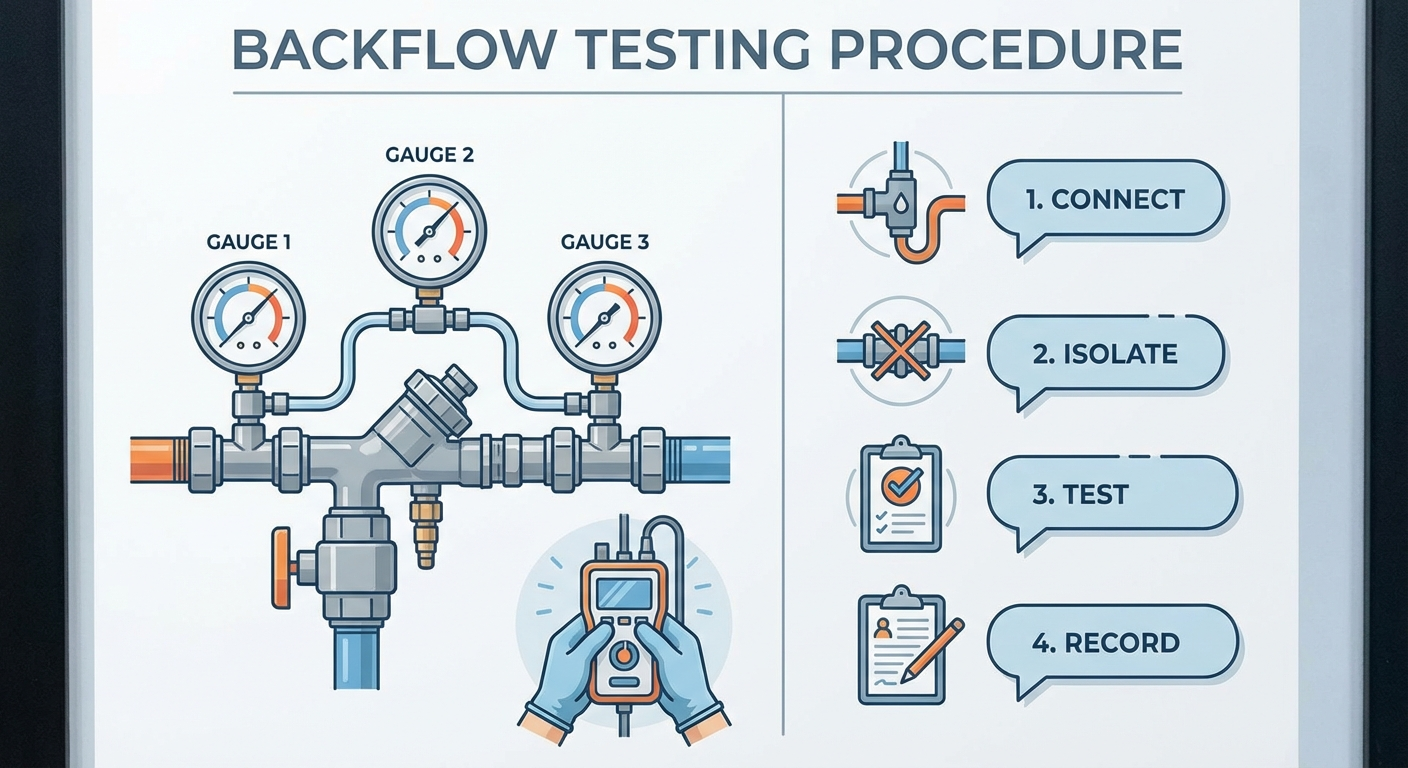 Certified testers use calibrated differential pressure gauge kits to measure each component's performance.
Relief Valve Opening Point: This is unique to RPZ assemblies. The relief valve is designed to open and discharge water if both check valves fail — it's the safety net. The tester measures the pressure differential at which the relief valve opens.
- Passing threshold: The relief valve must open at a differential pressure less than the check valve readings (typically 2.0 psi or less below the #1 check reading)
- What it means: If both check valves fail, the relief valve will dump water rather than allowing contaminated water to flow backward into the supply
For DCVA Assemblies
Check Valve #1:
- Passing threshold: Typically 1.0 psi or greater
Check Valve #2:
- Passing threshold: Typically 1.0 psi or greater
DCVA testing is simpler because there's no relief valve to test. Both check valves just need to hold above the minimum threshold.
For PVB Assemblies
Air Inlet Opening Point: The air inlet valve on a PVB must open to let air in (breaking the vacuum) when supply pressure drops.
- Passing threshold: Must open at 1.0 psi or greater above the downstream pressure
Check Valve:
- Passing threshold: Typically 1.0 psi or greater
Pass vs. Fail
The report will clearly indicate whether the device passed or failed. A device passes when all tested components meet or exceed the minimum thresholds. A device fails when any single component falls below its threshold.
A failure doesn't mean your device is worthless — it means a component needs attention. Common failure causes include:
- Worn rubber seals or disc assemblies
- Debris lodged in a check valve
- Fouled relief valve (RPZ only)
- Corrosion on internal components
- Spring fatigue
If your device fails, the tester will typically note which component failed and may offer repair services on the spot. After repairs, a retest is performed and documented on the same form.
For more on what to do when a device fails, read our guide on common reasons backflow tests fail.
The Repair Section
If repairs were needed, the report will document:
- Which components were replaced or serviced
- Part numbers for replacement components
- Retest results after repair
- Whether the device passed after repair
This section matters for tracking device history. If the same component fails year after year, it may indicate the device is approaching end of life and full replacement is more cost-effective than repeated repairs.
Tester Credentials
The bottom of the report includes the tester's information:
- Name and company
- Certification number — issued by their certifying body (ASSE, state agency, etc.)
- Certification expiration date
- Test gauge serial number and calibration date — testers are required to use calibrated equipment, typically recalibrated annually
- Signature and date
This section is what makes the report official. Without valid tester credentials, your utility won't accept the report.
What Your Utility Does With the Report
Once submitted (usually by the tester), your utility's cross-connection control program:
- Logs the test date and results in their compliance database
- Marks your property as compliant for the current testing period
- Flags any failures for follow-up to ensure repairs were completed
- Schedules your next test reminder based on the test date (typically 12 months)
If there's an issue with the report — missing information, invalid tester credentials, or illegible entries — the utility will contact you or your tester for corrections. This is another reason to keep your own copy.
Keeping Your Records
Always request a copy of your test report. Store it with your other property maintenance documents. Over time, these reports create a history that helps you:
- Track device performance trends — readings that decline year over year signal approaching failure
- Plan for replacement — if repair costs are climbing annually, a new device may be more economical
- Prove compliance — if there's ever a dispute about your testing history
- Support property sales — buyers and inspectors appreciate organized compliance documentation
The Bottom Line
Your backflow test report is more than a checkbox for compliance — it's a health check for a device that protects your drinking water. Understanding what the numbers mean helps you make informed decisions about maintenance, repair, and replacement.
If you haven't had your annual test yet, find a certified tester near you. And for a deeper dive into the testing process itself, check out our guide on what happens after you get a backflow test notice.
Sources
This article references guidance and regulations from authoritative sources including:
- USC Foundation for Cross-Connection Control and Hydraulic Research - Manual of Cross-Connection Control — Standard test report formats and testing procedures used by utilities nationwide
- American Water Works Association (AWWA) - Manual M14: Backflow Prevention and Cross-Connection Control — Technical specifications for backflow device testing thresholds
- American Society of Sanitary Engineering (ASSE) - Standard 5110: Backflow Prevention Assembly Tester — Tester qualification and equipment calibration requirements
- U.S. Environmental Protection Agency (EPA) - Safe Drinking Water Act — Federal authority underpinning cross-connection control programs
Last updated: February 24, 2026