State-by-State Backflow Testing Requirements: A General Overview
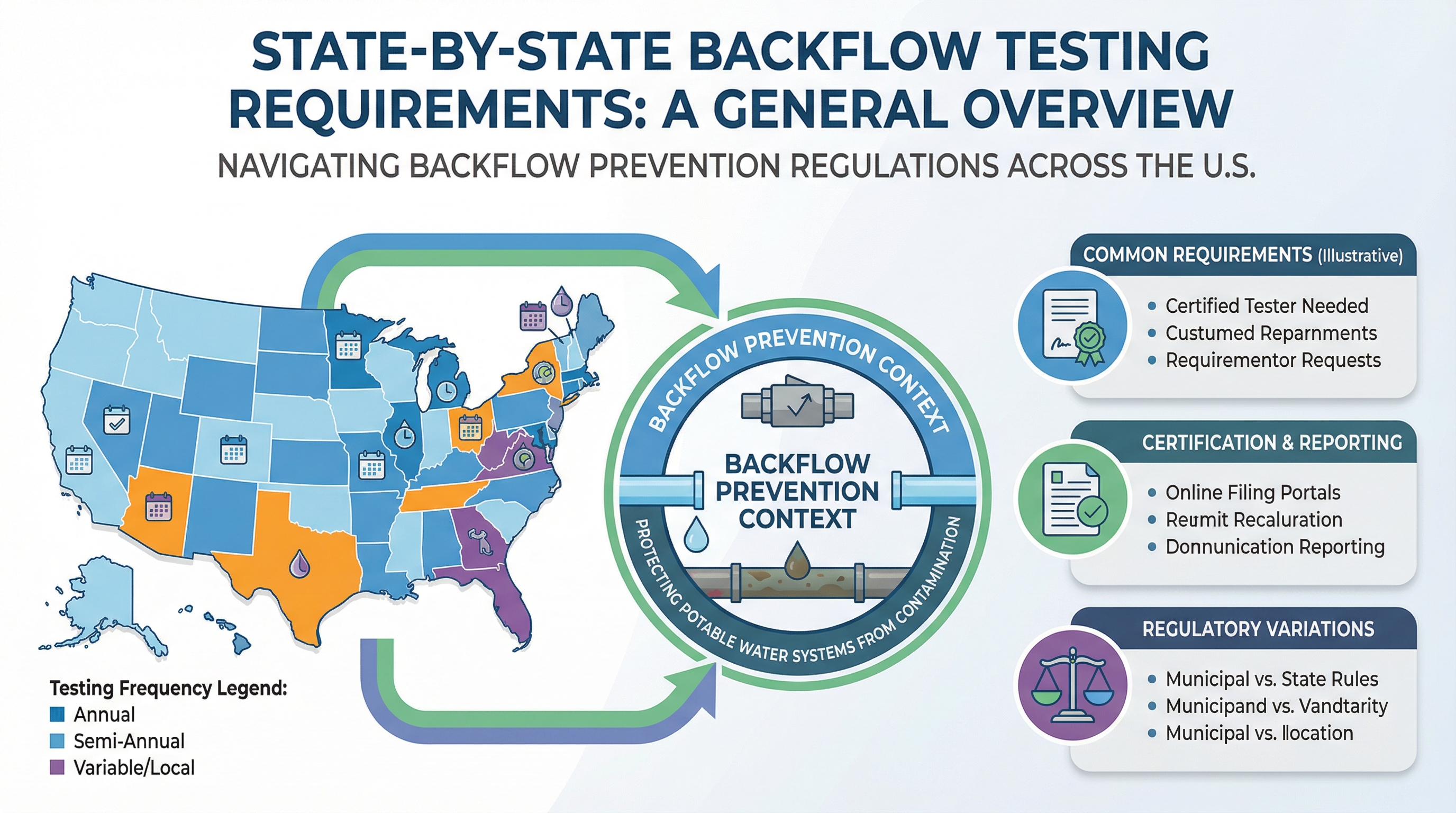
One of the most confusing aspects of backflow testing for property owners is that the requirements vary from state to state — and sometimes from city to city within the same state. While the federal Safe Drinking Water Act creates the foundation, each state implements cross-connection control differently. Here's a general overview of how states approach the key questions.

The Federal Foundation
The Safe Drinking Water Act (SDWA) requires all public water systems to protect drinking water quality. Under "primacy" agreements, most states take responsibility for implementing and enforcing these requirements within their borders. This means the EPA sets the floor, but states set the specific rules.
For a detailed look at the federal framework, see our guide on what the EPA says about backflow prevention.
How States Differ
Testing Frequency
The standard: Annual testing
Virtually every state that has cross-connection control requirements mandates annual testing of backflow prevention assemblies. This is consistent across the country and based on industry recommendations from the AWWA and USC Foundation.
A small number of jurisdictions allow extended testing intervals (18 months or 2 years) for devices that have consistently passed for several consecutive years — but this is the exception, not the rule. The majority require testing every 12 months.
Tester Certification Requirements
This is where states diverge significantly:
States with state-issued certification: Some states manage their own backflow tester certification programs. Testers must pass a state-administered exam, complete state-approved continuing education, and renew their certification on a state-defined schedule (usually every 1-3 years).
States that accept ASSE certification: Many states accept certification from the American Society of Sanitary Engineering (ASSE) under Standard 5110. ASSE certification involves a standardized exam and hands-on testing component.
States that accept multiple certifications: Some states accept certification from multiple organizations — including ASSE, ABPA (American Backflow Prevention Association), or state-specific programs. As long as the certification meets the state's requirements, the tester is authorized to perform tests.
States with local certification: A few states leave certification entirely to individual water utilities or counties. This creates a patchwork where a tester certified in one city may not be recognized in the next.
When hiring a tester, always verify their certification is valid in your specific jurisdiction. You can check with your water utility's cross-connection control department.
Regulatory Approach
States generally fall into one of three categories:
Strong state-level regulation: These states have detailed, statewide cross-connection control regulations that apply uniformly to all water systems. The state drinking water agency provides clear rules about device requirements, testing frequency, tester qualifications, and enforcement. Examples of this approach are found in several large states with mature regulatory programs.
State guidelines with local implementation: These states provide guidelines or recommendations rather than binding regulations. Individual water utilities adopt the guidelines and may modify them based on local conditions. This creates more variation within the state — one city may have strict enforcement while a neighboring town may have minimal requirements.
Minimal state regulation: A small number of states have limited state-level cross-connection control requirements, leaving almost everything to individual water utilities. In these states, your experience depends heavily on which utility serves your property.
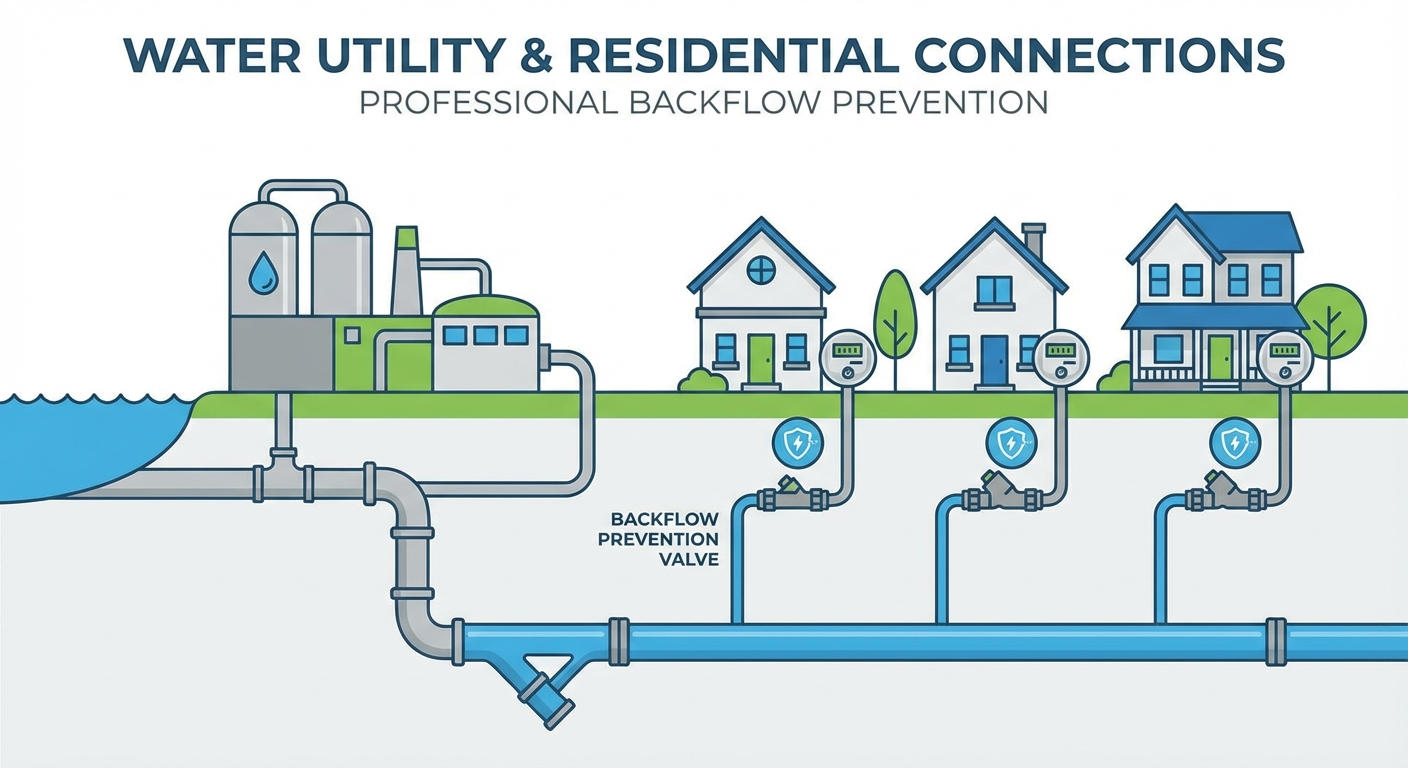 Regardless of state regulatory approach, your local water utility is the primary enforcer of backflow testing requirements.
Device Approval
Most states reference an approved device list for backflow prevention assemblies. The most commonly referenced list is maintained by the USC Foundation for Cross-Connection Control and Hydraulic Research. Devices must be tested and listed by the USC Foundation (or equivalent organization) before they can be installed in most jurisdictions.
Some states maintain their own approved device lists, which may differ slightly from the USC Foundation list. If you're having a new device installed, your plumber or tester should verify the device is approved for use in your state.
Regional Patterns
While every state is different, some regional patterns emerge:
Western States
Many western states have mature, well-developed cross-connection control programs. Water scarcity has made drinking water protection a high priority, and cross-connection control programs tend to be well-funded and actively enforced. States like California, Colorado, and Washington have comprehensive state-level regulations.
Southern States
Southern states show more variation. Some have strong state programs, while others rely more heavily on local utility implementation. The rapid growth in many southern cities has driven expansion of cross-connection control programs in recent years.
Northeastern States
Northeastern states generally have mature programs, often with long histories of cross-connection control dating back decades. The older infrastructure in many northeastern cities means there are more legacy cross-connections to manage.
Midwestern States
Midwestern states typically have solid but not always uniform programs. Agricultural connections (irrigation, chemical application) are a particular focus in rural areas.
What This Means for You
As a property owner, the practical takeaways are:
Check your local requirements. Don't assume your state's rules are the same as your neighbor state. Your water utility is the definitive source for what's required at your property.
Verify tester credentials for your jurisdiction. A tester certified in one state may not be authorized in yours. Always confirm.
Annual testing is nearly universal. Regardless of your state, if you have a backflow prevention assembly, plan on testing it once a year.
Enforcement varies. Some jurisdictions aggressively enforce compliance with fines and shutoffs. Others are more lenient. Don't assume your utility won't enforce — the trend nationwide is toward stricter enforcement.
Use your utility as a resource. Your water utility's cross-connection control department can answer questions about your specific requirements, approved testers, and compliance status.
Finding Your State's Requirements
To find the specific requirements for your property:
- Contact your water utility's cross-connection control department — they'll know the exact requirements
- Check your state drinking water agency's website — most publish cross-connection control regulations or guidelines
- Browse our state directory — find testers and information by state
- Ask your certified tester — experienced local testers know the requirements inside and out
The Bottom Line
While the details vary, the fundamentals are consistent across all 50 states: if you have a backflow prevention assembly, it needs to be tested annually by a qualified professional, and the results need to be submitted to your water utility. The variations in certification requirements, enforcement approaches, and regulatory structure don't change this core obligation.
Stay compliant by knowing your local requirements and keeping your testing current. Find a certified tester in your state and make annual backflow testing part of your property maintenance routine.
Sources
This article references guidance and regulations from authoritative sources including:
- U.S. Environmental Protection Agency (EPA) - Safe Drinking Water Act and State Primacy — Federal-state regulatory framework for drinking water protection
- American Water Works Association (AWWA) - Manual M14: Backflow Prevention and Cross-Connection Control — Industry guidance on program requirements and implementation
- USC Foundation for Cross-Connection Control and Hydraulic Research - Manual of Cross-Connection Control — National reference for device approval and testing standards
- American Society of Sanitary Engineering (ASSE) - Standard 5110 — National tester certification standard adopted by many states
- Centers for Disease Control and Prevention (CDC) - Cross-Connection Control — Public health context for cross-connection control programs
Last updated: March 18, 2026