Should You Use Your Plumber or a Specialized Backflow Tester
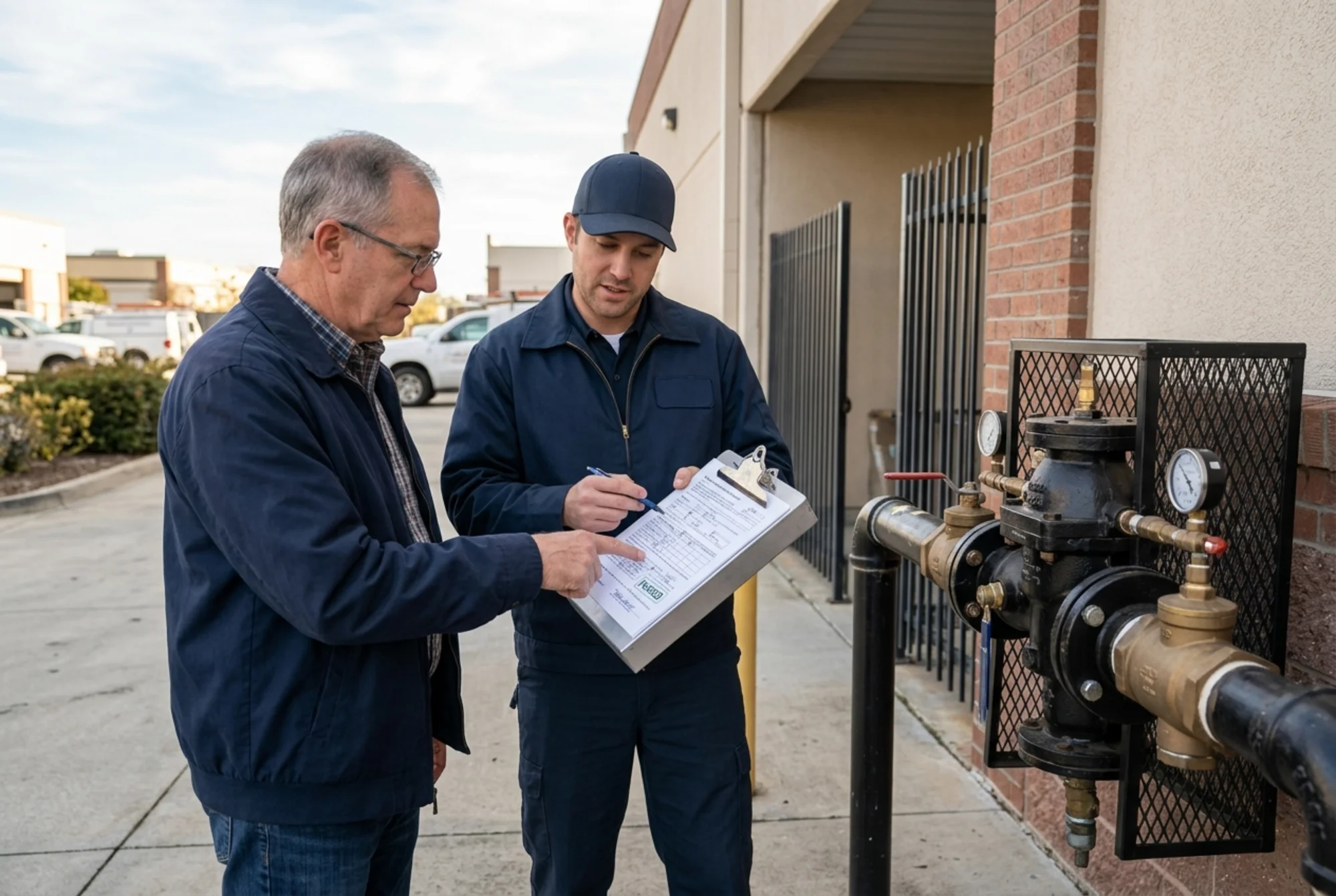
Should You Use Your Plumber or a Specialized Backflow Tester
If you own a property with a backflow preventer, the practical question is not just who can show up first. It is who can solve the actual problem in front of you.
Sometimes that problem is plumbing work, like a leaking assembly body, damaged shutoff valves, or a device that needs to be installed or replaced. Sometimes it is compliance work, like an annual test report your water utility expects from a certified tester using calibrated gauges. And sometimes it is both.
That distinction matters because hiring the wrong person can lead to a wasted visit, a report your utility will not accept, or a repair that still leaves your property out of compliance. If you want the broader why behind these requirements, start with why backflow testing is required.
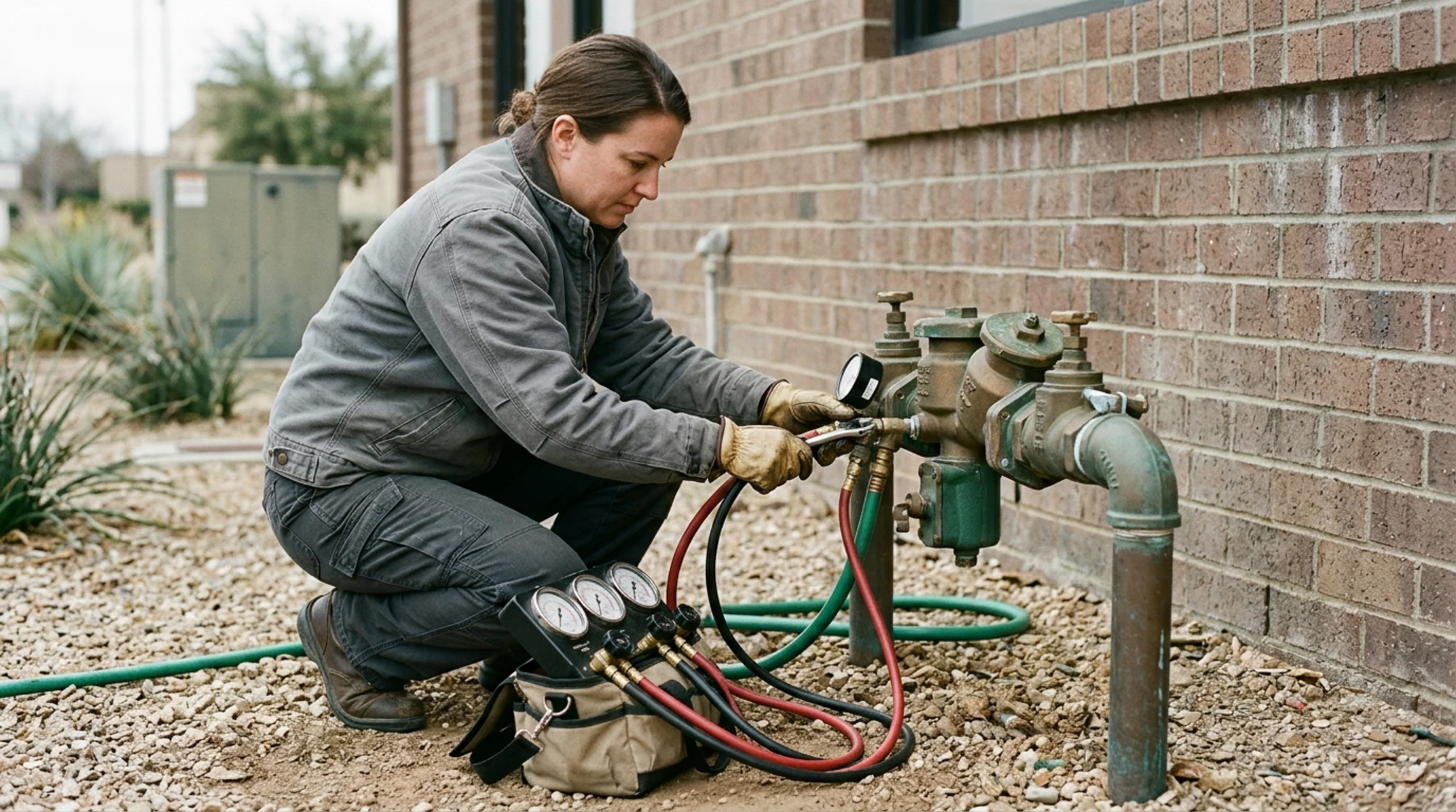 A certified backflow tester kneeling beside an outdoor reduced pressure backflow assembly, connecting a differential pressure gauge kit with natural daylight, no visible logos or text overlay
A plumber and a backflow tester do different jobs
A licensed plumber works on the physical plumbing system. That includes installing water lines, replacing fittings, relocating assemblies, swapping out damaged shutoff valves, and handling the pipe work around a backflow preventer. If the issue involves cutting pipe, changing the assembly location, or replacing the device body, that is plumbing work.
A specialized backflow tester handles the diagnostic and compliance side. They use calibrated differential pressure gauges to test whether the internal checks and relief functions are operating correctly. Then they complete the field test report your utility or local cross-connection control program may require.
Those are different skill sets, and many jurisdictions treat them as different credentials.
Texas is a good example. The Texas Commission on Environmental Quality says a person who repairs or tests the installation or operation of backflow prevention assemblies must hold a TCEQ license. Washington is another useful example. The Washington Department of Health publishes Backflow Assembly Tester duties, field test report content requirements, and a sample field test report to help testers and water systems comply with the rule.
So even though both people may work around the same device, they are not interchangeable by default.
When a plumber may be enough
There are plenty of situations where your regular plumber is the right first call.
New installation or replacement
If you are adding a backflow assembly for the first time, replacing a cracked device body, or relocating an assembly to meet clearance or drainage requirements, that is plumbing work first. A plumber handles the physical installation and pipe connections.
Visible leaks or pipe damage
If the issue is a leaking fitting, corroded pipe, damaged shutoff valve, or freeze-related plumbing damage around the assembly, a plumber is the logical person to call. Those problems may eventually lead to a compliance issue, but the first task is still physical repair.
Device relocation or site work changes
If construction, landscaping, or access problems mean the assembly needs to move, a plumber handles that change. A tester may still be needed afterward, but the relocation itself is not the testing step.
No report or deadline is involved yet
If there is no annual test due notice, no failed report, and no utility paperwork waiting on a result, you may simply be dealing with a plumbing service call.
The simplest rule is this: if the main problem is the pipe system, the assembly body, or the installation itself, a plumber is usually the right starting point.
When a specialized backflow tester is the better choice
If the issue involves the annual test, the official report, or whether the assembly is still protecting the drinking water supply, a specialized backflow tester is usually the safer call.
Seattle Public Utilities is very clear on this. It says annual testing must be performed by a State of Washington Certified Backflow Assembly Tester, and that test reports cannot be submitted unless the tester's certification and test equipment calibration information are already in the system. That is a great example of why the distinction matters. A competent plumber who is not recognized as the right kind of tester may still leave you with a report the utility refuses.
Philadelphia shows the same idea from a different angle. The Philadelphia Water Department publishes city-certified technician resources, city-approved backflow assembly lists, and an official Backflow Prevention Assembly Test and Maintenance Record form. That tells property owners the utility cares not just that someone looked at the device, but that the right person documented it the right way.
A specialized tester is usually the better choice when:
- you received an annual test notice from the utility,
- you need an official passing report submitted,
- the assembly recently failed a test and needs a retest,
- you want to verify whether the device is functioning before a sale, inspection, or compliance deadline,
- or you manage a property where recordkeeping matters as much as the physical device.
If you are still comparing providers, our guide on how to choose a qualified backflow tester goes deeper on credentials, calibration, and paperwork.
When you probably need both
A lot of real-world backflow problems do not stay in one lane.
Failed test, then repair, then retest
This is the most common example. The tester identifies that the assembly failed. Then someone has to repair or rebuild it. In Texas, a licensed BPAT may be allowed to both test and repair certain assemblies. In other jurisdictions, the scope of repair may push the work back toward a plumber, especially if the assembly body, surrounding piping, or shutoff valves need major physical work.
Then, after the repair, the assembly still needs a passing retest and proper documentation.
New assembly installation plus initial test
A plumber may install the assembly, but many programs still want an initial test before the device is treated as fully compliant. That means installation first, then testing and report submission.
Major physical repair plus compliance paperwork
If the device has a cracked body, broken fittings, or severe corrosion, you may need a plumber for the physical repair and a tester for the compliance closeout. One without the other leaves the job unfinished.
This is where it helps to ask one simple question up front: Are you handling the plumbing work, the certified test, or both?
If the company can only do one part, that is fine, but you want to know it before the first visit, not after the first invoice.
How to decide who to call first
Use this checklist.
Call a plumber first if:
- water is leaking from nearby piping, fittings, or valves,
- the assembly needs installation, relocation, or replacement,
- freeze damage or physical breakage is obvious,
- or the issue is clearly mechanical before it is administrative.
Call a specialized backflow tester first if:
- you got a utility notice for annual testing,
- you need a report submitted to a utility or cross-connection office,
- the previous report was rejected or never received,
- or you need to confirm whether the assembly is actually passing before a deadline.
Ask for both, or a dual-credential provider, if:
- the assembly already failed its test,
- you expect repair plus retest,
- a replacement assembly may be needed,
- or the property is commercial, multi-tenant, HOA-managed, or otherwise harder to coordinate.
This matters even more on properties where utilities actively track records. If you want the utility side of that process explained in plain English, our post on how utilities track backflow test compliance is useful.
Questions to ask before booking
Whether you call a plumber, a tester, or a company that claims to do both, ask these questions first:
- Are you performing the certified backflow test, the repair work, or both?
- If you test the assembly, will you also submit the report if my utility requires that?
- If the assembly fails, can you repair it and retest it, or will I need a second company?
- Does your credential match my local program requirements?
- Will I receive a copy of the completed report for my records?
- If replacement is needed, who handles the installation and who handles the final test?
Seattle explicitly tells owners to work with their tester or testing company to make sure documentation is provided for their records. That is not a small detail. Good paperwork is part of the job.
If you are preparing for an upcoming visit, how to prepare your property for a backflow test can help you avoid the most common access and scheduling mistakes.
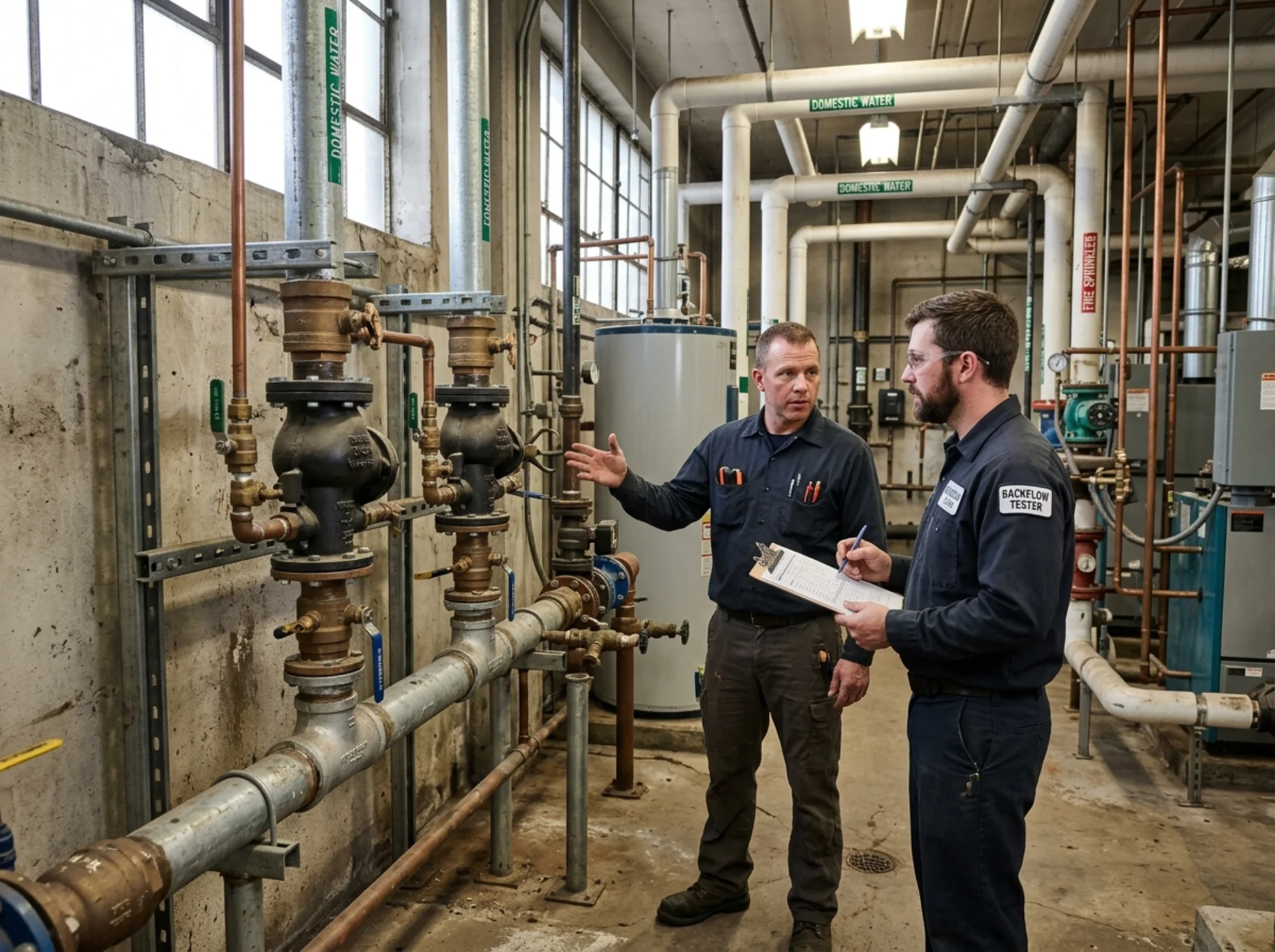 A commercial mechanical room with multiple backflow assemblies, visible shutoff valves and test cocks, while a plumber and a certified tester discuss next steps beside a clipboard, natural industrial lighting, no logos or text overlay
What this means for homeowners and property managers
For a homeowner with one irrigation or domestic assembly, the decision is usually straightforward. If the utility wants an annual test, use a certified tester. If the assembly or nearby piping is physically damaged, call a plumber. If the test fails, you may end up using both.
For property managers, the coordination problem is bigger. Multi-property schedules, shared systems, tenant access, and utility deadlines make it more valuable to use providers who can explain exactly how they handle testing, repair, retest, and documentation. That is one reason city and utility pages matter so much. You can compare local options in places like Austin, Charlotte, and Philadelphia, then review utility-specific expectations on the Austin Water program page or the Philadelphia Water Department program page.
For quick baseline questions, our FAQs are also a good starting point.
Bottom line
A plumber and a specialized backflow tester are not competitors. They are different roles that solve different parts of the same water-safety and compliance problem.
Use a plumber when the job is physical installation, replacement, relocation, or visible plumbing repair. Use a specialized backflow tester when the job is annual testing, retesting, report submission, and proving the assembly is still protecting the water supply the way your utility expects.
And when the issue crosses both lines, like a failed test that turns into a repair, assume you may need both unless one provider clearly holds the right credentials for the whole job.
That small distinction saves time, reduces duplicate visits, and makes it much more likely that your property ends up actually fixed and actually compliant.
Sources
This article references guidance and regulations from authoritative sources including:
- U.S. Environmental Protection Agency (EPA) - Safe Drinking Water Act (SDWA)
- American Water Works Association (AWWA) - Cross-Connection Control and Backflow Prevention Resources
- Texas Commission on Environmental Quality (TCEQ) - Occupational Licenses: Backflow Prevention Assembly Tester (BPAT)
- Washington State Department of Health - Cross-Connection Control and Backflow Prevention
- Seattle Public Utilities - Backflow Assembly Testing
- Philadelphia Water Department - Cross-Connection & Backflow Compliance
- Oregon Health Authority - Cross Connection and Backflow Prevention Program
- Centers for Disease Control and Prevention (CDC) - Preventing Drinking Water-Related Illnesses
Last updated: April 29, 2026
Failed a backflow test?
Send one request with your service address and property type, and we will help connect you with local testers who handle repairs and retests.