Repair vs. Replace: What to Do When Your Backflow Preventer Fails Its Annual Test

There's a particular kind of dread that comes with hearing a contractor say "it failed." Whether it's a car inspection, a home inspection, or — as is the case here — an annual backflow test, the word "failed" has a way of making your stomach drop before you even know what it means for your wallet.
Here's the reassurance you need right upfront: a failed backflow test is not a catastrophe. It happens regularly, it's fixable, and in many cases the resolution is faster and less expensive than you're probably imagining right now. What matters is understanding what actually failed, what your options are, and how to make the right call between repairing your existing device and replacing it entirely.
This guide walks you through all of it — clearly, practically, and without unnecessary alarm.
What Does It Mean to "Fail" a Backflow Test?
A backflow preventer fails its annual test when it doesn't perform within the pressure and mechanical standards required by your water authority. But "failed" is actually a broader category than most people realize, and the nature of the failure tells you a lot about what comes next.
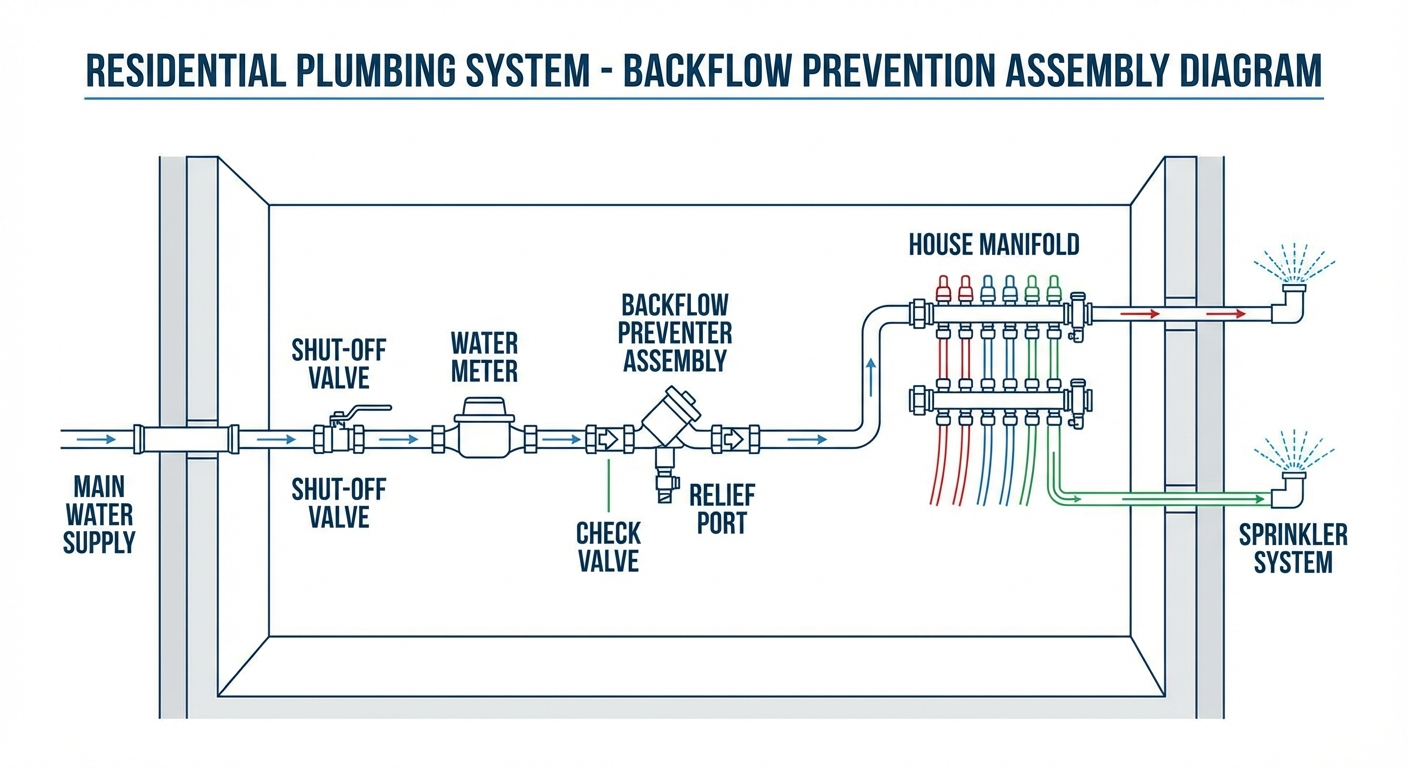
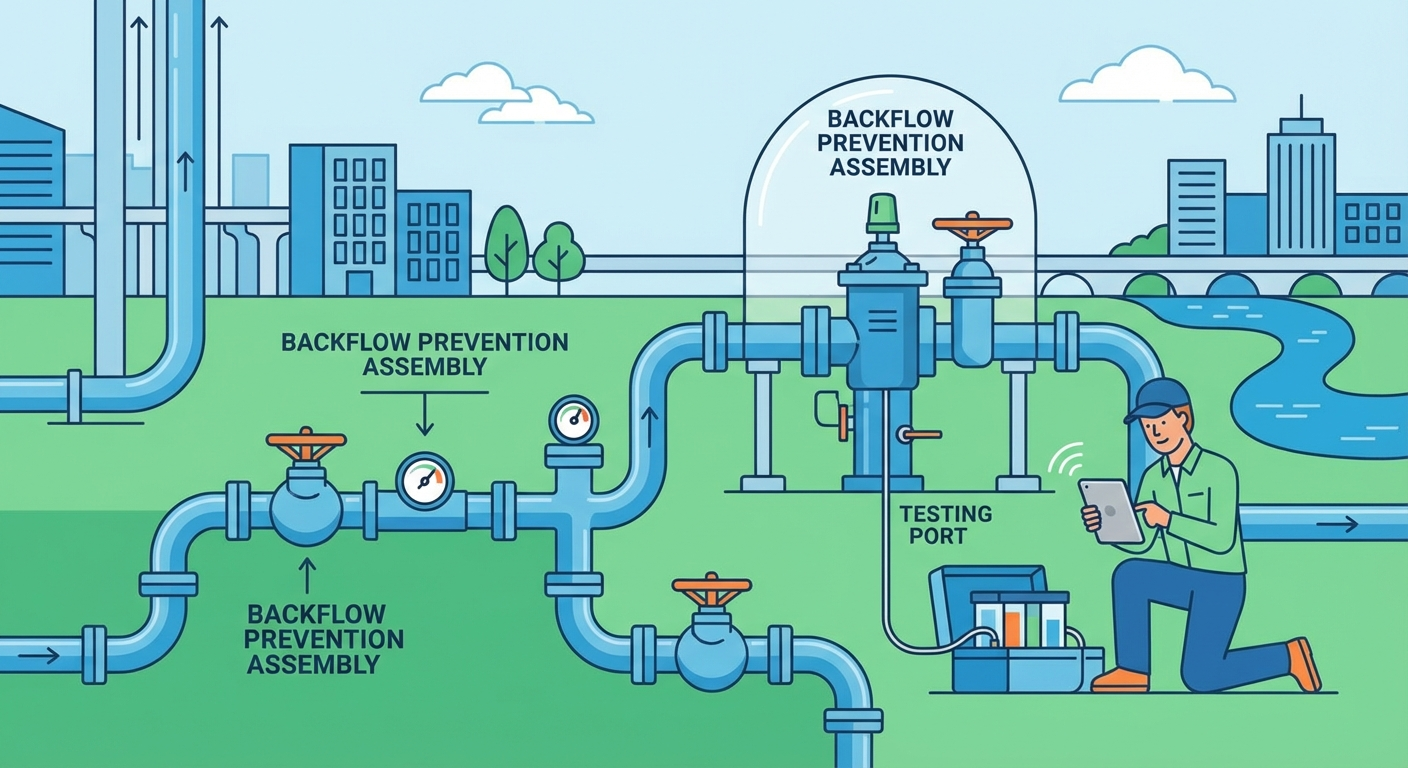
Most backflow preventers — particularly the reduced pressure zone (RPZ) assemblies common in higher-hazard applications and the double check valve assemblies found on many residential systems — work through a combination of spring-loaded check valves and a relief valve that together prevent water from reversing direction. During a test, a certified tester uses calibrated gauges to measure exactly how these components are performing under controlled pressure conditions.
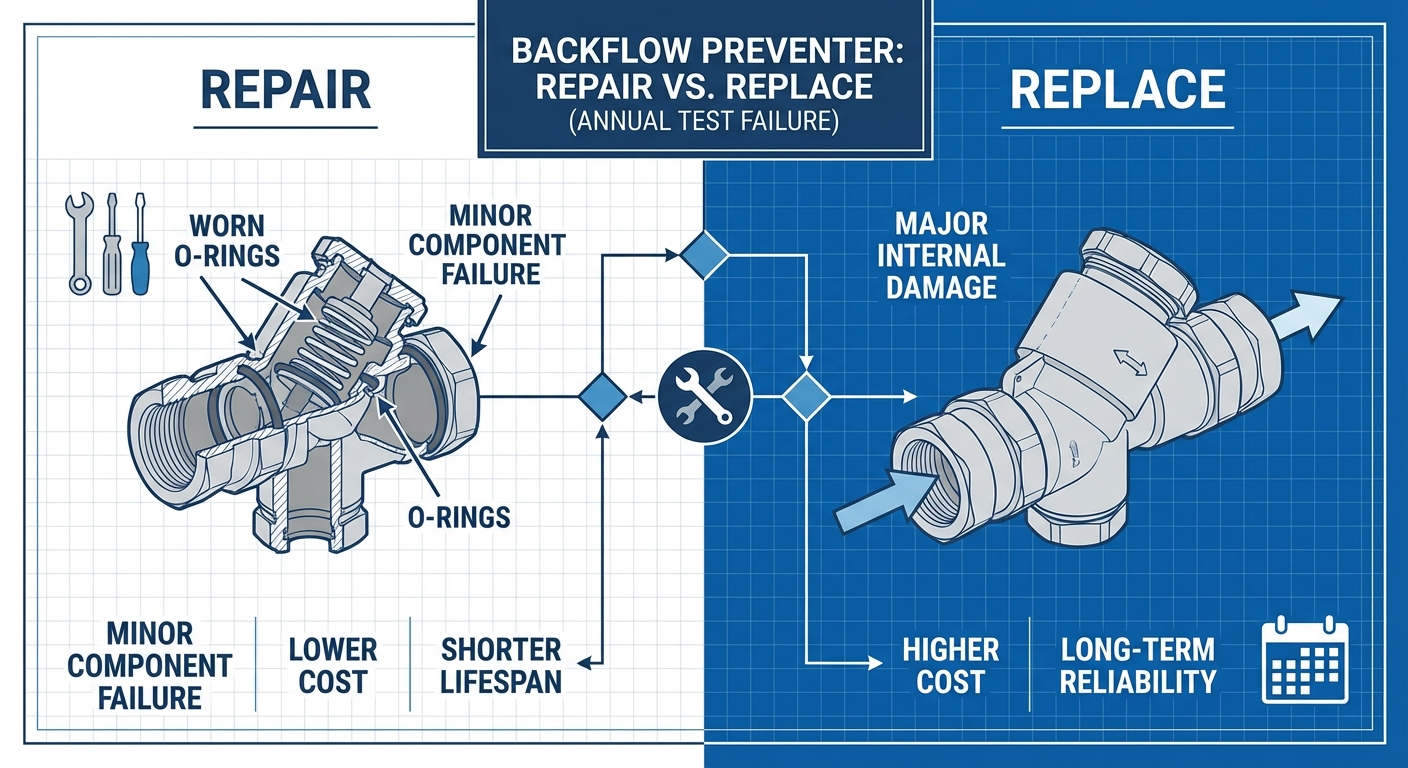
A failure typically falls into one of a few categories. A fouled or stuck check valve is one of the most common — debris, sediment, or mineral buildup can prevent the valve from seating properly, which means it's no longer forming a reliable seal. A weakened or broken spring is another frequent culprit, since springs fatigue over time and lose the tension needed to keep check valves functioning correctly. A leaking or malfunctioning relief valve — particularly in RPZ assemblies — is also a common failure point. And in some cases, the failure is more significant: cracked housing, severe corrosion, or internal damage that goes beyond what a component swap can fix.
Not all failures are equal in severity, and an experienced tester will usually be able to tell you after the test whether what they observed looks like a simple component issue or something more serious. That initial assessment is valuable — it's your first clue about which direction you'll be heading.

The Immediate Next Steps After a Failed Test
When a backflow preventer fails, your tester is required to document and report the failure to your water authority — the same way they'd report a passing result. This is a mandatory part of the process, and it officially puts your municipality on notice that your device is out of compliance.
From that point, most water authorities give property owners a defined window to resolve the issue and submit proof of repair or replacement — commonly 30 days, though this varies by municipality. Some jurisdictions are stricter, particularly for high-hazard commercial applications, and may require faster action. Others are more lenient with first-time failures, especially for residential properties. Your tester or your water utility can tell you exactly what your local timeline looks like.
What's important is that you don't treat this window as optional. Once a failure is on record, the clock is running. Acting promptly not only keeps you on the right side of your water authority — it also gives you time to get multiple quotes if needed, rather than being forced into a rushed decision as your deadline approaches.
When Repair Is the Right Call
For many backflow preventer failures, repair is the faster, more cost-effective path — and it's the right choice more often than people expect.
Repair makes the most sense when the device is relatively new, meaning it has years of useful life left in it. A device that's only a few years old and failing due to a worn seal or a fatigued spring is a strong candidate for repair. The assembly itself is structurally sound; it just needs a component refresh.
It also makes sense when the failure is clearly isolated to a specific, replaceable part. If a tester can point to a single check valve that's fouled or a relief valve that's weeping, those are targeted problems with targeted solutions. Replacement kits — which include new seals, springs, and check discs — are widely available for most standard assemblies and are inexpensive relative to the cost of a whole new device.
Repair is also worth considering when the device is a larger or more expensive assembly, such as a 2-inch or 3-inch commercial RPZ. At that size, the cost differential between repairing and replacing becomes significant, and a repair that extends the device's life by several years represents real savings.
A typical repair visit involves shutting off the appropriate water supply, disassembling the relevant portions of the backflow preventer, replacing the worn or damaged components, reassembling the device, and then re-testing it to confirm it now passes. In straightforward cases, this can be completed in a single visit.
When Replacement Is the Better Option
There are situations where putting money into repairing an existing device simply doesn't make financial or practical sense — and where replacement is the smarter long-term decision.
Age is the most significant factor. Most backflow preventers have a functional lifespan of roughly 5 to 10 years under normal conditions, though this varies based on water quality, usage, and maintenance history. A device that's pushing the outer edge of that range and failing its test is telling you something. Even if a repair passes this year's test, you may find yourself in the same situation — or a worse one — within a year or two. At some point, the cumulative cost of ongoing repairs exceeds the cost of a new device.
Repeated failures are another clear signal. If a device has failed two or more consecutive tests, or required repairs in back-to-back years, it's likely past the point where repair is a reliable solution. The internal components have reached the end of their service life, and continued investment in a tired assembly is rarely worthwhile.
Discontinued parts are a practical concern for older devices. Manufacturers don't support every model indefinitely, and if repair kits are no longer available for your specific assembly, replacement isn't just the better option — it may be the only one.
Significant physical damage is also a straightforward case for replacement. Severe corrosion, cracked housing, or damage caused by freezing or impact can compromise the structural integrity of the assembly itself, not just its internal components. No amount of new seals and springs fixes a compromised body.
Finally, if your property has undergone changes that affect the level of hazard at a cross-connection point — such as adding an irrigation system with fertilizer injection, or changes to commercial operations — you may be required by code to upgrade to a higher-grade assembly regardless of whether your current device could otherwise be repaired. This is worth confirming with your tester or local water authority.
The Cost Comparison: Repair vs. Replace
Understanding the realistic numbers for both paths helps you evaluate your options clearly rather than guessing.
Repair costs are generally modest when the failure involves standard internal components. Parts for most residential and light commercial assemblies are inexpensive — often $20 to $75 for a complete rebuild kit. Labor to perform the repair typically runs $75 to $150 depending on the size of the device and local rates, bringing an average repair to somewhere in the range of $100 to $250 for most residential situations. More complex commercial assemblies can run higher, but repair still usually comes in well below replacement cost.
Replacement costs cover a wider range depending on the type and size of device. A standard residential backflow preventer — a 3/4-inch or 1-inch assembly for an irrigation system, for example — and its installation typically runs $300 to $600 all-in. Mid-range commercial assemblies in the 1.5-inch to 2-inch range can run $600 to $1,500 installed. Larger commercial and industrial assemblies, particularly RPZ units on fire suppression lines or main service entries, can run $1,500 to $3,000 or more, depending on size, complexity, and permitting requirements.
When weighing repair against replacement, a useful mental benchmark is this: if the repair cost approaches or exceeds 50 percent of what replacement would cost — and the device is older or has a history of problems — replacement is almost always the better value.
Who Does the Repair or Replacement?
This is a question that trips up a lot of property owners, and it's worth being clear about it.
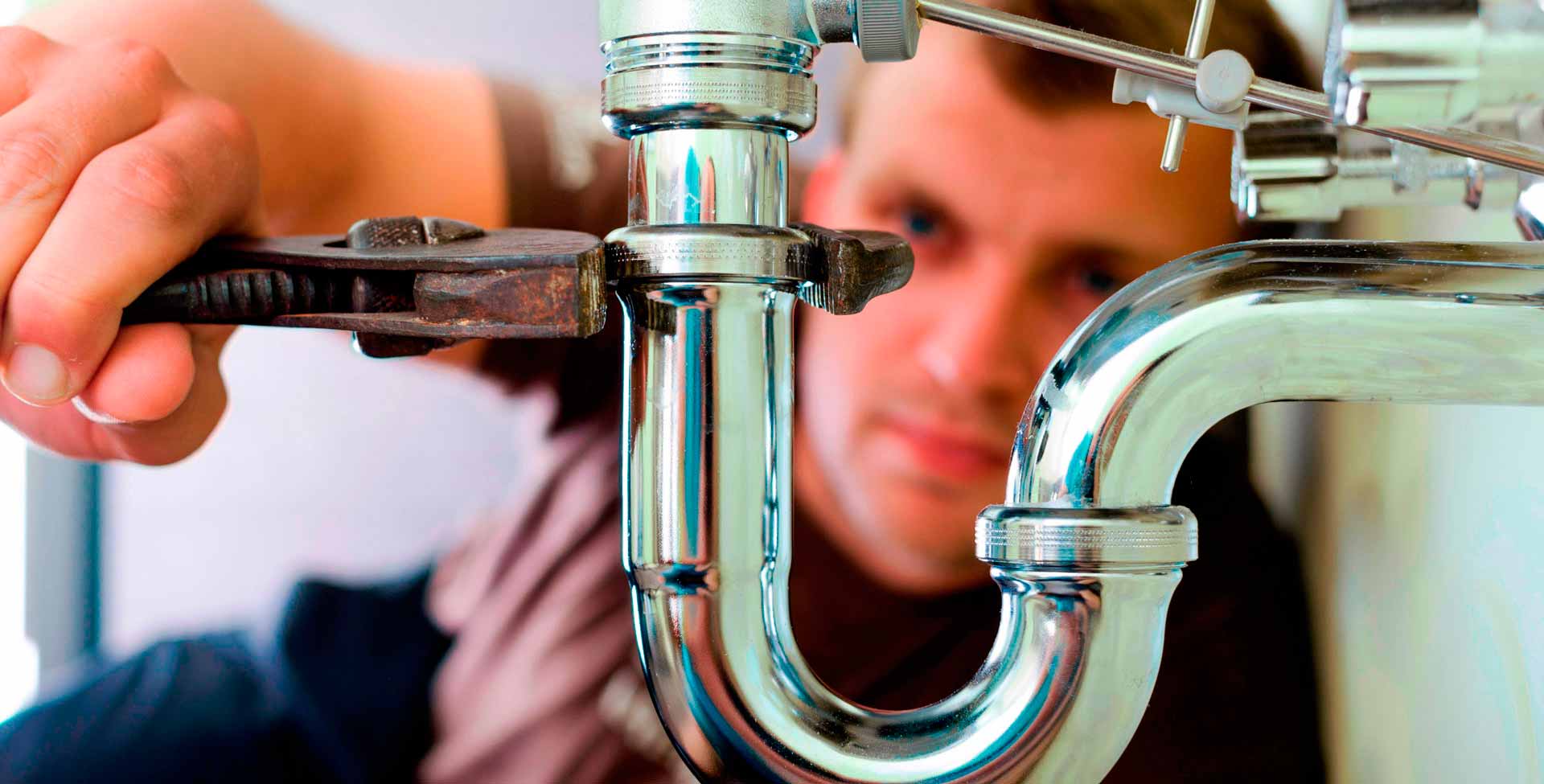
A certified backflow tester is qualified to identify what failed and document it. In some cases — particularly when a tester also holds a plumbing license — they may be able to perform minor field repairs on the spot. But the actual repair or replacement of a backflow prevention assembly is plumbing work, and in most jurisdictions it must be performed by a licensed plumber. Replacement in particular often requires a permit and inspection, depending on local regulations.
This means that if your tester identifies a failure and isn't also a licensed plumber, you'll need to bring in a separate contractor to do the remediation work. Once the repair or replacement is complete, the device then needs to be retested and a passing report filed — which again requires a certified backflow tester.
This is precisely why many property owners find it valuable to work with a licensed plumber who also holds backflow certification. A dual-credentialed professional can test the device, diagnose the failure, perform the repair or replacement, retest the assembly, and file the compliance report — all without you needing to coordinate between multiple contractors. If you're not already working with someone like this, a failed test is a good reason to find one.
How to Avoid Future Failures
Once you've resolved a failed test — whether through repair or replacement — it's worth thinking about what you can do to extend the life of your backflow preventer and reduce the likelihood of going through this again sooner than necessary.
The single most effective thing you can do is stay current with annual testing. This might seem counterintuitive — testing is what identified the failure in the first place — but regular testing catches small issues before they become expensive ones. A tester who notices a check valve starting to show early signs of wear can flag it before it becomes a full failure, giving you time to address it on your schedule rather than under deadline pressure.
Physical protection matters too. Backflow preventers installed in locations exposed to freezing temperatures are vulnerable to frost damage, which can crack housings and destroy internal components in a single cold night. If your device is in an exposed location, an insulated cover designed for backflow assemblies is an inexpensive investment that can significantly extend its life. In regions with harsh winters, your plumber or tester can advise on the best approach for your specific installation.
Water quality plays a role as well. Properties with hard water or high sediment levels in their supply may see faster fouling of check valves and seals. A water treatment professional can advise whether a filtration or treatment solution upstream of your backflow preventer makes sense for your situation.
Finally, keep records. Maintain a file that includes your annual test reports, any repair or replacement documentation, and any correspondence with your water authority. Beyond satisfying compliance requirements, this history is useful context for any professional who works on your system in the future — and it helps you spot patterns if failures start occurring more frequently.
The Bottom Line
A failed backflow test is a problem with a clear path to resolution — not a reason to panic. The decision between repair and replacement comes down to a few key factors: the age and condition of your device, the nature of the failure, the cost difference between the two options, and whether parts are readily available. In many cases, especially for newer devices with isolated component failures, repair is the faster and more economical choice. For older devices, repeat failures, or situations involving significant damage, replacement is the smarter long-term investment.
Whatever path you choose, act within your compliance window, work with properly credentialed professionals, and make sure a passing test report gets filed with your water authority when the work is done. That report is your proof of compliance, and it's the finish line you're working toward.
A backflow preventer that's well-maintained and promptly serviced when needed does its job quietly and reliably for years. One test, one repair or replacement if needed, and you're back on track — with the peace of mind that comes from knowing your water supply is protected.