A Property Manager's Backflow Testing SOP Template for 2026
If you manage commercial, HOA, multi-family, or mixed-use property, backflow testing usually stops being a simple annual reminder pretty quickly. Someone has to know which assembly is on site, who is allowed to test it, when the report is due, what happens if the assembly fails, and where the paperwork lives after the appointment ends.
That is why a written SOP helps. It turns backflow testing from a vendor task into an operating system your team can repeat.
The official sources all point in the same direction. EPA says the Safe Drinking Water Act protects public health by regulating the nation’s public drinking water supply. State and utility programs then translate that into real-world testing, reporting, and compliance rules. Seattle Public Utilities says annual testing is the only way to ensure assemblies are functioning properly and requires reports to be submitted with the tester’s certification and calibration information already on file. Washington DOH publishes specific field test report content requirements. Philadelphia publishes approved assembly information, certified technician resources, and official forms. In Texas, TCEQ says a person who repairs or tests backflow prevention assemblies must hold the required license.
So the goal of the SOP is simple: make sure the right assembly gets tested by the right person, the right report gets filed, and your team can prove it later.
If you want the public-health background first, start with why backflow testing is required. If you are ready to operationalize it, use the template below.
Why every property manager needs a written SOP
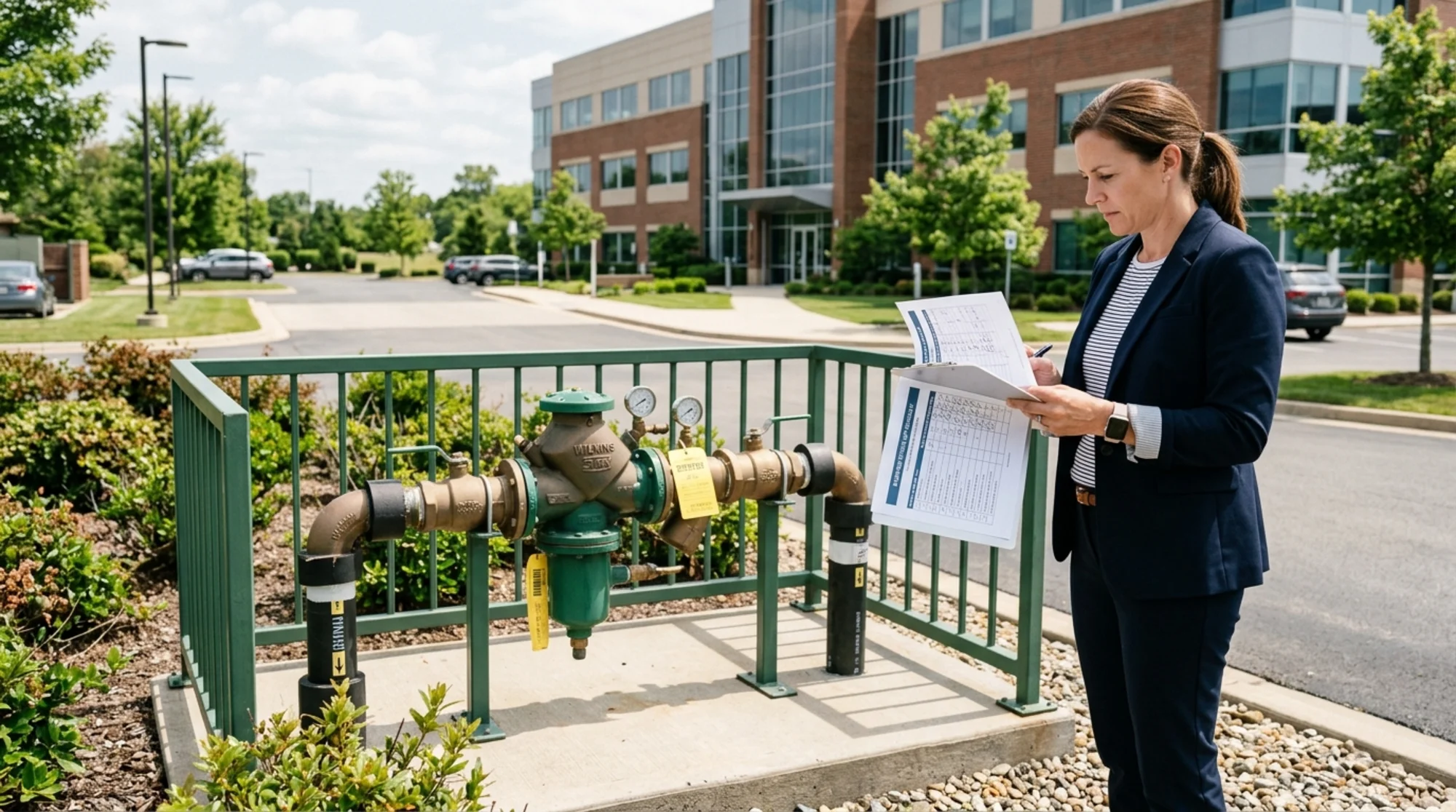
Property manager reviewing a printed backflow testing SOP checklist and annual compliance calendar beside an outdoor commercial backflow prevention assembly, natural daylight, realistic office park setting, no logos or text overlay
A lot of backflow compliance failures are not technical failures. They are handoff failures.
The assembly may have been tested, but:
- nobody confirmed the tester held the right credential,
- the report was incomplete,
- the utility never received it,
- the next due date was not tracked,
- or a failed assembly sat in limbo while everyone assumed someone else was handling repair and retest.
That is exactly the kind of mess an SOP is supposed to prevent.
A good SOP helps with five things:
- Ownership. It names who is responsible internally.
- Consistency. It gives every property the same basic workflow.
- Timing. It creates lead time before a deadline becomes urgent.
- Documentation. It keeps reports, credentials, and follow-up records together.
- Escalation. It tells the team what to do when a test fails or a report gets rejected.
If you manage more than one site, pair this article with how to schedule backflow testing for multiple properties. If you are still building your deadline system, how to create a backflow compliance calendar for your business is the companion piece.
What your SOP should cover
Do not overcomplicate it. For most property teams, the SOP only needs a few sections.
1. Purpose and scope
Define which properties, assemblies, and staff the SOP applies to. For example, it may cover domestic, irrigation, and fire-related assemblies across all managed properties, or only the assets your team directly controls.
2. Assembly register
Keep one live list with:
- property name and address,
- utility or jurisdiction,
- assembly location,
- assembly type and size,
- service type, such as domestic, irrigation, or fire,
- make, model, and serial number if available,
- last passing test date,
- expected next due date,
- preferred tester or vendor,
- and where the latest report is stored.
This matters because utilities track compliance by the actual protected connection, not by your memory of what happened last year.
3. Tester qualification check
Your SOP should require staff to confirm the tester fits the jurisdiction before booking the job. That can mean Washington BAT certification, a TCEQ BPAT license, local utility approval, or another program-specific credential.
4. Scheduling cadence
Set standard lead times. A practical starting point is:
- 60 days before due: review assembly register and request scheduling windows.
- 30 days before due: confirm vendor, access plan, and prior paperwork.
- 7 days before test: confirm gates, rooms, shutoff access, and on-site contact.
- 2 business days after test: confirm report submission and file the final documents.
5. Failed-test procedure
The SOP should tell staff what happens if the assembly does not pass. That usually means opening a repair task immediately, assigning an owner, scheduling retest, and tracking the utility-facing deadline until a passing result is on file.
6. Document retention
Washington DOH and utilities like Seattle and Philadelphia make it obvious that paperwork is part of compliance, not an optional extra. Your SOP should specify where to save:
- completed test reports,
- tester credentials if needed,
- calibration documentation when relevant,
- repair invoices,
- retest reports,
- utility notices,
- and proof of submission or acceptance.
For local provider search and program context, keep a few quick links in the SOP too. Internal references like Austin, Philadelphia, Seattle, the Austin Water backflow testing program, the Philadelphia Water Department backflow testing program, and the FAQs page are useful shortcuts for staff.
Copy-paste SOP template for 2026
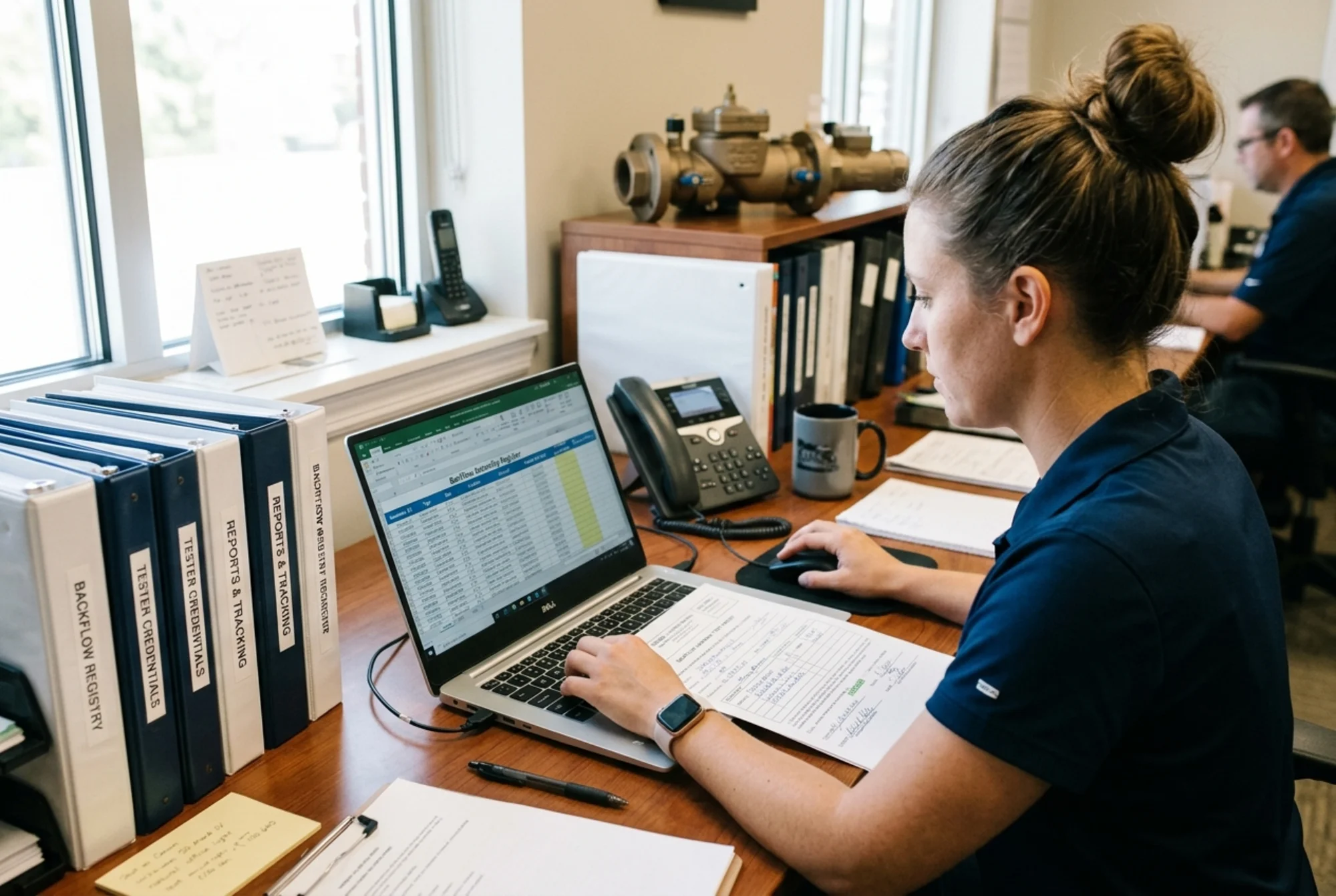 Operations coordinator updating a backflow assembly register, tester credential check, and report-tracking workflow on a laptop with organized binders and a completed field test report on a desk, natural office lighting, no logos or text overlay
Use this as a starting point and adapt it to each property or portfolio.
SOP title
Backflow Testing and Compliance SOP
Purpose
To ensure all required backflow prevention assemblies are tested on time, documented correctly, and returned to compliant status when failures occur.
Scope
Applies to all managed properties with domestic, irrigation, or fire-related backflow assemblies that require testing, report submission, repair follow-up, or compliance recordkeeping.
Responsible roles
- Property manager: overall owner of compliance status.
- Facilities or maintenance lead: confirms access, assembly location, and site readiness.
- Administrative coordinator: tracks due dates, files reports, and checks submission status.
- Approved tester or vendor: performs testing, provides required documentation, and submits reports where required.
Procedure
Maintain the assembly register
- Update the register whenever an assembly is added, replaced, relocated, or newly discovered.
- Review the register monthly for upcoming due dates.
Verify the tester before booking
- Confirm the tester holds the required state or local credential.
- Confirm the tester can handle the assembly type and service type on site.
- Confirm who submits the report and how submission is documented.
Schedule early
- Start outreach at least 60 days before the expected due date.
- Leave enough time for repairs and retests if the assembly fails.
Prepare the site
- Confirm access to gates, vaults, mechanical rooms, and shutoff points.
- Notify tenants or occupants if water interruption is possible.
- Pull the prior report, serial details, and utility notice if one exists.
Close the loop after the visit
- Collect the completed report.
- Confirm whether the result was pass or fail.
- Confirm whether the tester submitted the report directly.
- Save the report and update the register with the new status.
Escalate failed tests immediately
- Open a repair task the same day.
- Assign the owner for repair approval and retest scheduling.
- Track the issue until a passing result is submitted and saved.
Store records in one place
- Save reports, repair invoices, retests, and utility correspondence in the same property file.
- Keep naming consistent so future managers can find the full history quickly.
Review cadence
Review the SOP at least annually and any time a utility program, vendor process, or internal team structure changes.
That template is intentionally simple. Most property teams do better with a short SOP that gets followed than a perfect SOP that nobody opens.
The two places most SOPs break
The first weak spot is credential drift. Someone uses the same vendor as last year without checking whether that tester still meets the local program requirements.
The second weak spot is false completion. The team marks the job done because the appointment happened, even though the report was incomplete, missing, or never confirmed as submitted.
Seattle’s process is a useful warning sign here. It explicitly says test reports cannot be submitted without tester certification and test kit calibration information already in the system. Philadelphia’s program also shows how formal the paperwork side can get, with approved assemblies, technician lists, and dedicated forms. If your SOP does not include a document checkpoint, it is incomplete.
That is why the cleanest internal rule is this: a backflow test is not complete until the report is accepted, stored, and the next due cycle is updated.
Failed-test escalation workflow
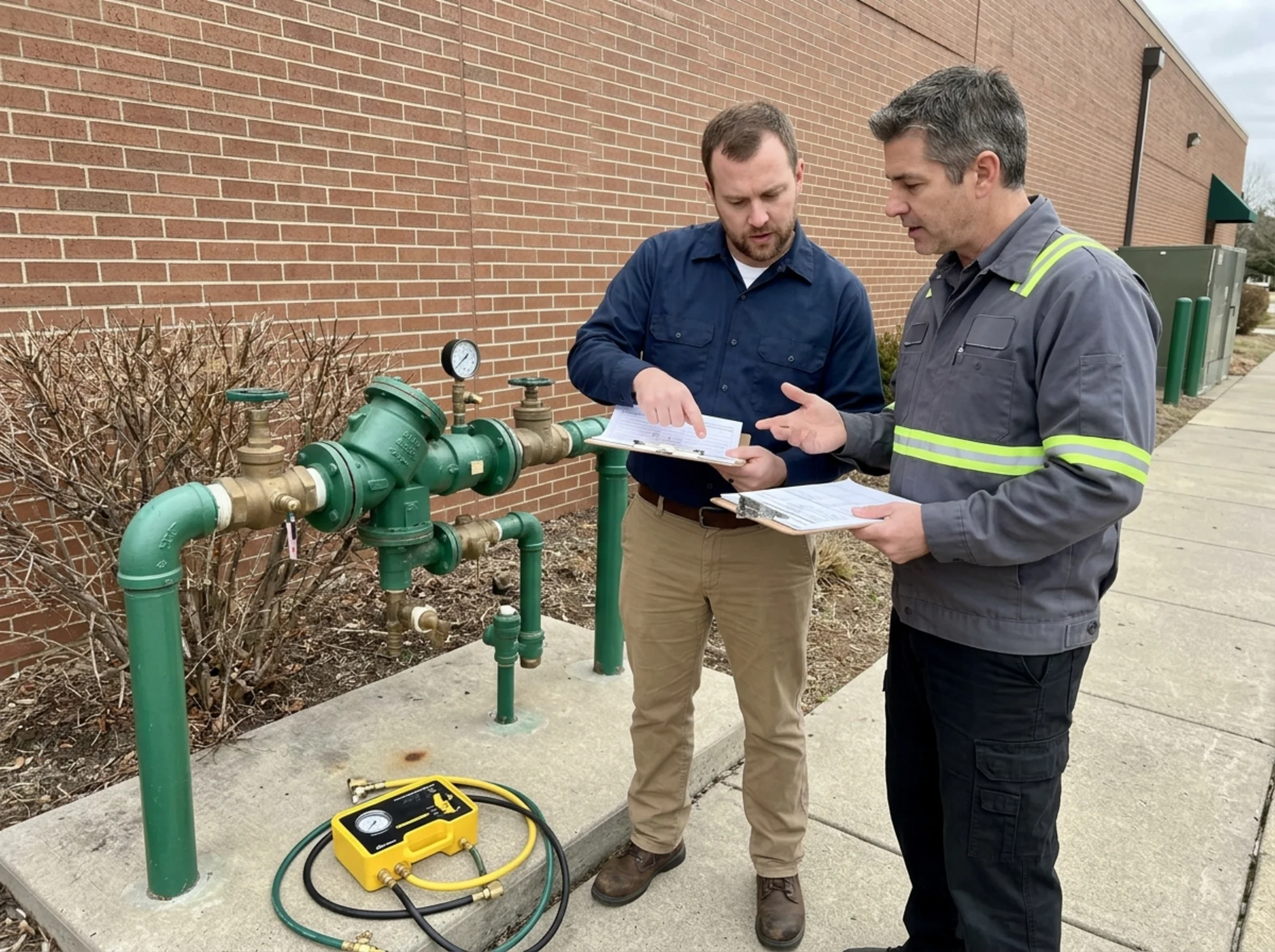 Property manager and certified backflow tester reviewing a failed test report, repair quote, and retest action plan beside a service entrance assembly, realistic documentary style, natural daylight, no logos or text overlay
A failed assembly is where panic usually starts. Your SOP should remove most of that panic.
A practical escalation path looks like this:
- Same day: log the failure, collect the report, and identify whether water service, tenant operations, or a utility deadline is at risk.
- Within 1 business day: assign repair responsibility and request the repair plan or quote.
- As soon as feasible: schedule repair and retest, not just repair.
- After retest: confirm the passing result was submitted and filed.
- Final closeout: update the assembly register and archive all related records together.
If you manage properties with a lot of moving parts, this is also where city and utility pages help. Teams can quickly jump from the market pages for Austin, Philadelphia, or Seattle into utility-specific guidance without digging through old emails.
Bottom line
A property manager’s backflow SOP does not need to be fancy. It needs to answer a few practical questions every time:
- What assembly is due?
- Who is allowed to test it?
- When are we scheduling it?
- Who confirms the report was submitted?
- What happens if it fails?
- Where does the paperwork live after that?
If your team can answer those questions the same way every time, you are already ahead of most avoidable compliance problems.
If you still need a provider, start by checking local directories, comparing utility program expectations, and lining up a tester before the next notice forces the schedule.
Sources
This article references guidance and regulations from authoritative sources including:
- U.S. Environmental Protection Agency (EPA) - Overview of the Safe Drinking Water Act
- American Water Works Association (AWWA) - Cross-Connection Control and Backflow Prevention resources
- Washington State Department of Health - Cross-Connection Control and Backflow Prevention
- Seattle Public Utilities - Backflow Assembly Testing
- Philadelphia Water Department - Cross-Connection & Backflow Compliance
- Texas Commission on Environmental Quality (TCEQ) - Backflow Prevention Assembly Tester Information and Requirements
- Centers for Disease Control and Prevention (CDC) - Preventing Drinking Water-Related Illnesses
Last updated: May 7, 2026