Oregon Backflow Testing Laws: Portland Water Bureau Compliance
Oregon Backflow Testing Laws: Portland Water Bureau Compliance Explained
If you own a commercial building, run an irrigation system, or manage property in Oregon, there's a good chance you're on the hook for annual backflow testing. It's one of those rules that catches people off guard, usually right when a notice shows up in the mail with a deadline attached. The good news is that Oregon's backflow rules are pretty clear once you know where to look. The bad news is that the details vary by water provider, and Portland does things a little differently than the rest of the state.
Here's a plain-English breakdown of what Oregon requires, how the Portland Water Bureau handles it, and what you need to do to stay compliant.
Why Backflow Testing Exists in the First Place
Backflow is when water flows backward through your plumbing, the opposite direction it's supposed to go. Normally water pushes from the public main into your building. But if pressure drops in the main (say a water line breaks, or a fire hydrant gets opened nearby) water can get sucked back out of your property and into the public supply.
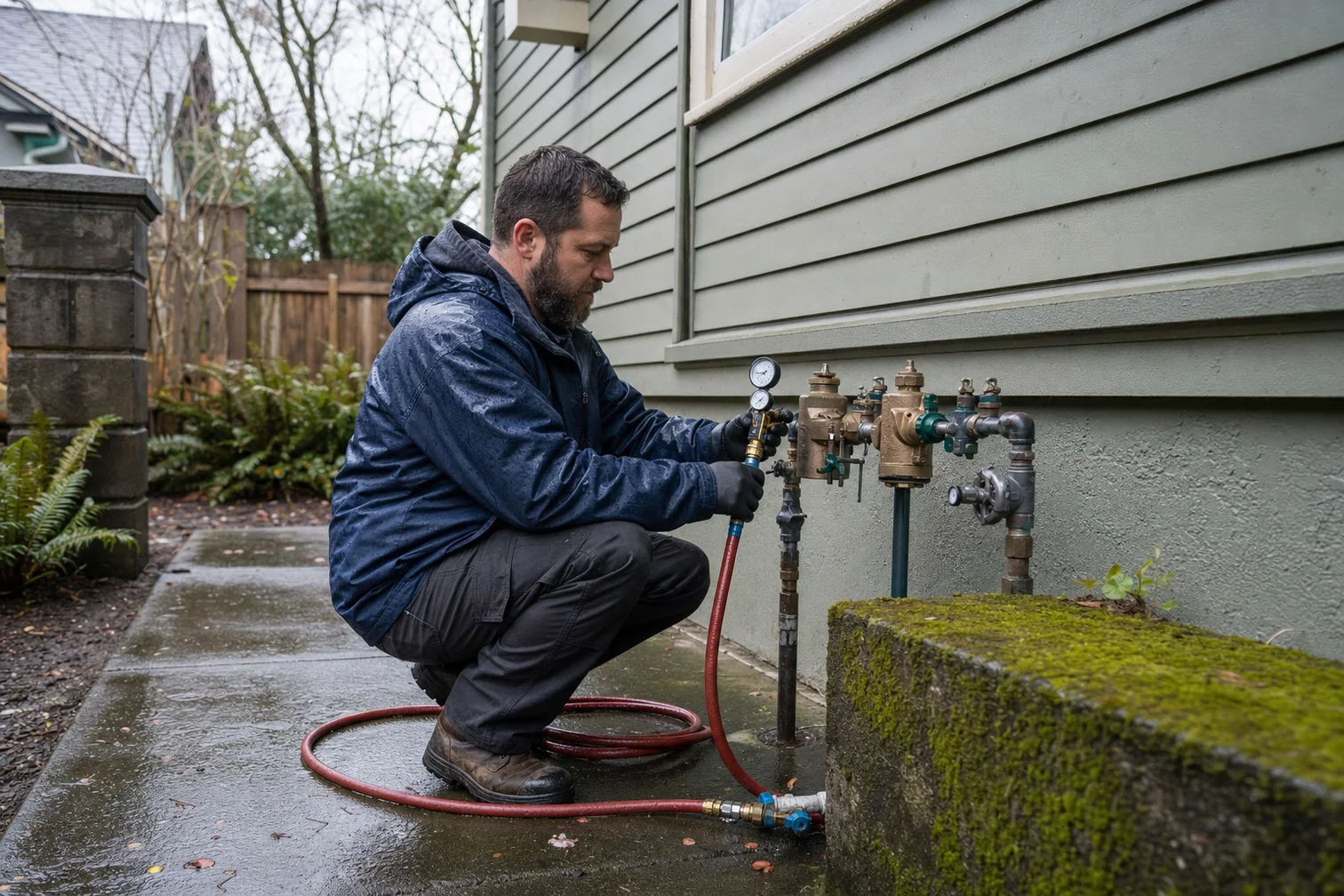
 Backflow preventer assembly installed outside residential property
That's a problem when your property has things the public shouldn't drink: lawn fertilizer in an irrigation line, chemicals in a boiler, soap in a commercial dishwasher, or worse. A backflow prevention assembly is the mechanical valve that stops that reverse flow. And because it's a mechanical device with springs and seals that wear out, the state requires it to be tested every year to prove it still works.
That annual test is the part that trips people up. Installing the device once isn't enough. Oregon wants documented proof, every single year, that your assembly still does its job.
What Oregon State Law Requires
Oregon's backflow rules live in two main places. The Oregon Health Authority (OHA) Drinking Water Services program sets the statewide framework under Oregon Administrative Rules (OAR) Chapter 333, Division 61. The plumbing side, covering how assemblies get installed, falls under the Oregon Plumbing Specialty Code.
The key points that apply to nearly everyone:
- Annual testing is mandatory. Any backflow prevention assembly protecting the public water system has to be tested at least once a year, and right after any installation, repair, or relocation.
- Only certified testers can do it. Oregon requires backflow testing to be performed by someone holding a current Backflow Assembly Tester certification. This isn't a plumber's general license, it's a specific certification issued through OHA's program.
- Results have to be reported. The test report goes to your water provider, not just kept in a drawer. If the provider doesn't get it, you're considered non-compliant even if the device passed.
- Failed devices must be fixed fast. If an assembly fails the test, it has to be repaired or replaced and retested, usually within a short window your provider sets.
The state sets the floor. Your local water provider, Portland Water Bureau in this case, runs the actual program and can be stricter on timing and paperwork.
How the Portland Water Bureau Runs Its Cross-Connection Program
If your water comes from the Portland Water Bureau (PWB), your backflow assemblies fall under the Bureau's Cross-Connection Control program. PWB serves Portland proper plus a number of wholesale customers, and it takes this program seriously because Portland's drinking water comes largely from the protected Bull Run watershed. Keeping that supply clean downstream is the whole point.
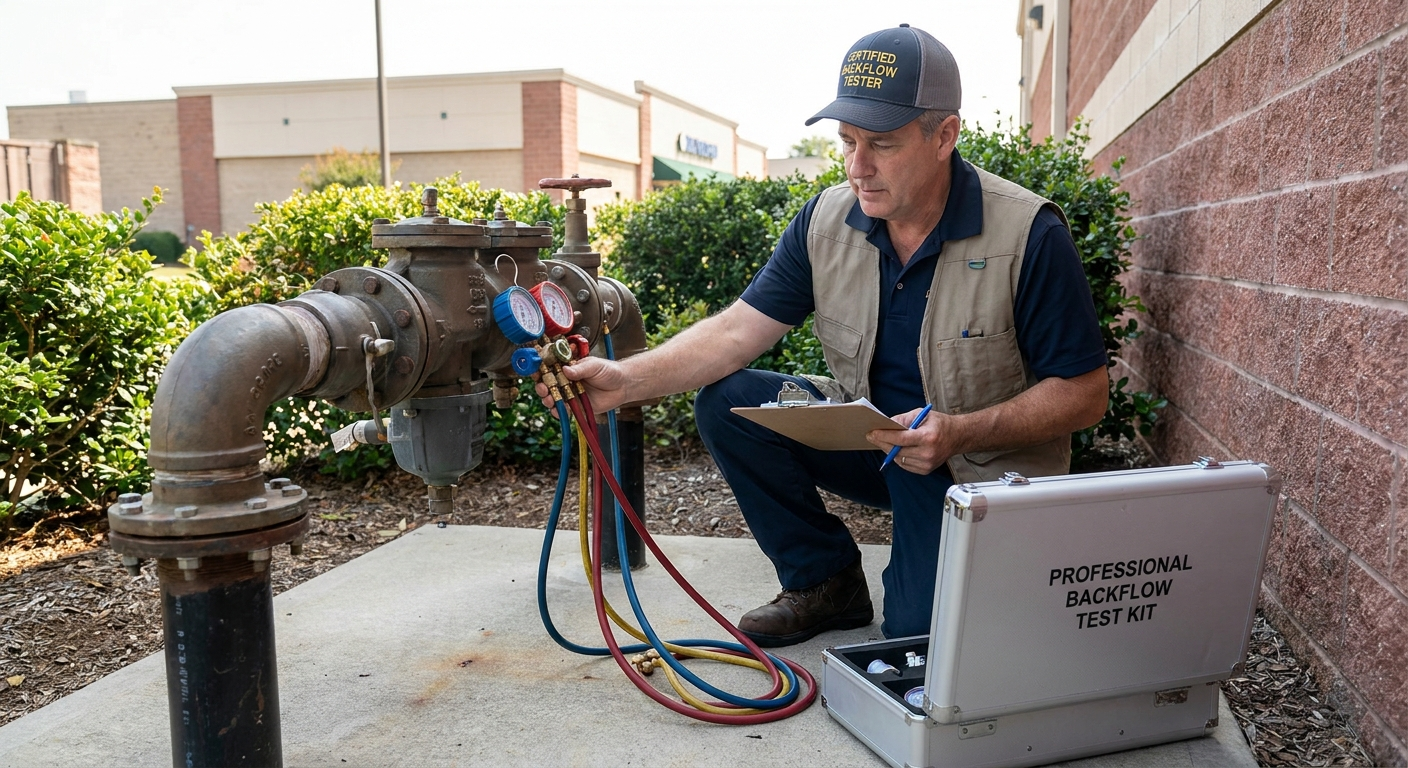
 Certified tester inspecting backflow prevention device during annual test
Here's how PWB's process actually works for a typical property owner.
You get a notice. PWB tracks which properties have backflow assemblies on file. When your annual test is coming due, they send a notice listing the device, its location, and the deadline. If you've got an irrigation system, a fire sprinkler line, or a commercial process connection, you very likely have one or more assemblies on record.
You hire a certified tester. You're responsible for arranging and paying for the test. PWB doesn't send their own crew to test private assemblies. You bring in an Oregon-certified Backflow Assembly Tester, they run the test on a calibrated gauge, and they fill out the official test report.
The report gets submitted to PWB. This is the step people forget. The completed test report has to reach the Water Bureau by the deadline. Many testers submit it on your behalf, but it's ultimately the property owner's responsibility to confirm it was filed. PWB has moved toward electronic submission, so a good tester will usually handle this electronically and give you a copy.
You keep proof. Hold onto your copy of the passing report. If there's ever a dispute about whether you complied, that report is your evidence.
PWB generally expects the test to happen on or before the anniversary date of your assembly, and they'll follow up if a report doesn't arrive. Miss it long enough and you move into enforcement.
Who Actually Needs a Backflow Assembly
Not every home in Portland has a backflow device, but more properties do than people realize. You almost certainly need one if you have:
- An in-ground irrigation or sprinkler system. This is the single most common reason residential properties get pulled into the program. The instant you tie an irrigation system into the potable supply, you create a cross-connection that needs protection.
- A fire suppression sprinkler system. Commercial buildings and many multifamily properties have these, and the assemblies protecting them need annual testing too.
- Commercial or industrial process equipment. Boilers, cooling towers, commercial kitchens, car washes, medical and dental offices, photo labs, and similar operations all create hazards that require protection.
- A well or auxiliary water source on the same property. If you have any alternate water supply, providers treat that as a high hazard.
If you're not sure whether you have an assembly on file, you can contact PWB's Cross-Connection program directly and ask. They keep the records.
Common Backflow Assembly Types You'll See
When your tester shows up, they'll be working on one of a few standard device types. Knowing the names helps you understand your paperwork:
- Reduced Pressure Principle Assembly (RP or RPZ). The highest level of protection, used for high-hazard connections like commercial process water and irrigation systems with chemical injection.
- Double Check Valve Assembly (DCVA). Used for lower-hazard connections, common on fire sprinkler lines and basic irrigation.
- Pressure Vacuum Breaker (PVB). A common, cost-effective choice for irrigation systems.
Each of these gets tested differently, but all of them need that annual certified test. Your test report will list the type, make, model, and serial number of your specific device.
What Testing Actually Costs and How Long It Takes
A standard annual backflow test in the Portland area usually runs somewhere in the range of $75 to $150 per assembly for residential and light commercial devices, though prices vary by tester and how many devices you have. The test itself is quick, often 20 to 30 minutes per assembly once the tester is on site. They'll shut your water briefly, attach a calibrated test kit, run through the readings, and record the result.
If your device passes, you're done for the year. If it fails, you'll need repairs or a replacement assembly, then a retest, and that's where costs climb. Worn rubber seals and springs are the usual culprits, and on older assemblies a repair kit is often cheaper than a full replacement.
What Happens If You Miss the Deadline
Ignoring a backflow notice is a bad idea in Oregon. Water providers, including PWB, have the authority under state rule to enforce compliance, and the ultimate enforcement tool is water shutoff. They generally don't jump straight to that, you'll get notices and reminders first, but a property that stays out of compliance long enough can have service interrupted until a passing test is on file.
Beyond the shutoff risk, there's liability. If your untested assembly fails and contaminates the public supply, you could be looking at far more than a testing fee. Annual testing is cheap insurance against a very expensive problem.
The fix if you've fallen behind is simple: hire a certified tester now, get the assembly tested, and make sure the report reaches your provider. Most providers will clear your account as soon as a passing report is filed.
Staying Ahead of It Year to Year
The easiest way to handle backflow compliance is to stop treating it as a surprise. Put your assembly's anniversary date on a calendar. Build a relationship with one certified tester who keeps your device records and reminds you when the next test is due. Many testers offer annual reminder service and will file your report electronically with PWB, which takes the paperwork worry off your plate entirely.
If you manage multiple properties or multiple assemblies, that reminder system matters even more, because each device has its own due date and its own report.
Sources
- Oregon Health Authority, Drinking Water Services - Cross Connection and Backflow
- Oregon Administrative Rules, Chapter 333, Division 61 - Public Water Systems
- Portland Water Bureau - Cross-Connection and Backflow Prevention
- EPA - Cross-Connection Control Manual
- American Water Works Association (AWWA) - Cross-Connection Control
Backflow testing doesn't have to be a headache, but it does have to get done, on time, by someone certified. If you're in Portland or anywhere in Oregon and your annual test is coming due, FindBackflowTesters.com makes it easy to find a certified backflow assembly tester near you who knows the local rules and can file your report directly with your water provider. Search your area, compare testers, and get your assembly tested before the deadline catches up with you.
Need a compliance test filed?
Tell us your service type and property details so we can help route the request to backflow testers near you.