Irrigation Backflow Prevention 2026: Assemblies, Codes & Compliance Guide
Why Irrigation Systems Need Backflow Prevention
Irrigation systems are one of the most common — and most overlooked — sources of contamination risk in a building's potable water supply. The moment you connect a sprinkler line to your drinking water, you create a cross-connection. Fertilizers, pesticides, pet waste, soil bacteria, and stagnant water in buried pipes are all sitting at the other end of that connection, waiting for a pressure drop to pull them backward into the lines that supply your kitchen sink.
That pressure drop happens more often than people think. A water main break down the street, a fire hydrant flushing nearby, or even a major draw from an upstream user can briefly reverse flow in your service line. Without a working backflow preventer, garden chemistry ends up in drinking water. This is why nearly every municipality in the United States — and most of Canada — requires an approved backflow assembly on any irrigation system tied to a potable supply, with annual testing by a certified tester.
This guide walks through what irrigation backflow prevention actually involves in 2026: the assembly types you'll encounter, how to choose one, what installation looks like, and how to stay compliant without paying more than you need to.
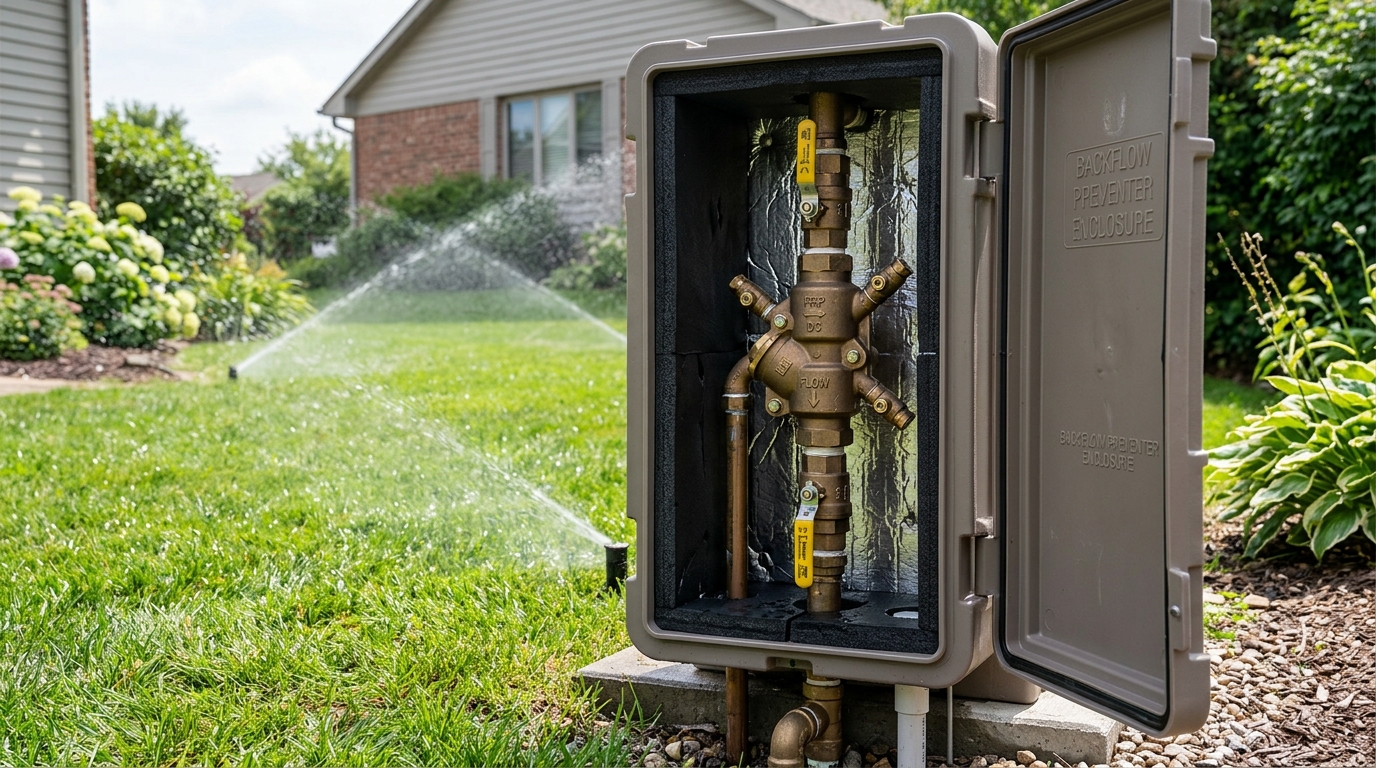
 A brass double-check valve assembly mounted vertically inside an above-ground insulated enclosure next to a residential lawn
The Two Failure Modes You're Protecting Against
Every backflow scenario falls into one of two categories, and the distinction matters because it drives which assembly your local code requires.
Backsiphonage happens when upstream pressure drops and creates a vacuum. Imagine pulling soda through a straw — the same thing can happen in a city water main when a hydrant opens or a pump fails. If a sprinkler head is sitting in a puddle of pesticide runoff, that contaminated water gets pulled backward into your service line. Backsiphonage is the more common irrigation hazard because sprinkler heads are routinely submerged or splattered with debris.
Backpressure is the opposite: downstream pressure exceeds supply pressure and pushes contaminated water upstream. This is less common in residential irrigation but shows up in systems with booster pumps, elevated reservoirs, or chemical injection setups (think large commercial properties with fertigation systems).
The hazard level of what's downstream also matters. Codes use two categories:
- Low hazard (non-health): plain water that may be aesthetically objectionable but won't make you sick — basically a clean lawn sprinkler with no chemicals.
- High hazard (health): water that could cause illness or death if ingested — anything with fertilizer injection, pesticide systems, reclaimed water, or sprinkler heads that contact animal waste.
Almost every jurisdiction now classifies irrigation as high hazard by default, because you can't realistically guarantee that no one will ever hook up a fertilizer injector or that a dog won't relieve itself near a sprinkler head. Plan for high-hazard requirements unless your local code explicitly says otherwise.
The Four Assembly Types You'll See
Four assembly types dominate the irrigation market. Each has a specific use case, and using the wrong one is the single most common compliance failure during inspections.
Pressure Vacuum Breaker (PVB)
A PVB protects against backsiphonage only — not backpressure. It must be installed at least 12 inches above the highest downstream sprinkler head or outlet, which is why you'll often see them on a riser sticking up above the lawn. They're affordable, easy to test, and approved for high-hazard residential irrigation in most jurisdictions.
Use when: standard residential lawn irrigation with no booster pump and no chemical injection.
Avoid when: the system has any backpressure source, or where freezing winters require burying the assembly (you can't bury a PVB).
Spill-Resistant Vacuum Breaker (SVB)
A modernized PVB designed not to dump water out the relief port during normal startup. Same protection profile (backsiphonage only), same elevation requirement, but cleaner operation for installations near patios or walkways where a discharge spray is unwelcome.
Use when: same situations as a PVB, but in locations where occasional discharge would be a nuisance.
Double Check Valve Assembly (DCVA / DC)
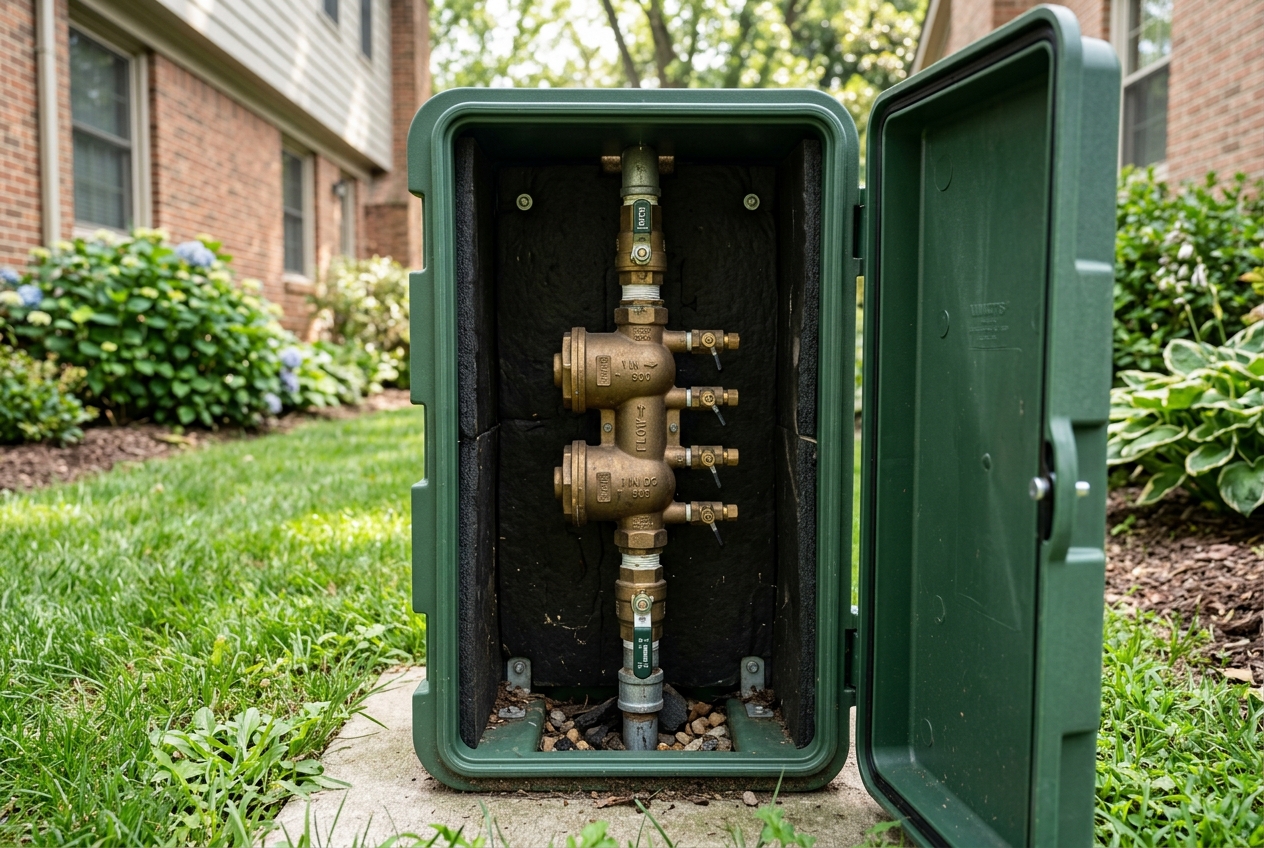
Two independent check valves in series with test cocks between them. Protects against both backsiphonage and backpressure, but only for low-hazard applications. Can be buried below grade in a vault, which makes it popular in cold climates.
Use when: your jurisdiction classifies irrigation as low hazard (rare in 2026) or for specific commercial systems where the inspector has approved a DC.
Avoid when: your local code requires RPZ for irrigation — increasingly the default.
Reduced Pressure Zone Assembly (RPZ / RP)
The gold standard for high-hazard protection. Two check valves separated by a differential pressure relief valve that physically dumps water to atmosphere if either check fails. An RPZ is the only assembly that creates an air gap under fault conditions, which is why it's required for fertigation, reclaimed water, and most modern commercial irrigation.
Use when: high-hazard irrigation, chemical injection, reclaimed water, or any system where local code mandates it.
Watch for: RPZs cannot be buried — they need an above-ground or vault installation with proper drainage for the relief port discharge, which can occasionally dump significant water.
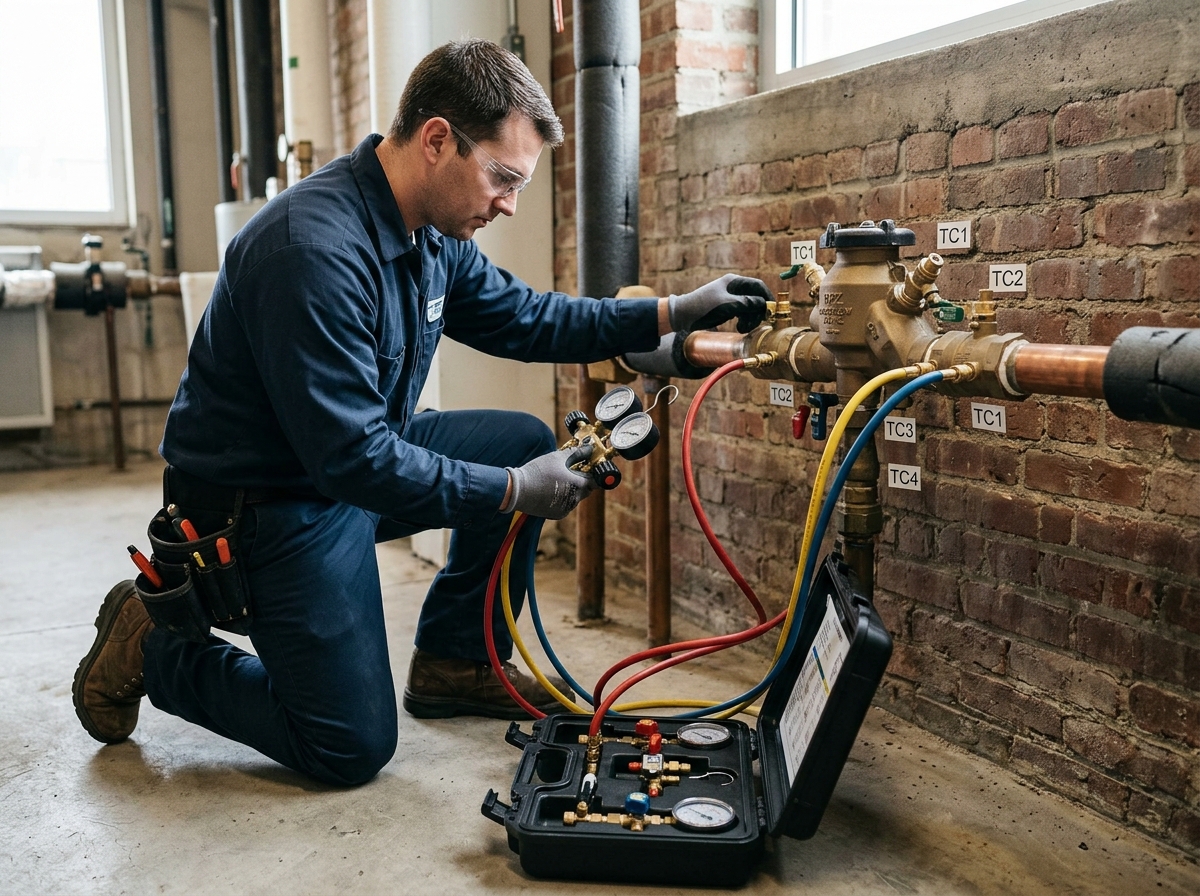 A technician kneeling beside an RPZ backflow assembly using a calibrated test kit with three color-coded hoses connected to the test cocks
Choosing the Right Assembly
Don't guess. The selection sequence is:
- Check your local code. Most water utilities publish a cross-connection control program document listing approved assembly types by application. This overrides anything you read online.
- Confirm the hazard classification. If irrigation is high hazard in your jurisdiction (it usually is), DCVAs are off the table.
- Account for site conditions. Freezing climate? PVB is risky unless you have a heated enclosure or a reliable winterization process. Buried vault available? RPZ needs drainage. Booster pump downstream? PVB and SVB are eliminated.
- Verify the model is on your state or province's approved list. USC Foundation (FCCCHR) and ASSE both maintain approval lists; most jurisdictions follow one or both. An unlisted assembly will fail inspection regardless of how well it works.
For a typical 2026 residential irrigation install in a temperate U.S. climate with high-hazard classification, you'll almost always end up with either an SVB on a riser or an RPZ in an insulated above-ground enclosure.
Installation: What Good Looks Like
Installation details are where most failures originate. A correctly specified assembly installed wrong is just as non-compliant as the wrong assembly.
Location. Install the assembly as close as practical to the water meter or service entrance, before any branch to the irrigation system. The shorter the unprotected run, the smaller the cross-connection risk.
Orientation. PVB and SVB must be installed vertically with the canopy up. RPZs are typically horizontal but check the manufacturer spec — some newer models allow vertical orientation. Wrong orientation is an automatic test failure.
Clearance. You need access to all test cocks and shutoff valves. Code typically requires 12 inches of clearance below an RPZ relief port (for drainage and inspection) and enough side clearance for a tester to swing a wrench. Buried in mulch behind a hedge is a guaranteed re-inspection.
Drainage for RPZs. The relief valve can discharge several gallons per minute under fault conditions. If that water can't drain freely, you'll flood whatever the assembly is sitting next to — basement, garage, mechanical room. Plan a floor drain, daylight discharge, or air-gapped drain line sized to the assembly's full discharge rate.
Freeze protection. In any climate with sustained freezing temperatures, plan for either:
- An insulated above-grade enclosure (look for ASSE 1060-rated enclosures with appropriate Class rating for your climate)
- A vault installation with a DC (if code allows)
- A full winterization protocol: drain the assembly, blow out the irrigation lines, and isolate the supply
A burst backflow assembly is one of the most expensive irrigation repairs you can have — replacement plus water damage plus emergency labor often runs $1,500 to $4,000.
Approved installer. Many jurisdictions require the assembly to be installed by a licensed plumber and tested by a certified backflow tester within 10 days of installation. These are often two different people. Confirm both before scheduling.
Annual Testing: What to Expect
Backflow assemblies have moving parts — springs, seats, diaphragms — that wear out. Annual testing is a code requirement in nearly every U.S. jurisdiction, and the tester submits results directly to your water utility.
A typical test takes 20 to 45 minutes and runs $35 to $150 depending on your market and assembly type. RPZ tests are slightly more involved than DC or PVB tests, which is reflected in price.
What the tester is verifying:
- Each check valve holds at minimum required differential (typically 1 psid)
- The relief valve (on an RPZ) opens at the correct differential
- The air inlet (on a PVB/SVB) opens before any check valve closes
- Shutoff valves seal completely
- No external leakage
If the assembly fails, repair or replacement is typically required within 30 days. Common failure points are debris in the check seats (caused by upstream pipe scale or post-construction sediment) and worn seat discs in older assemblies. A rebuild kit and an hour of labor usually fixes a failed unit; full replacement is needed for cracked bodies or obsolete models.
Keep your test reports. Some utilities send reminders; many don't. A missed test can result in fines, water service shutoff, or both. Set a calendar reminder 60 days before your annual deadline.
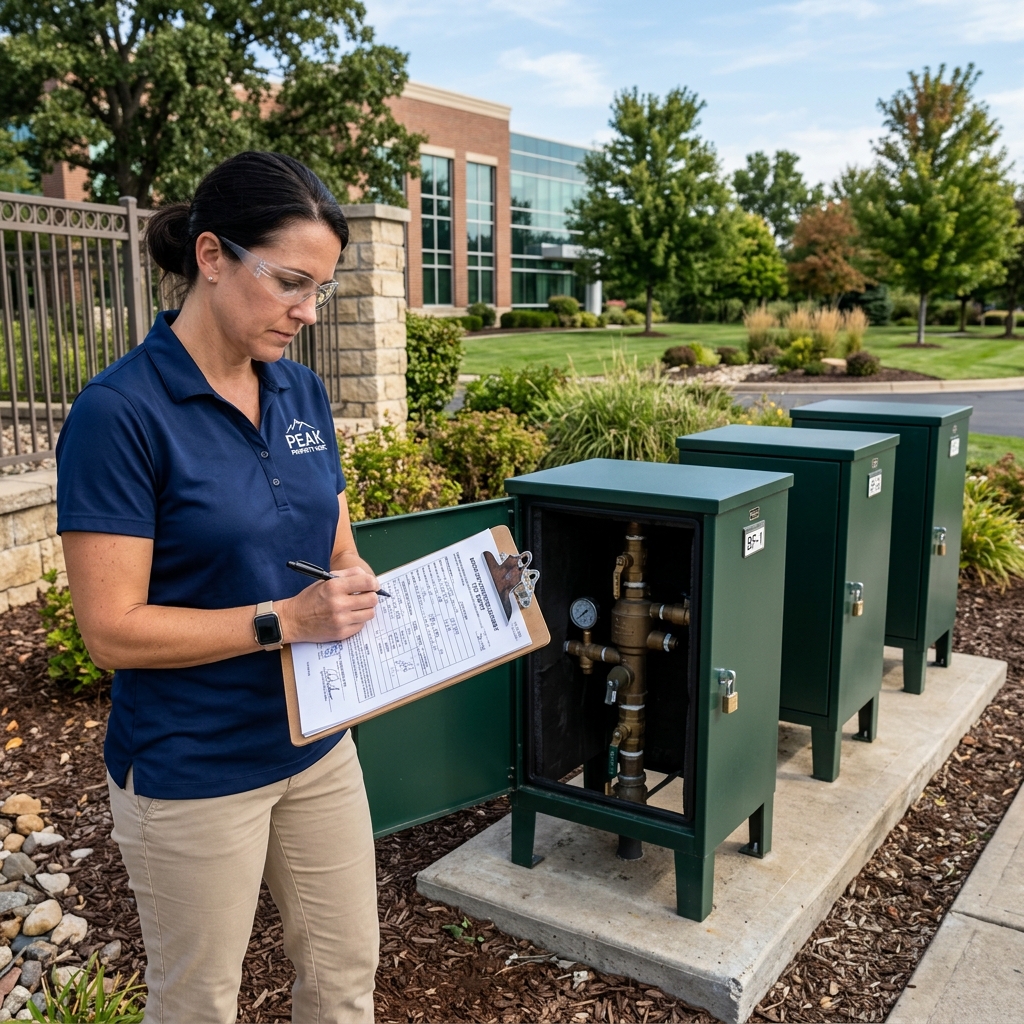 A property manager reviewing a clipboard test report next to a row of insulated backflow enclosures at the perimeter of a commercial landscaped property
Property Manager and Commercial Considerations
Multi-property operators have additional concerns beyond the single-assembly residential case.
Inventory tracking. If you manage more than a handful of properties, build a spreadsheet (or use a cross-connection management platform) with: address, assembly make/model, serial number, install date, last test date, next test due, hazard level, and tester contact. This is the single most useful operational tool in a multi-site portfolio.
Bulk testing contracts. Most certified testers will discount per-assembly pricing for portfolios of 10 or more. Lock in a multi-year agreement with consistent annual scheduling — same week each year — to avoid lapses.
Reclaimed water. If your property uses reclaimed or graywater for irrigation (increasingly common in drought-affected regions), you're automatically in the highest hazard category. RPZ is mandatory, and many jurisdictions also require dual-piping color codes (purple pipe) and additional signage.
Tenant separation. In multi-tenant commercial properties, decide whether you want a single master assembly protecting all irrigation or sub-meters with individual assemblies. Single master is cheaper but ties testing to building access; sub-meters give per-tenant accountability but multiply testing costs.
Construction projects. When landscape contractors do major renovations, debris frequently enters the irrigation lines and lodges in the backflow assembly check seats. Schedule a post-construction test after any significant irrigation work, separate from your annual compliance test.
Common Mistakes to Avoid
A short list of things I see fail inspections every season:
- Installing a DCVA where the code requires an RPZ. The assembly works; it just doesn't match the hazard rating.
- Burying an RPZ. The relief port needs atmospheric discharge — buried RPZs fail closed and silently lose protection.
- PVB installed below the highest sprinkler head. Common when landscape grade changes after the assembly is installed.
- Skipping the post-install test. Many jurisdictions consider an untested new assembly non-compliant from day one.
- Using a non-listed assembly purchased online. Even if it's mechanically identical to an approved model, "not on the list" means "fails inspection."
- Forgetting about isolation valves. The assembly's own shutoffs are part of the test — they must hold tight. Adding upstream isolation valves makes maintenance and winterization much easier.
Next Steps
If you're putting in new irrigation, start with your water utility's cross-connection control program document — it tells you exactly which assemblies are approved for your hazard class. Have a licensed plumber install the unit, schedule a certified tester within 10 days, and put the next year's test on your calendar before you finish reading the report.
If you already have an irrigation system and aren't sure when it was last tested, call your local water utility. They keep records of which assemblies are registered to your address and when the last passing test was filed. If it's been more than a year, book a test this week — most testers can come out within a few business days, and you'd rather pay $75 now than a fine plus a re-inspection later.
If you manage multiple properties, the next step is building or updating your assembly inventory and locking in a single tester (or testing company) for the whole portfolio. Consistent annual scheduling is the difference between a clean compliance record and a stack of overdue notices.
Backflow prevention on irrigation isn't complicated, but it is unforgiving — the rules are specific, the inspections are real, and the consequences of getting it wrong range from a failed test to genuine public health harm. Get the right assembly, install it correctly, and test it every year. That's the whole job.