How to Get Listed on FindBackflowTesters.com as a Provider
If you run a backflow testing business, getting listed on FindBackflowTesters.com is not just a marketing task. It is also a trust task. The providers who convert best are usually the ones whose listings make sense to both customers and compliance-driven buyers: property managers, facility teams, HOAs, and owners who need somebody qualified to handle a required test, submit paperwork correctly, and show up on time.
That is why the best way to approach your listing is not “how do I sound impressive.” It is “how do I present my business accurately, clearly, and in a way that lines up with how local utilities and regulators actually handle backflow work.”
If your business is already in the directory, you can claim it through the site’s claim page. If you are new, you can register a fresh listing or review the broader provider overview at For Providers. Either way, the goal is the same: make it easy for a serious customer to see who you are, where you work, and why they should trust you.
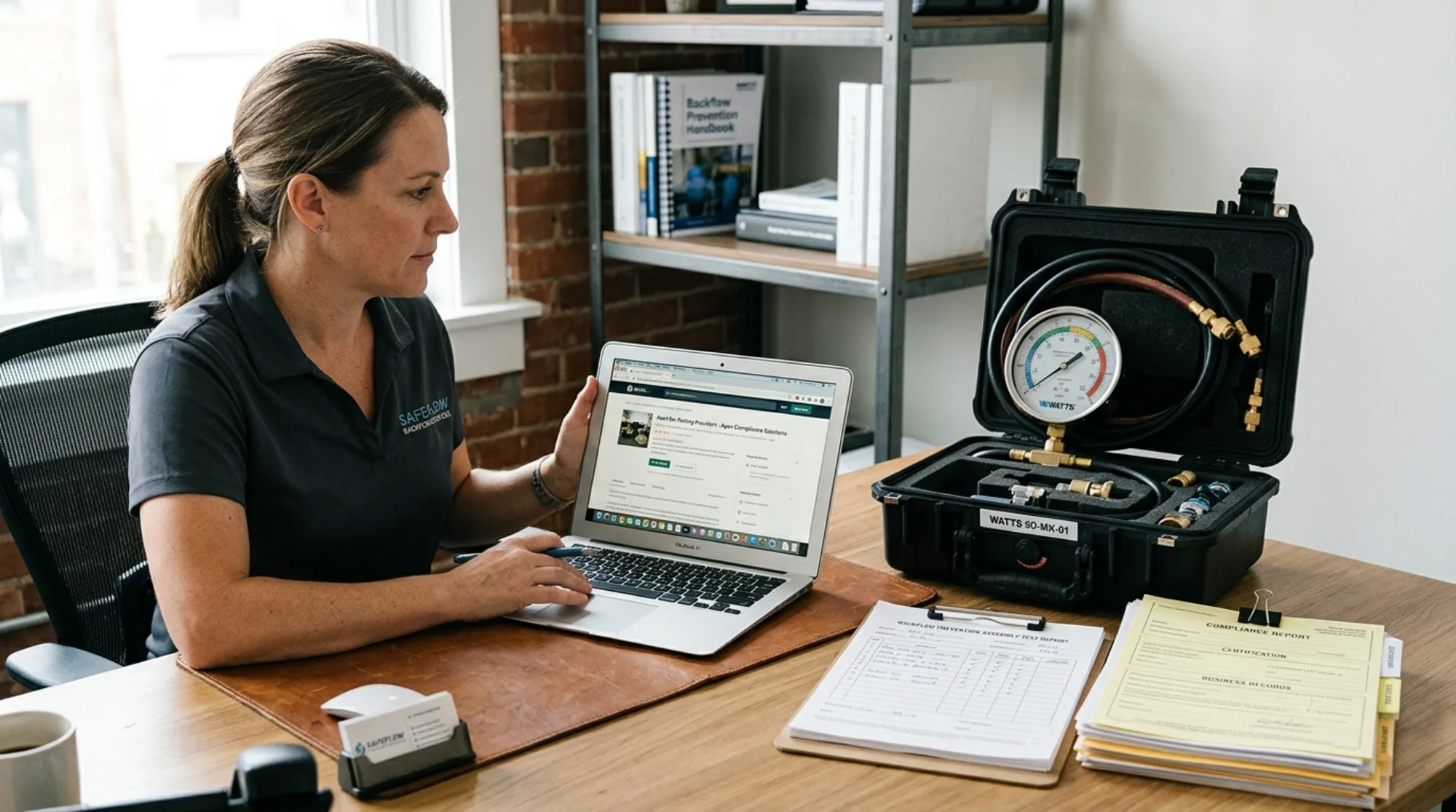
Backflow testing business owner reviewing a provider listing on a laptop beside a differential pressure gauge kit and neatly organized compliance paperwork
Step 1: Decide whether you should claim or register
FindBackflowTesters.com supports both paths.
If your company is already in the directory, the fastest route is to claim the existing listing. The site’s claim flow is built around searching by business name, identifying the correct provider record, and submitting the claim for review. If your business is not already listed, you can register a new listing instead.
From the live provider pages and claim flow, a few details matter right away:
- Existing businesses can search for and claim a listing.
- New providers can register a listing from the same general flow.
- New registrations are reviewed within 2 business days.
- Claimed profiles can add photos, service descriptions, licenses, and certifications.
- Providers can later upgrade for more visibility, but the first job is getting the basic listing accurate.
That accuracy matters because customers using the site are often not casual shoppers. Many are trying to solve a real compliance obligation, sometimes under a deadline. If you want a profile that converts, start with the exact business identity you use in the field, on invoices, and on utility paperwork.
Step 2: Gather the information a serious buyer actually needs
Before you submit anything, pull together the core information that reduces friction for both review and customer decision-making.
At minimum, that usually means:
- legal business name or doing-business-as name,
- contact name,
- email and phone number,
- service address or business address,
- cities, counties, or metro areas you actually serve,
- website if you have one,
- short service description,
- current certifications or licenses that are relevant to your markets,
- and any documentation you may want to reference in your profile.
This is where many provider listings go wrong. They are written like broad plumbing ads when the actual service being sold is narrower and more technical. Customers looking for backflow testing often want to know things like:
- Do you only test, or do you also repair and replace assemblies?
- Do you handle irrigation, commercial, industrial, or fire-line work?
- Do you understand local report submission requirements?
- Are you certified in the states or utility jurisdictions you are targeting?
A clear listing beats a vague one every time. If you only serve certain markets, say that. If you only handle domestic assemblies and not fire systems, say that. If you specialize in commercial compliance work, say that too.
Step 3: Present credentials the same way regulators and utilities think about them
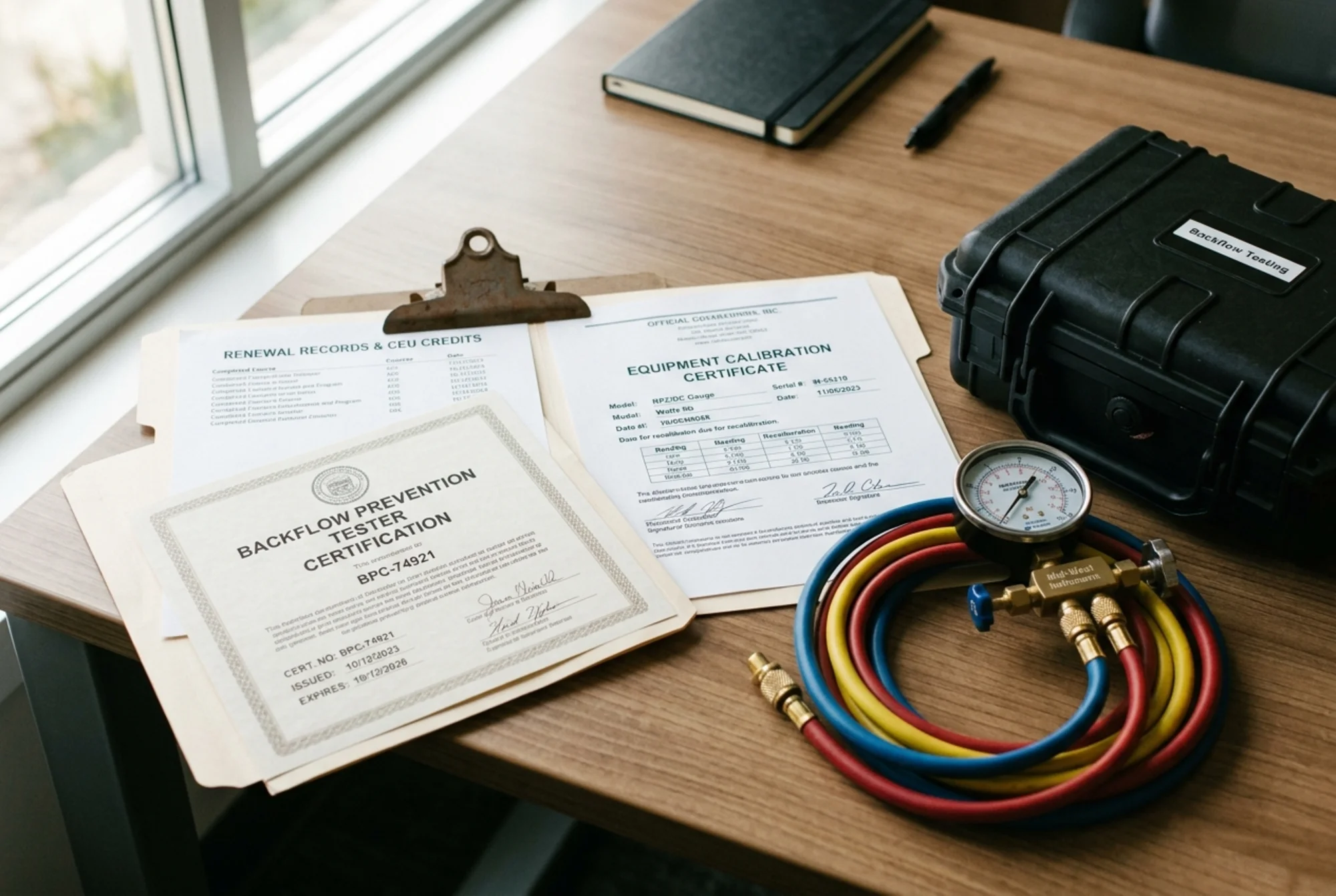 Close-up of a provider desk with certification documents, renewal records, a calibration certificate, and a backflow test kit ready for a profile update
This is the most important part of the whole process.
Utilities and regulators do not think in generic marketing language. They think in terms of approved testers, valid credentials, report content, and whether the person doing the work is authorized in that jurisdiction.
A few official examples make that clear:
- The Texas Commission on Environmental Quality says a person who repairs or tests the installation or operation of backflow prevention assemblies must hold a TCEQ-issued license, and it lays out specific BPAT education, training, exam, and continuing-education requirements.
- The Washington State Department of Health publishes specific rules for Backflow Assembly Tester duties and field test report content, along with supporting forms and guidance.
- The Philadelphia Water Department publishes lists for city-certified backflow prevention technicians, approved assemblies, and official forms tied to compliance activity.
- The EPA explains the public-health framework behind drinking-water protection under the Safe Drinking Water Act, which is the broader reason these local programs exist in the first place.
So when you fill out your listing, do not just say “licensed and certified” unless you can back that up in the markets you serve. Be more precise.
A stronger approach looks like this:
- list the states or jurisdictions where you actively hold valid credentials,
- mention the kind of work you are authorized to perform,
- keep renewal status current,
- and avoid claiming coverage in places where you do not meet the local standard.
If you work across multiple cities or states, this matters even more. A provider might be properly credentialed for one state’s testing requirements and still need a different approval path somewhere else. Customers comparing providers in Austin, TX, Philadelphia, PA, or Seattle, WA are not all operating under the same exact program rules.
That is also why official program pages are worth reviewing before you write your profile copy. For example, the local program pages for Austin Water backflow testing and the Philadelphia Water Department backflow testing program help show how location-specific these expectations can be.
Step 4: Complete the profile like you want to be hired, not just discovered
A listing that ranks or gets seen is only half the job. The second half is conversion.
FindBackflowTesters.com gives providers room to add the details that help customers trust the listing. Claimed profiles can include things like:
- logo and business photos,
- service descriptions,
- licenses and certifications,
- service area details,
- and profile information that helps distinguish one company from another.
This is where you should answer the questions a buyer is already thinking:
What kind of properties do you serve? Residential, multi-family, commercial, industrial, irrigation, or mixed?
What kind of assemblies do you work on? If you only test domestic assemblies and do not touch fire lines, be direct.
What happens after the test? If you can explain your reporting process, repair follow-up, or scheduling approach, that helps.
Do you understand compliance-sensitive clients? Property managers and facilities people want less drama, fewer missed deadlines, and cleaner documentation.
The tone should be factual, not inflated. A calm, specific profile often performs better than a salesy one because the people hiring backflow testers are usually solving a requirement, not browsing for entertainment.
If you want a good example of the kind of signals property owners care about, the site’s Learning Center page on how to choose the right provider is a useful mirror. It shows the kinds of trust cues customers are already being taught to look for.
Step 5: Align your listing with your real service area
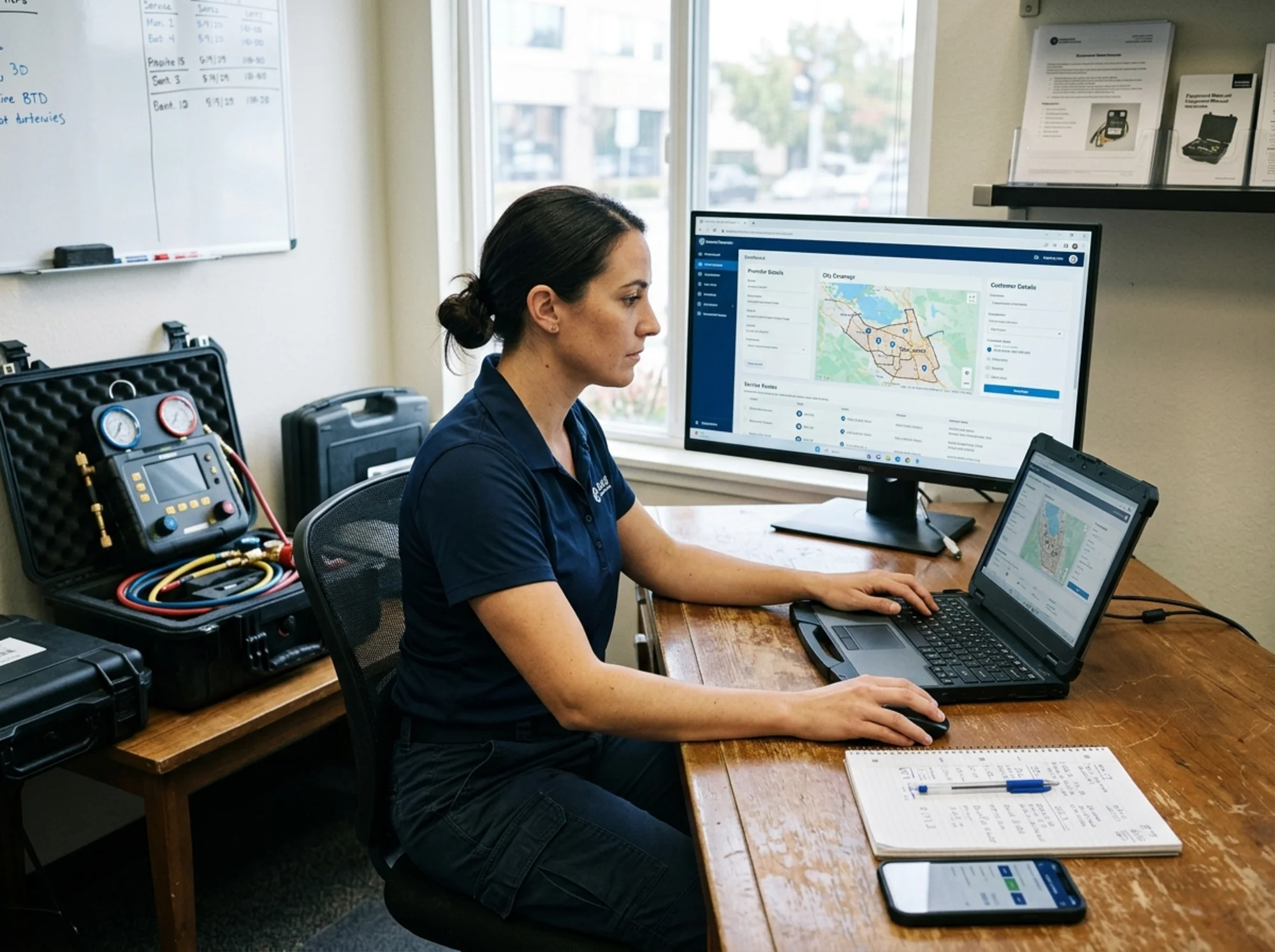 Provider updating city coverage, phone details, and profile information on a dashboard while planning service routes across nearby metro areas
One of the easiest ways to create bad leads is to overstate geography.
If you say you serve an entire state but in practice only work one metro and a few nearby suburbs, your listing should reflect that. Overbroad coverage can create:
- calls from areas you do not actually service,
- lower close rates,
- frustrated property managers on tight timelines,
- and a weaker trust signal if customers discover the mismatch quickly.
A tighter service area usually produces better leads. It also helps the directory make more sense to users who are browsing local pages and utility-program content.
For many providers, the right move is to start with the cities and metros you can confidently cover, then expand later once the listing, response process, and lead handling are working well.
Step 6: Treat your listing as an ongoing compliance asset
The mistake is thinking the listing is done the day it goes live.
In reality, your listing should be maintained the same way you maintain other trust-critical business records. Update it when:
- a certification is renewed,
- a credential lapses or changes,
- your service area expands or contracts,
- your phone, email, or office changes,
- you add repair or replacement capabilities,
- or you stop offering a category of work.
That keeps the listing aligned with reality, and reality matters here. CDC guidance around drinking-water safety is aimed at the public side of the equation, but the operating principle is still relevant for providers: water-safety work depends on reliable systems, current information, and fewer weak links.
If you are using the directory as a long-term lead channel, maintenance is part of the ROI. A claimed profile that stays current is more useful than one that was “optimized” once and then neglected.
What not to do when submitting your listing
A few quick red flags are worth avoiding:
- Do not claim credentials vaguely. Name the relevant certification or license accurately.
- Do not overstate your territory. Better to be credible in fewer markets than misleading in many.
- Do not describe yourself as a full-scope provider if you subcontract key work. Be clear.
- Do not ignore local program differences. Utility requirements are not identical everywhere.
- Do not leave the profile half-finished. Incomplete listings look less trustworthy.
If you want the customer-facing version of these concerns, the site’s FAQs and Learning Center content are worth reviewing before you write the final copy.
Bottom line
The fastest way to get listed on FindBackflowTesters.com is simple: claim your existing listing if it is already there, or register a new one if it is not. But the best way to get listed is to do it with the same discipline you bring to compliance work.
Use your real business identity. Describe your real service area. Present credentials precisely. Complete the profile fully. Then keep it current.
That approach is better for review, better for customers, and better for the kind of trust-based lead generation that backflow testing businesses actually need.
Sources
This article references guidance and regulations from authoritative sources including:
- U.S. Environmental Protection Agency (EPA) - Overview of the Safe Drinking Water Act
- American Water Works Association (AWWA) - Cross-Connection Control and Backflow Prevention resources
- Texas Commission on Environmental Quality (TCEQ) - Occupational Licenses: Backflow Prevention Assembly Tester (BPAT)
- Washington State Department of Health - Cross-Connection Control and Backflow Prevention
- Philadelphia Water Department - Cross-Connection & Backflow Compliance
- Centers for Disease Control and Prevention (CDC) - Preventing Drinking Water-Related Illnesses
Last updated: May 8, 2026