How to Choose a Certified Backflow Tester: Complete Vetting Guide
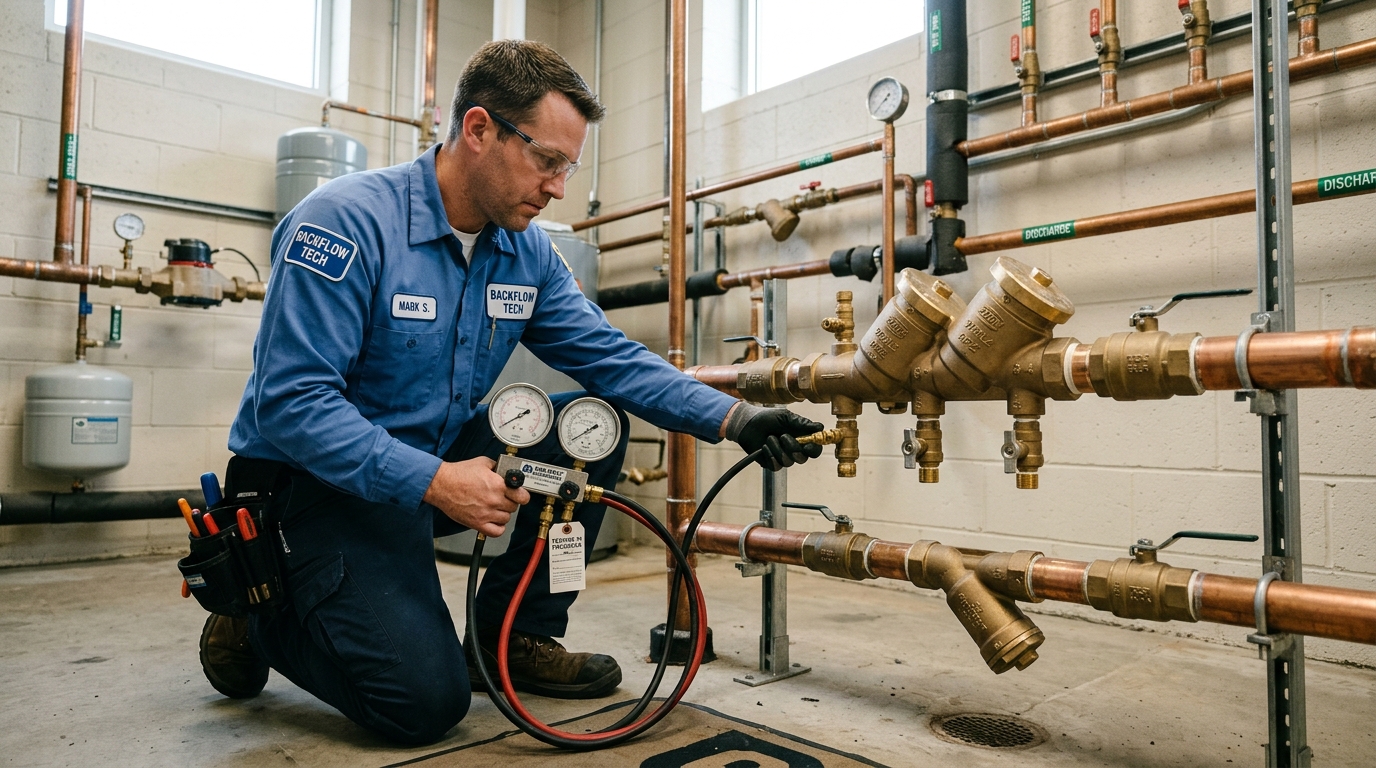
Why Choosing the Right Backflow Tester Matters
Your backflow preventer is the single device standing between contaminated water and your drinking supply. When it fails, fertilizer, boiler chemicals, irrigation runoff, or industrial fluids can siphon backward into the potable system serving your home, building, or the wider municipal grid. That is why nearly every water purveyor in the United States and Canada now requires annual testing by a certified professional, with the report filed directly to the utility.
The catch is that "certified backflow tester" means something different in nearly every jurisdiction. A tester licensed in one county may not be allowed to sign off on a device three miles away across a city line. Test gauges must be calibrated within a specific window. Reports must arrive on the right form, by the right deadline, sometimes through a specific third-party portal. Hire the wrong person and you can end up paying twice, failing compliance, or worse, receiving a shut-off notice from your water department even though the device itself is fine.
This guide walks through how to vet a tester properly, what credentials actually matter, how to compare quotes without getting burned, and what to do after the test is complete.
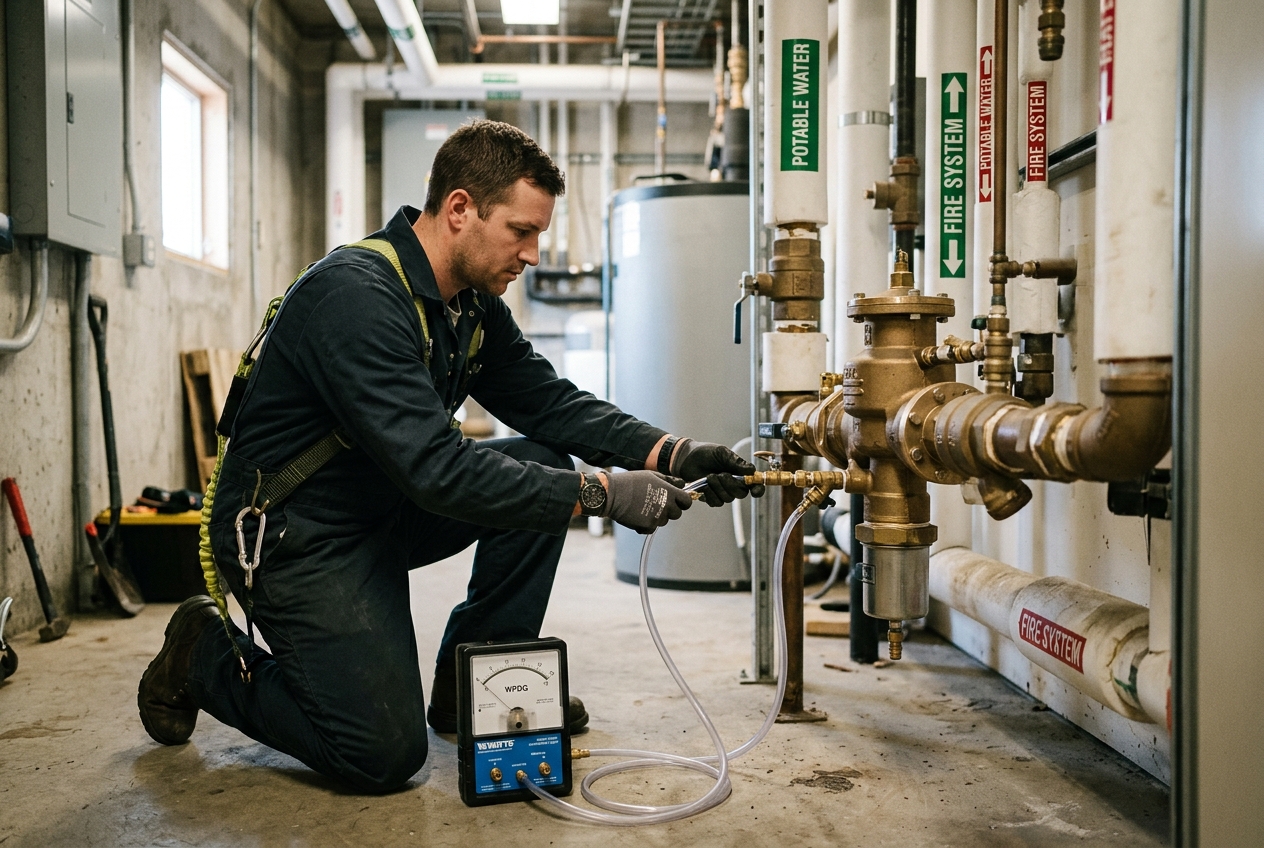 A technician kneeling beside a brass reduced-pressure zone assembly in a mechanical room, attaching test cocks to a calibrated three-valve differential gauge
Understand What "Certified" Actually Means
There is no single national backflow certification in the U.S. Instead, certification is issued by a patchwork of organizations, and your local water authority decides which ones it accepts. The most common bodies are:
- ASSE International (Series 5110 for testers, 5130 for repair, 5120 for service)
- AWWA (American Water Works Association) — often through state sections
- ABPA (American Backflow Prevention Association)
- University of Florida TREEO Center — widely accepted in the Southeast
- State-specific programs — California (AWWA Cal-Nev section), Texas (TCEQ BPAT license), Washington (BAT certification), and many others
Before you call anyone, look up your water utility's website and find their cross-connection control program page. It will list the certifications they recognize and almost always provide a roster of approved testers. Hiring directly from that roster eliminates 90 percent of the risk.
Certification is not a one-time stamp. Most credentials expire every two to three years and require continuing education plus a hands-on recertification test. When you ask a tester for their certification, ask for the expiration date, not just the number.
The Gauge Question
The single most overlooked detail in tester selection is the test kit itself. Backflow assemblies are checked with a differential pressure gauge that must be calibrated annually against a known reference by an accredited calibration lab. The calibration certificate has to be current on the day of your test, and many water districts will reject a report if the gauge calibration expired even one day before the inspection.
Ask any tester two questions before you hire them:
- When was your gauge last calibrated, and who calibrated it?
- Can you send me a copy of the current calibration certificate?
A legitimate tester will answer both within minutes. Hesitation, vague answers, or "I'll get back to you" is a red flag. Some testers carry multiple gauges precisely so that one is always within the calibration window — a good sign of a professional operation.
Local Licensing on Top of Certification
Certification proves a tester knows how to operate a gauge. Licensing proves the local authority has approved them to file reports in your jurisdiction. These are two different things and you need both.
A tester in a metropolitan region often holds five or six separate utility approvals because each district maintains its own list. If you own property across multiple jurisdictions — say a portfolio of commercial buildings — confirm the tester is approved by each water purveyor that services those addresses. One missing approval means one rejected report and one fine.
Some utilities also require:
- A plumbing contractor's license (for any tester who may need to make repairs)
- A business license in the city of service
- General liability insurance, typically $1M minimum
- Workers' compensation coverage if employees are entering your property
For commercial and multifamily properties, ask the tester to email proof of insurance before they arrive. For homeowners, this is less critical but still worth verifying for any tester doing repair work in addition to testing.
How to Find Candidates
There are four reliable channels for finding certified testers, in rough order of usefulness:
1. Your water utility's approved tester list. This is the gold standard. Anyone on this list has already proven their credentials to the authority that will receive your report. Many utilities update the list quarterly.
2. Backflow tester directories. Independent directories like FindBackflowTesters.com aggregate approved testers across thousands of jurisdictions and let you filter by ZIP code, device type, and service area. These are particularly useful if your utility's list is short or out of date.
3. Your plumber or property management company. Established plumbing contractors often have a backflow division or a long-standing relationship with a tester. The advantage here is integration — if the device fails, repairs can happen quickly.
4. State association rosters. ASSE, ABPA, and AWWA section websites typically publish member directories. These tend to skew toward more experienced, career-focused testers.
Be cautious of generic home-services platforms and lead-generation sites that don't verify certifications. Anyone can list themselves as a "backflow tester" on a general marketplace; very few of those listings are vetted against an actual approved-tester roster.
Vetting Questions That Separate Pros from Amateurs
When you call or email a potential tester, work through these questions. The answers will tell you almost everything you need to know.
- What certifications do you hold, and through which body? Look for current ASSE, AWWA, ABPA, or state-specific credentials.
- Are you on the approved tester list for [your water utility]? They should know the answer instantly.
- What is the calibration date on your gauge? Should be within the last 12 months.
- Do you file the report directly with the water department, or do I file it? Most pros file directly through the utility's portal (often Aqua Backflow, Tokay, BSI Online, or a similar service).
- What is your flat fee for a test, and what happens if the device fails? A reputable tester gives a clear test price and a separate, itemized rate for repairs.
- Do you repair on the spot if the device fails, or do you schedule a return visit? Both are acceptable; what matters is they tell you upfront.
- What devices do you test? Confirm they handle your assembly type — RPZ (reduced pressure zone), DCVA (double check valve assembly), PVB (pressure vacuum breaker), or SVB (spill-resistant vacuum breaker).
- Do you carry parts for common repair kits? Watts, Febco, Wilkins, Apollo, and Conbraco are the dominant brands; a tester who carries kits for all five saves you a follow-up appointment.
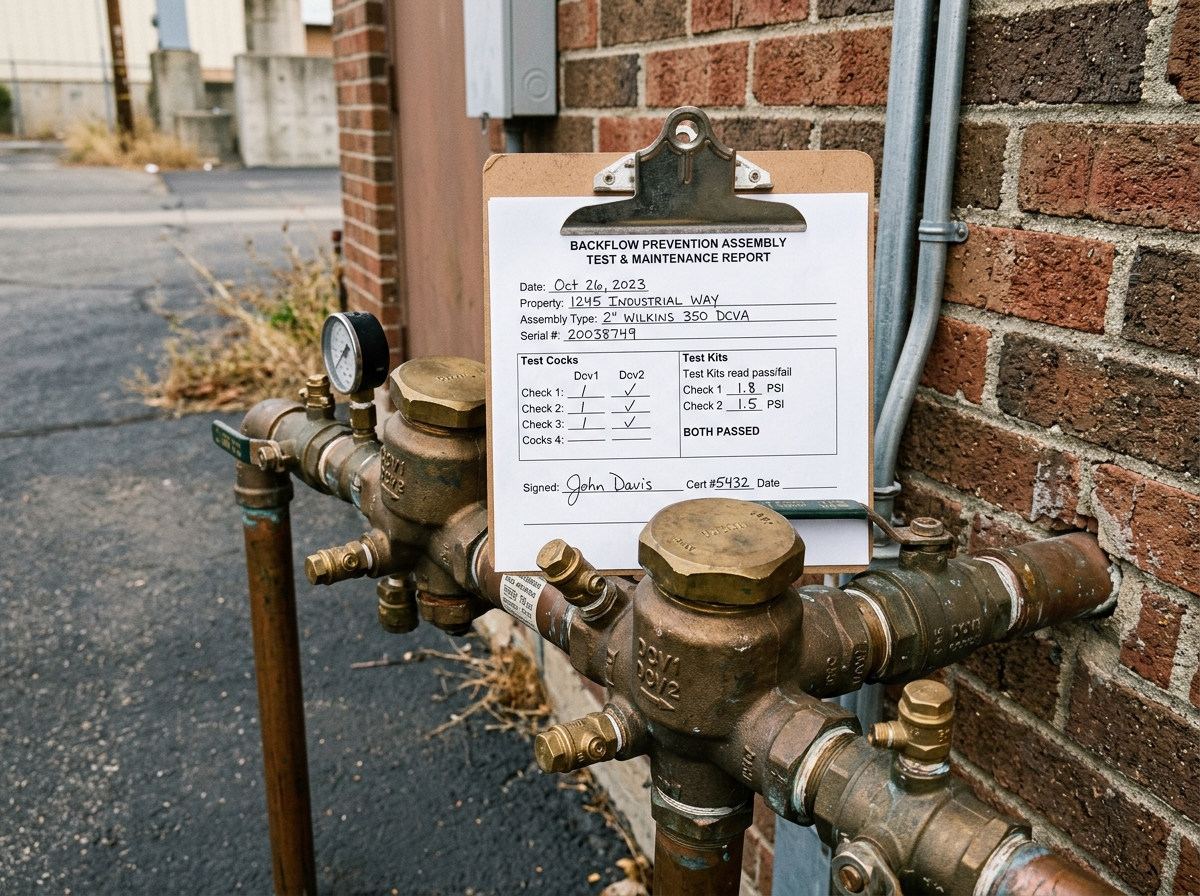 A clipboard with a completed backflow test report form lying on top of a closed brass double-check valve assembly outside a commercial building
Reading a Quote Correctly
Pricing varies widely by region, but in 2026 the typical range for an annual residential or light commercial test is $35 to $125 for the test itself, with most metro areas clustering between $65 and $95. Commercial RPZ devices on larger lines may run $150 to $300. A few patterns to watch for:
- Suspiciously low pricing ($25 and under) often means the tester is making up margin on repair upsells or filing fees.
- Filing fees are sometimes added separately. Some utilities charge a $5 to $20 administrative fee that gets passed through.
- Trip charges for properties outside the tester's normal service area are reasonable, but should be disclosed upfront.
- Repair pricing should be itemized: labor rate, parts cost, and any minimum service charge. The cheapest test in town becomes the most expensive if repairs are billed at $250/hour with a four-hour minimum.
Get two or three quotes for any commercial property. For a single residential device, the spread is rarely worth shopping past the first reputable name on your utility's list.
What to Expect on Test Day
A standard test takes 20 to 45 minutes per device. The tester will:
- Notify you before shutting off water, since the supply downstream of the device must be interrupted briefly.
- Attach hoses to the test cocks and read pressure differentials across the check valves and relief valve.
- Record readings on the appropriate form for your jurisdiction.
- Note the device's make, model, serial number, and location.
- Sign and submit the report — either directly to the utility's portal or to you for forwarding.
If the device passes, you'll typically receive a copy of the report by email within 24 to 48 hours. If it fails, the tester should explain exactly which component failed (first check, second check, relief valve, etc.) and provide a written repair estimate before doing any work.
For commercial properties with multiple devices, ask for a single consolidated report with a device-by-device summary. It makes annual record-keeping vastly easier.
Red Flags to Walk Away From
A few patterns reliably indicate trouble:
- No physical address or only a cell phone number. Legitimate backflow businesses are licensed in a specific city.
- Refusal to provide certification or calibration documentation.
- Pressure to perform "preventive" repairs without showing failed test readings. The test data should justify any repair recommendation.
- Cash-only pricing or no written invoice. This usually means no insurance and no business license.
- Failure to file the report after collecting payment. Surprisingly common; always confirm the utility has received your report within two weeks of the test date.
- Door-to-door solicitation claiming your "test is due." Some scammers monitor utility deadlines and arrive uninvited. Always verify against the utility's notice directly.
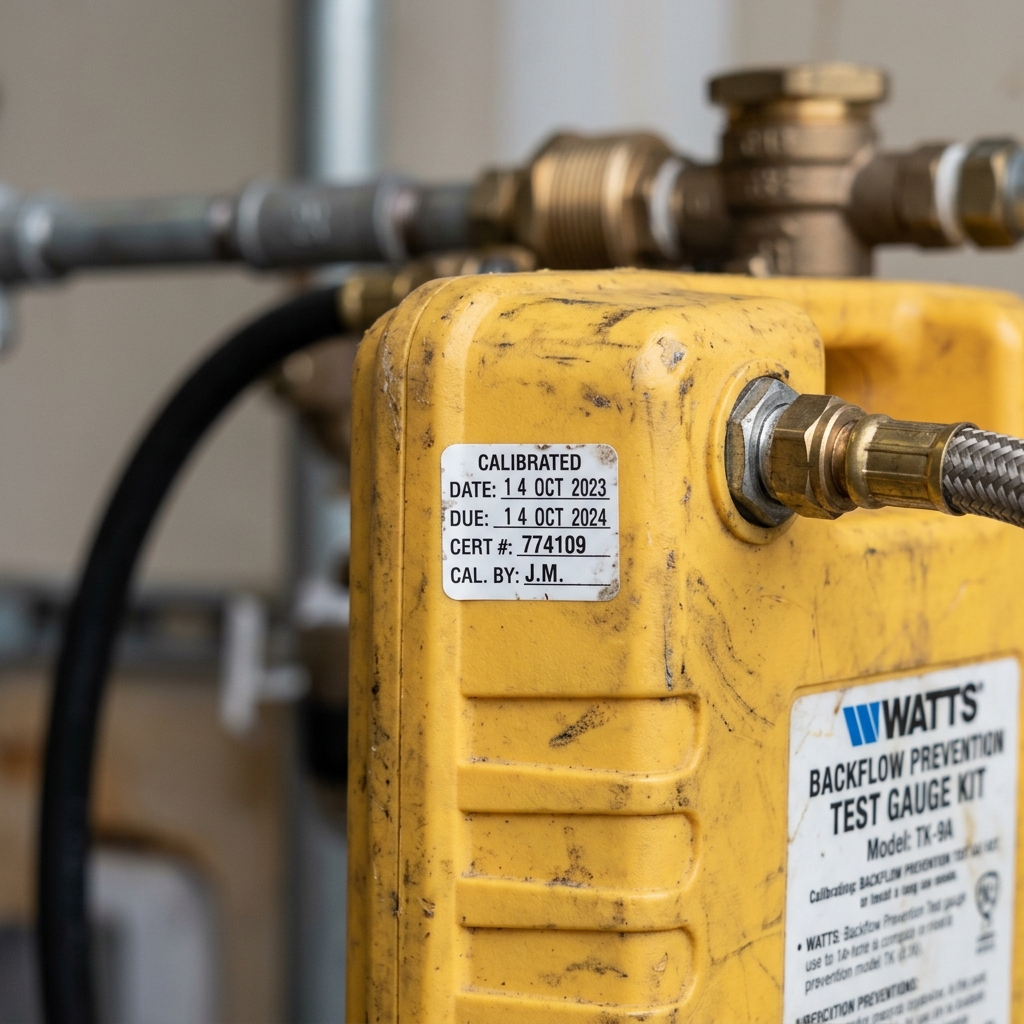 A small printed calibration sticker on the side of a yellow test gauge case, showing a recent calibration date
After the Test: Closing the Loop
Your job isn't done when the tester leaves. A few follow-through steps protect you from the most common compliance failures:
- Confirm the utility received the report. Log into your water department's cross-connection portal, or call and ask. Most utilities have a 30-day filing window after the test date.
- File your copy somewhere you'll find it next year. Email it to yourself with the device serial number in the subject line, or save it to a property management system. A surprising number of buildings re-test devices needlessly because they can't find last year's paperwork.
- Calendar next year's test. Add a reminder 60 days before the anniversary of this year's test. That gives you buffer to schedule before the utility's deadline notice arrives.
- Note your device's age. Most RPZ and DCVA assemblies last 15 to 25 years with normal maintenance. If yours is approaching that range and you've had multiple repairs, ask your tester for a replacement quote at the next visit rather than waiting for a catastrophic failure.
Choosing a Long-Term Provider
For homeowners, a one-time selection is usually fine — you'll see the same tester once a year. For property managers and commercial operators with five or more devices, treat this like any other recurring vendor relationship. The best long-term testers:
- Send proactive renewal reminders before your utility's deadline
- Maintain a database of your devices, serial numbers, and locations
- Offer fixed multi-year pricing or portfolio rates
- Handle repairs in-house rather than subcontracting
- File reports the same day they test, not weeks later
A tester who shaves $10 off the per-device price but consistently files late will cost you in penalty notices, emergency re-tests, and tenant complaints when water gets shut off without warning. The cheapest tester is almost never the most economical one.
Next Steps
Start with your water utility's cross-connection page today. Pull up their approved tester list, cross-reference two or three names against an independent directory, and request quotes that include the gauge calibration date and proof of approval for your specific service address. If you're in a region with seasonal testing windows — most utilities concentrate deadlines in spring and fall — book at least four to six weeks ahead of your renewal date. Testers in busy markets fill their calendars quickly, and a last-minute scramble is when corners get cut.
Done right, choosing a backflow tester is a one-afternoon project that pays off every year for the life of your property. Done poorly, it becomes a recurring headache. The credentials, the calibration, and the filing track record are the three things that matter — get those right and the rest follows.