Cross-Connection Control Programs: A Property Owner's Compliance Guide
What a Cross-Connection Control Program Actually Is
A cross-connection control program is the set of policies, inspections, and devices a water purveyor uses to keep contaminated water from flowing backward into the public drinking supply. Every water system in the United States is required by the Safe Drinking Water Act and EPA regulations to have one. What that looks like on the ground varies — a small rural district might run it with a single part-time inspector, while a major city water department maintains a dedicated cross-connection control unit with thousands of tracked assemblies.
If you own a home with an irrigation system, manage a commercial building, or run a facility with any kind of process water, you are part of this program whether you realize it or not. The water utility's job is to enforce it. Your job is to comply with it. This guide walks through what the program covers, what your obligations look like, and what to do when you receive that first letter from the water department telling you your backflow assembly is due for testing.
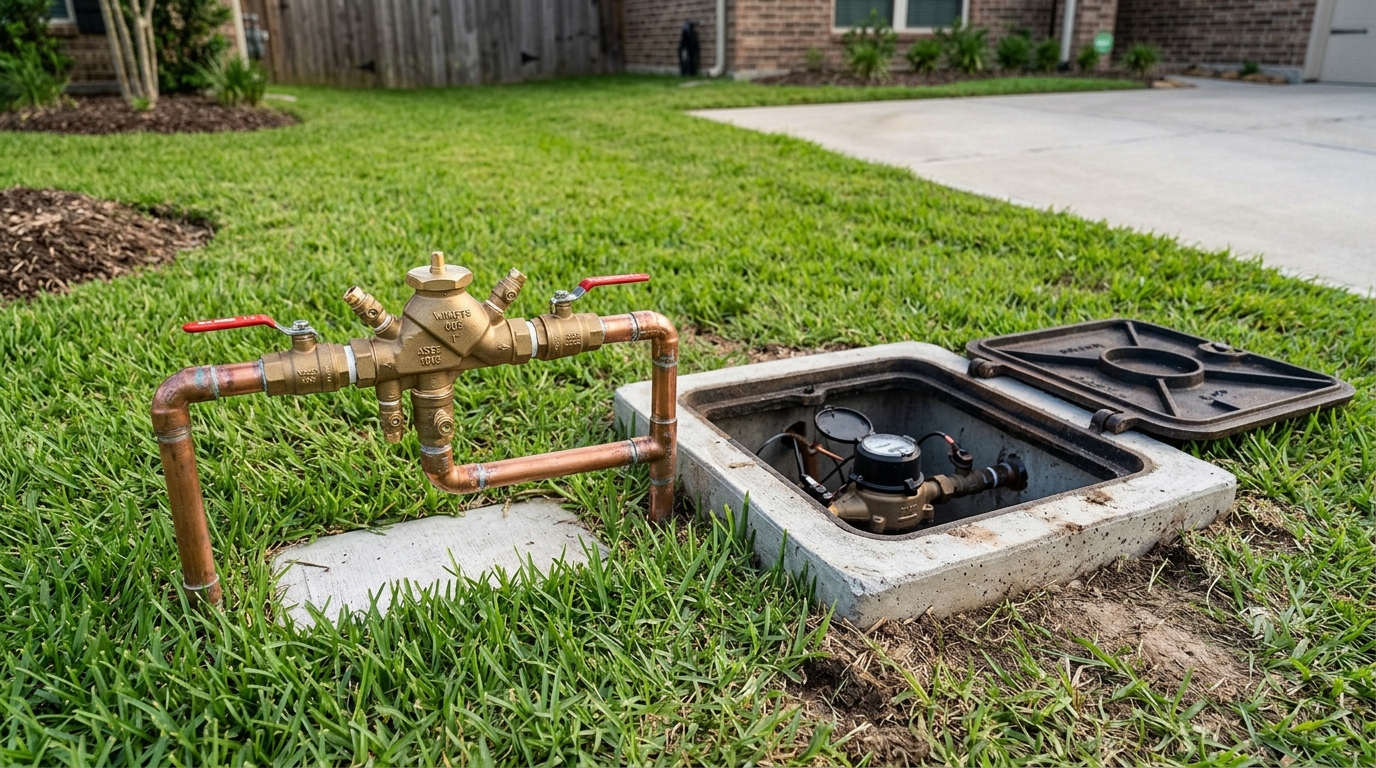
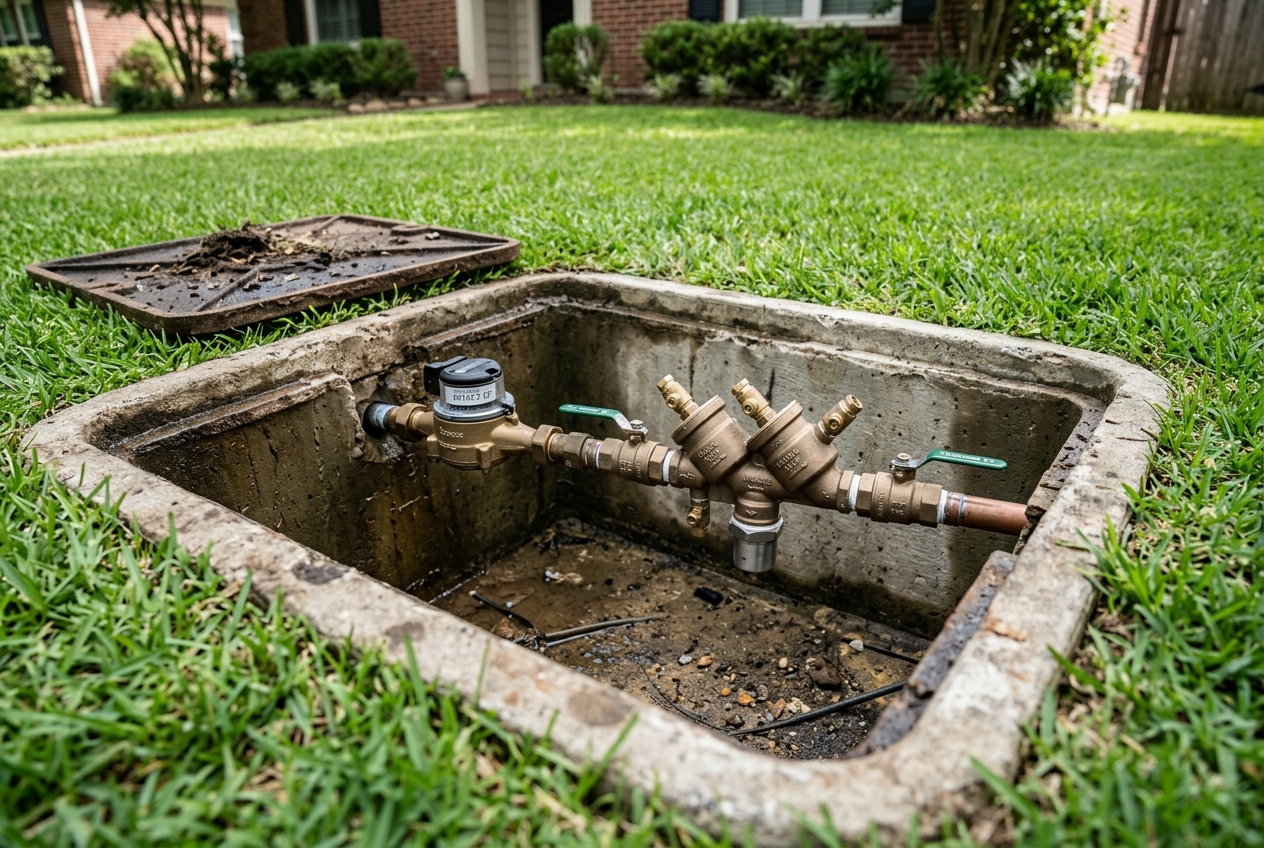 A municipal water meter pit open in a residential front lawn with a reduced pressure zone assembly installed on the customer side
The Underlying Problem: Backflow and Back-Siphonage
Drinking water flows under pressure from the utility's mains to your tap. As long as that pressure stays positive and higher than anything connected to the system, water moves in one direction. The moment that assumption breaks — a hydrant flushing, a water main break, a firefighting event, or a private booster pump creating higher pressure on the customer side — water can reverse direction.
Two failure modes drive every cross-connection control rule on the books:
- Back-siphonage happens when supply pressure drops and a vacuum effect pulls contaminants from a downstream source into the distribution main. A classic example is a garden hose left submerged in a pool or a bucket of fertilizer while a nearby hydrant is opened.
- Backpressure happens when a downstream system (a boiler, a pressurized chemical tank, a tall building's elevated piping) develops higher pressure than the supply main and pushes its contents upstream.
Either scenario can deliver pesticides, sewage, boiler chemicals, glycol, or industrial process fluids into the same line that feeds the kitchen sink three blocks over. Documented incidents have sickened hundreds of people at a time. The cross-connection control program exists to make those incidents rare.
Who Regulates It and Who Enforces It
At the federal level, the EPA sets the framework through the Safe Drinking Water Act. The agency doesn't inspect your building — it requires states to delegate that to local water purveyors. State plumbing codes (typically based on the Uniform Plumbing Code or International Plumbing Code) define what assemblies must be installed where, and state environmental or health agencies set testing intervals.
The enforcement entity is almost always your water utility. They have the authority to:
- Require a survey of your property's plumbing
- Demand installation of an approved backflow prevention assembly
- Require annual (sometimes more frequent) testing by a certified tester
- Shut off your water service if you don't comply
A few states (Washington, Florida, Texas, and others) have particularly mature programs with detailed administrative codes. Others lean heavily on AWWA Manual M14 as the de facto standard. Either way, the obligations flowing down to property owners look very similar.
Hazard Assessment: Why You Got That Letter
Water utilities classify every connection on their system by hazard level. Three tiers are common:
- High hazard (or "health hazard") — a cross-connection that could cause illness or death if contamination occurred. Hospitals, mortuaries, car washes, plating shops, irrigation systems with chemical injection, fire suppression systems with antifreeze, and any facility handling sewage or process chemicals fall here.
- Low hazard (or "non-health hazard") — a connection that could affect water quality (taste, odor, color) but is unlikely to cause illness. Food service operations without chemical hazards and certain heating systems can land in this category.
- No hazard — a typical residential connection with no auxiliary water sources, no irrigation, and no pools.
The hazard tier determines what device you need. High hazards require a reduced pressure zone (RPZ or RP) assembly. Low hazards can often use a double check valve assembly (DCVA or DC). No-hazard residential connections usually don't need premise isolation at all, though specific fixtures inside still need protection.
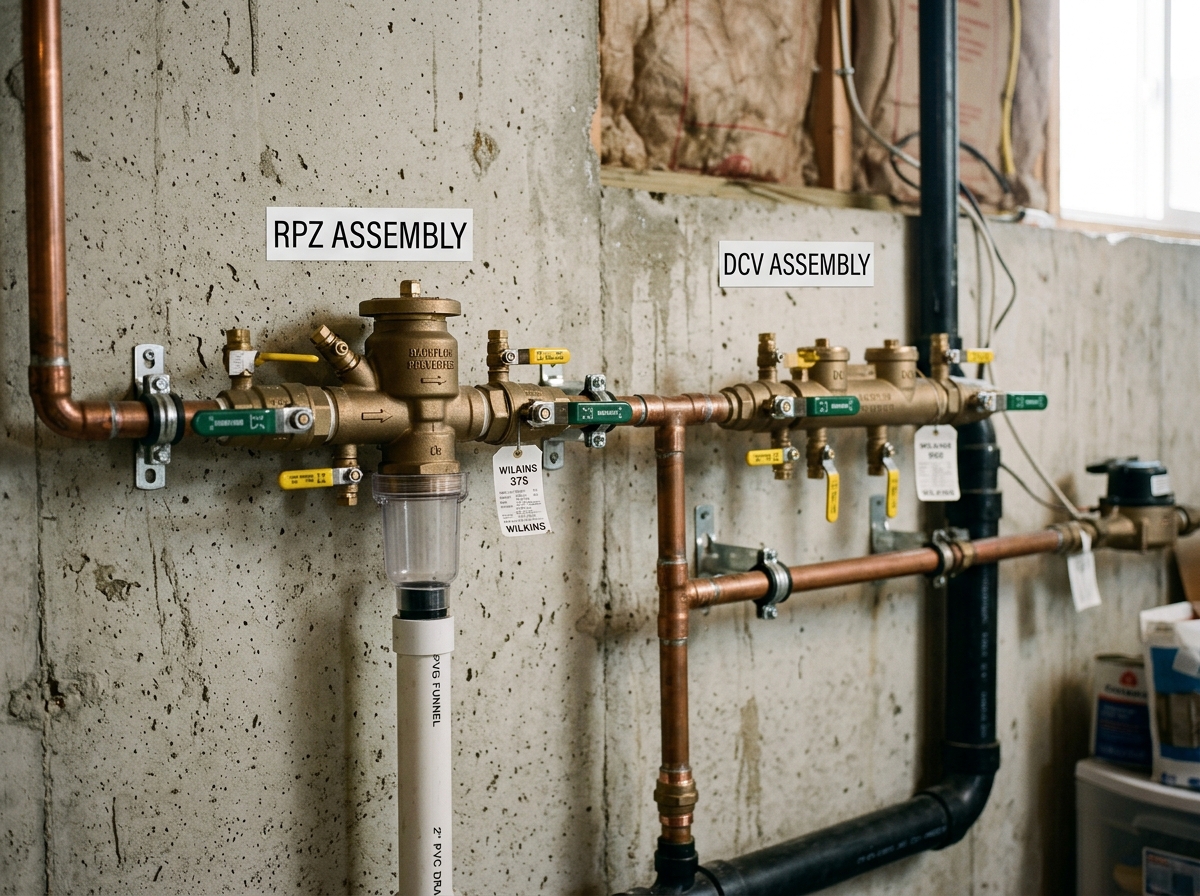 A side-by-side comparison of a reduced pressure zone assembly and a double check valve assembly mounted on a basement wall with shutoff valves and test cocks visible
The Device Hierarchy You'll Actually Encounter
There are five common types of backflow prevention, ranked roughly from most to least protective:
- Air gap. A physical vertical separation between the water outlet and the rim of a receiving vessel. Cannot be tested because there is nothing mechanical to fail, but also cannot be defeated as long as the gap is maintained. Required for the highest hazards.
- Reduced pressure zone assembly (RPZ). Two check valves with a pressure-monitored relief valve between them. Discharges to atmosphere if the assembly fails. Required for high hazards where an air gap isn't feasible.
- Double check valve assembly (DCVA). Two independently operating check valves. Used for low hazards. Cannot be installed where it might be submerged.
- Pressure vacuum breaker (PVB) or spill-resistant vacuum breaker (SVB). Used on irrigation systems and similar applications. Protects only against back-siphonage, not backpressure.
- Atmospheric vacuum breaker (AVB). Common on hose bibbs and some fixtures. Cannot be under continuous pressure for more than 12 hours and has no shutoffs or test cocks.
The assemblies in categories 2 through 4 are "testable" — they have shutoff valves and test cocks specifically so a certified tester can verify each check is holding properly. That annual test is the backbone of the entire program.
Where Devices Have to Be Installed
Most programs distinguish between premise isolation (protecting the public main from your entire property) and internal protection (protecting potable water inside your building from a specific fixture or system).
Premise isolation is what the water utility cares about most. It's the assembly installed at or near the meter, typically after the meter shutoff but before any branch. This is the boundary the utility can audit, test, and rely on.
Internal protection is what your plumbing inspector cares about. The plumbing code requires backflow protection on boilers, fire systems, dishwashers, lawn irrigation manifolds, water-fed equipment, lab sinks, and so on. Some of these are testable assemblies; some are non-testable devices integrated into the fixture.
For commercial properties, expect to need both. For homes with irrigation, you'll typically have a PVB or RPZ on the irrigation line and nothing else. For homes with a private well that's also connected (cross-connected) to municipal supply, you'll need a high-hazard assembly because of the auxiliary source.
Annual Testing: What the Process Looks Like
Testing is where most property owners first interact with the program in a meaningful way. The typical flow:
- Notification. The water utility sends a letter, postcard, or email roughly 30 to 60 days before the device is due. Some utilities send these annually based on the device's install date; others have a fixed cycle (e.g., all assemblies tested in spring).
- Hiring a tester. You're responsible for finding a certified backflow tester. Certifications are issued by states, ASSE International, the University of Florida TREEO Center, or AWWA, depending on the jurisdiction. The utility will not test it for you in most areas.
- The test itself. A tester arrives with a calibrated differential pressure gauge, isolates the assembly, opens test cocks in a defined sequence, and records pressure readings against pass/fail thresholds. The whole thing usually takes 20 to 40 minutes per device.
- Reporting. The tester submits a passing report to the utility, usually through an online portal. You'll typically get a copy. Keep it — auditors, lenders, and buyers ask for it.
- Repairs if needed. If a check valve or relief valve fails, the tester (or another licensed plumber) repairs it and retests. Rebuild kits are available for every major assembly model.
Common failure modes are debris on a check seat, corroded internal springs, worn rubber discs, and stuck relief valves. The repair is often cheap; ignoring the failure can be expensive — water utilities can and do shut off service for delinquent reports.
Budgeting and Realistic Costs
For 2026, expect these rough ranges in most U.S. markets:
- Annual test — $35 to $125 for a residential PVB or DCVA; $75 to $200 for a typical commercial RPZ; more for assemblies 3 inches and larger.
- Rebuild kit and labor — $150 to $500 depending on size and type.
- New installation of a 3/4 inch or 1 inch RPZ — $600 to $1,500 including plumber labor, with significant variation by region and accessibility.
- Freeze protection enclosure — $200 to $1,200 for above-grade outdoor installations in cold climates.
These line items are predictable and worth building into a property's maintenance budget rather than treating as surprise expenses. They are also tax-deductible for commercial properties as ordinary maintenance.
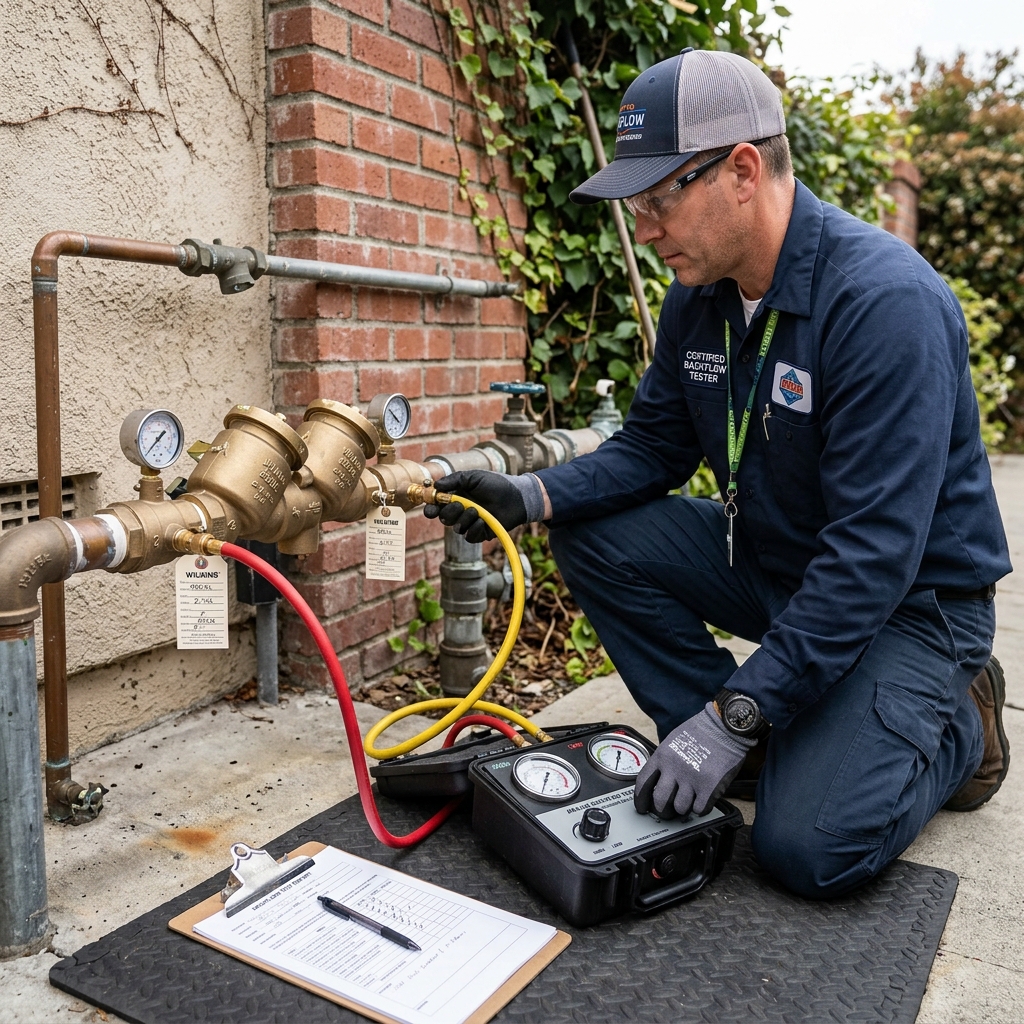 A certified tester kneeling beside a backflow assembly with a test kit attached via short hoses to the test cocks and a clipboard nearby
What Property Managers Should Build into Their Routines
If you manage multiple properties, the cross-connection control program is a recurring compliance task that benefits from a system. A few practices worth adopting:
- Maintain an asset list. Every device, by location, make, model, size, serial number, and last test date. A simple spreadsheet works for fewer than 20 devices; property management software handles larger portfolios.
- Calendar testing 60 days early. Utilities don't care that your tester is booked solid in May. Schedule in March.
- Use one certified tester for the entire portfolio when possible. Volume pricing, consistent paperwork, and a single point of contact when something fails.
- Keep electronic copies of every test report for at least seven years. Some states require longer retention. Buyers and lenders frequently request these in due diligence.
- Verify the tester is currently certified. Certifications expire and lapsed-certificate test reports get rejected by utilities. Most states publish a public registry.
For commercial tenants in multi-tenant buildings, clarify in the lease whether the landlord or the tenant is responsible for assembly testing on tenant-installed equipment (often: tenant). This is a frequent source of disputes when a utility comes knocking.
Homeowners: What You Specifically Need to Know
Most single-family homeowners don't have a premise-isolation assembly. Where they do encounter the program is through:
- Lawn irrigation. Almost universally requires a PVB or RPZ on the irrigation feed, tested annually. If you installed irrigation yourself, you may not be in compliance and may not know it.
- Pools, spas, and ponds. Auto-fill lines need protection. A submerged hose end is a textbook cross-connection.
- Boilers and hydronic heating. Closed-loop systems with glycol or boiler treatment chemicals need backflow protection on the fill line.
- Private wells alongside municipal service. If both sources can reach the same plumbing — even through a single valve — you need premise isolation.
If you've never received a backflow letter and any of the above applies to your property, a five-minute call to your water utility's cross-connection control coordinator will clarify your obligations. It is much cheaper than discovering noncompliance during a home sale.
What to Do This Week
A practical short list, in order:
- Find out who your water purveyor is and look up their cross-connection control page. Search "[your city] backflow program."
- Identify any assemblies on your property. Check near the water meter, the irrigation control valves, and any boiler or fire system rooms. Photograph the tag if there is one — it shows make, model, size, and often the install date.
- Verify the testing status. Call the utility or check their online portal with your account number. They can tell you when your device is due.
- Hire a certified tester if you're past due. Search local listings or use directories like FindBackflowTesters.com to locate certified professionals near you.
- File the test report with the utility and store your copy. Set a calendar reminder for 10 months out so you stay ahead next year.
The cross-connection control program is one of those quiet public health systems that mostly works because people follow through on small annual tasks. Your assembly costs less to test than to replace, and the water flowing back through your kitchen tap is cleaner because everyone upstream did the same thing. Treat it as routine maintenance, not a regulatory headache, and the program does its job.