California Backflow Testing Rules: How Cross-Connection Programs Work
Here's the complete blog post:
California Backflow Testing Rules: How the State's Cross-Connection Programs Work
If you own a business, run a farm with an irrigation system, or manage a property with a fire sprinkler line in California, there's a good chance you're on the hook for annual backflow testing. The rules can feel confusing because California splits the job between the state and your local water supplier. This guide breaks down who's in charge, what the law actually requires, and what you need to do to stay compliant.
What Backflow Is and Why California Cares
Backflow is what happens when water flows backward through your plumbing into the public drinking water system. Normally water moves in one direction, from the utility's main into your building. But pressure changes, like a water main break or a fire hydrant being opened nearby, can reverse that flow. When it reverses, anything connected to your pipes can get sucked back into the public supply: fertilizer from an irrigation system, chemicals from a boiler, or stagnant water sitting in a fire sprinkler line.
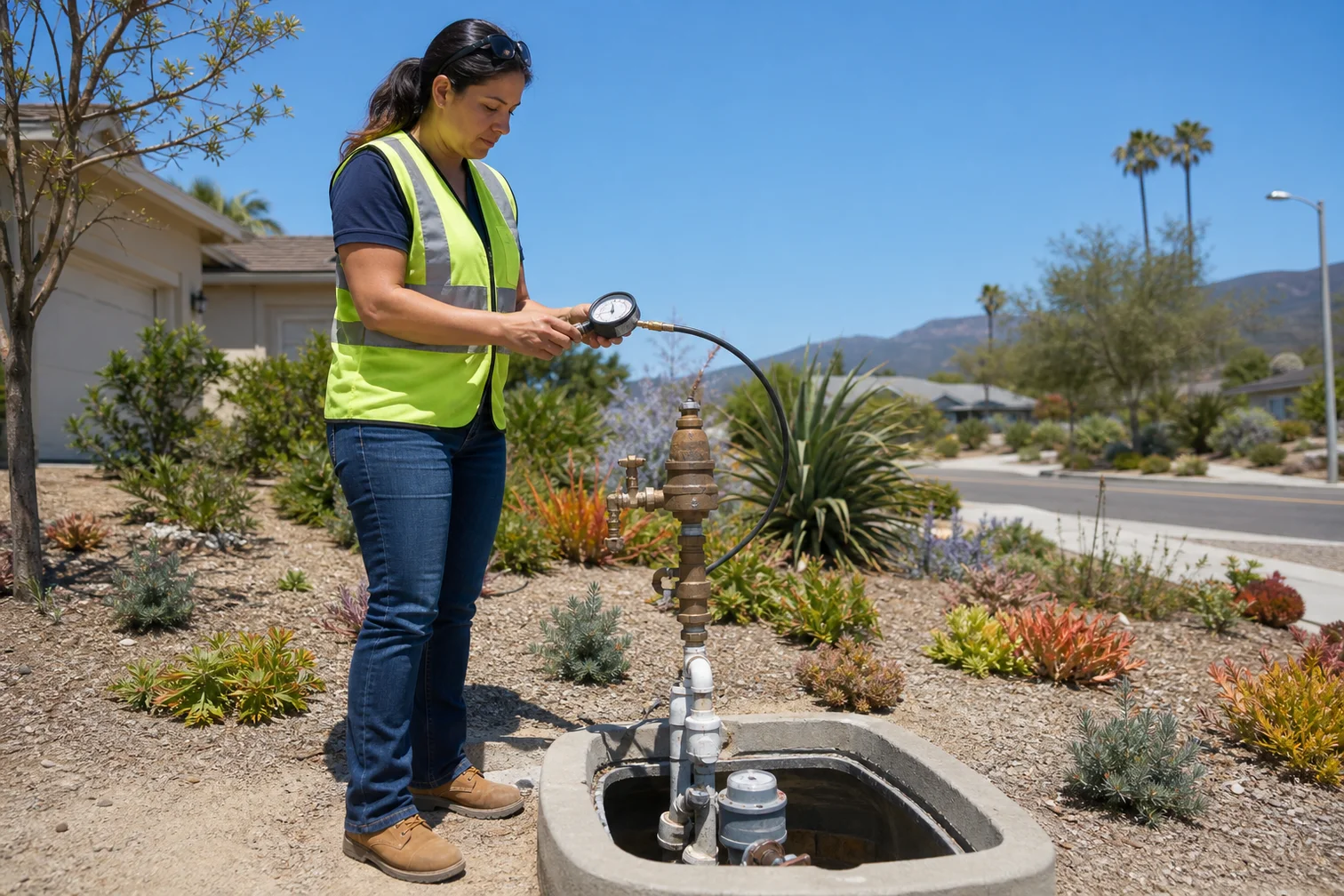
 Backflow preventer assembly installed outside residential property
That connection point where contamination can enter is called a cross-connection. A backflow prevention assembly is the device that stops it. California's whole regulatory framework exists to find those cross-connections, require the right device, and make sure the device actually works year after year.
The State Sets the Rules, the Water Supplier Enforces Them
California runs a two-layer system, and understanding the split saves a lot of headaches.
The State Water Resources Control Board, through its Division of Drinking Water (DDW), writes the rules. These live in Title 17 of the California Code of Regulations, sections 7583 through 7605. Title 17 is the legal backbone for cross-connection control statewide. It tells water suppliers they must run a program, sets the types of approved assemblies, and requires annual testing by a certified tester.
Your local water supplier, your city water department, a water district, or an investor-owned utility like California Water Service, actually runs the program day to day. They survey properties, decide which sites need protection, send you the annual test notices, and keep the records. So when you get a letter demanding a backflow test, it comes from your water provider, but the authority behind it traces back to Title 17.
This is why two businesses in different cities can get slightly different paperwork and deadlines even though the underlying state rule is the same. The supplier fills in the local details.
A Major Change Is Coming: From Title 17 to the New Cross-Connection Control Policy Handbook
Here's something every California property owner and tester should know. The State Water Board adopted a new Cross-Connection Control Policy Handbook (often called CCCPH) that's set to replace the Title 17 backflow rules. It was approved in 2023 and phases in over a few years, giving water suppliers time to update their local programs.
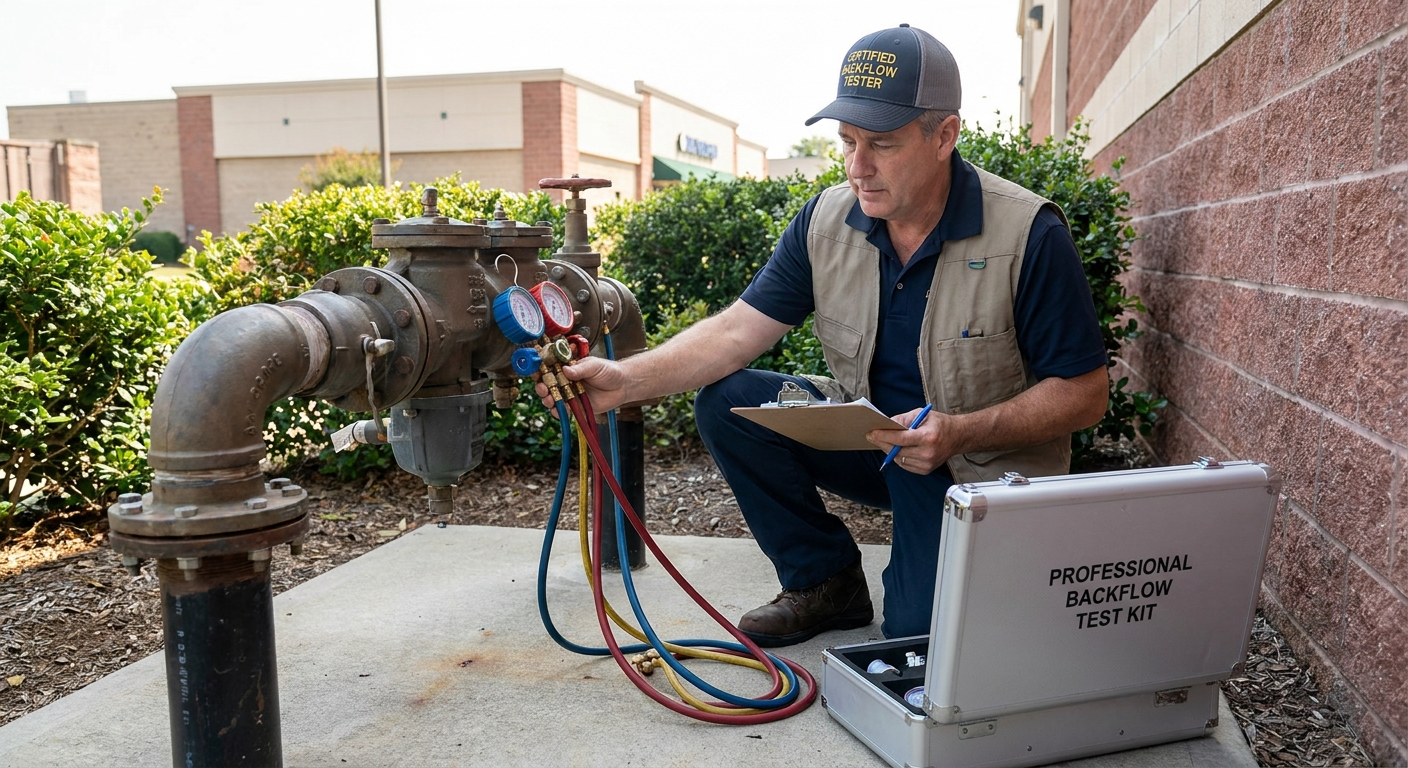
 Certified tester inspecting backflow prevention device during annual test
The handbook modernizes a lot of older language, aligns California more closely with national standards, and adds clearer guidance on things like assembly testing, tester certification, and hazard assessment. If your water supplier mentions the CCCPH or a new ordinance, that's what they're pointing to. The core requirement for most property owners doesn't change much: you still need the right assembly, tested every year by a certified person. But the details around recordkeeping and program administration are getting an update, so it's worth asking your supplier where they stand in the transition.
Who Has to Test in California
Not every home needs a backflow assembly, but a lot of properties do. Water suppliers generally require testable backflow protection for sites that pose a contamination risk. Common examples include:
- Commercial and industrial buildings with boilers, cooling towers, or process equipment
- Irrigation systems, especially any that use fertilizer or chemical injection
- Fire sprinkler systems, particularly those with chemical additives or that draw from a non-potable source
- Restaurants and food service with equipment connected to the water line
- Medical and dental offices, labs, and mortuaries
- Car washes, laundromats, and plating shops
- Agricultural operations with wells, ponds, or recycled water on the same property
- Apartment complexes and HOAs with shared irrigation or amenity water features
Residential homes can be required to have backflow protection too, usually when there's an in-ground irrigation system, a pool auto-fill, or a private well connected near the city supply. The trigger is the hazard, not just the building type.
The Annual Test Requirement
This is the part that affects the most people. Once a backflow assembly is installed at your property, California requires it to be tested at least once a year. Some high-hazard sites get tested more often if the local supplier requires it.
The test has to be done by a person holding a current backflow prevention assembly tester certification. In California, that certification typically comes through AWWA (American Water Works Association) or the American Backflow Prevention Association (ABPA), and many water suppliers specify which credentials they accept. The tester checks that the assembly holds pressure correctly, that the check valves and relief valve operate, and that nothing is leaking or stuck.
After the test, the tester submits a report to your water supplier, sometimes on the supplier's own form, sometimes through an online portal. You usually get a copy too. Keep it. If your assembly fails, you'll need repairs or a replacement and a passing retest, often within a short window like 10 to 30 days depending on your supplier.
What Happens If You Miss a Test
Water suppliers take this seriously because a failed cross-connection can contaminate water for an entire neighborhood. If you ignore test notices, the typical escalation looks like this:
- A reminder notice with a new deadline
- A second or final notice, sometimes with a warning of service interruption
- Water shutoff to the property until you comply
That last step is real. Suppliers like the City of Los Angeles Department of Water and Power, EBMUD in the East Bay, and San Diego all have the authority to discontinue water service to a property with an overdue or failed backflow assembly. Reconnection usually means passing the test plus paying any fees. It's far cheaper to schedule the test on time.
Approved Assemblies and Installation Rules
California doesn't let you install just any device. Assemblies have to be on the approved list, which historically came from the USC Foundation for Cross-Connection Control and Hydraulic Research, the testing lab whose approvals most California suppliers reference. The main assembly types you'll run into:
- Reduced Pressure Principle Assembly (RP or RPZ): the highest level of protection, required for high-hazard connections like chemical systems
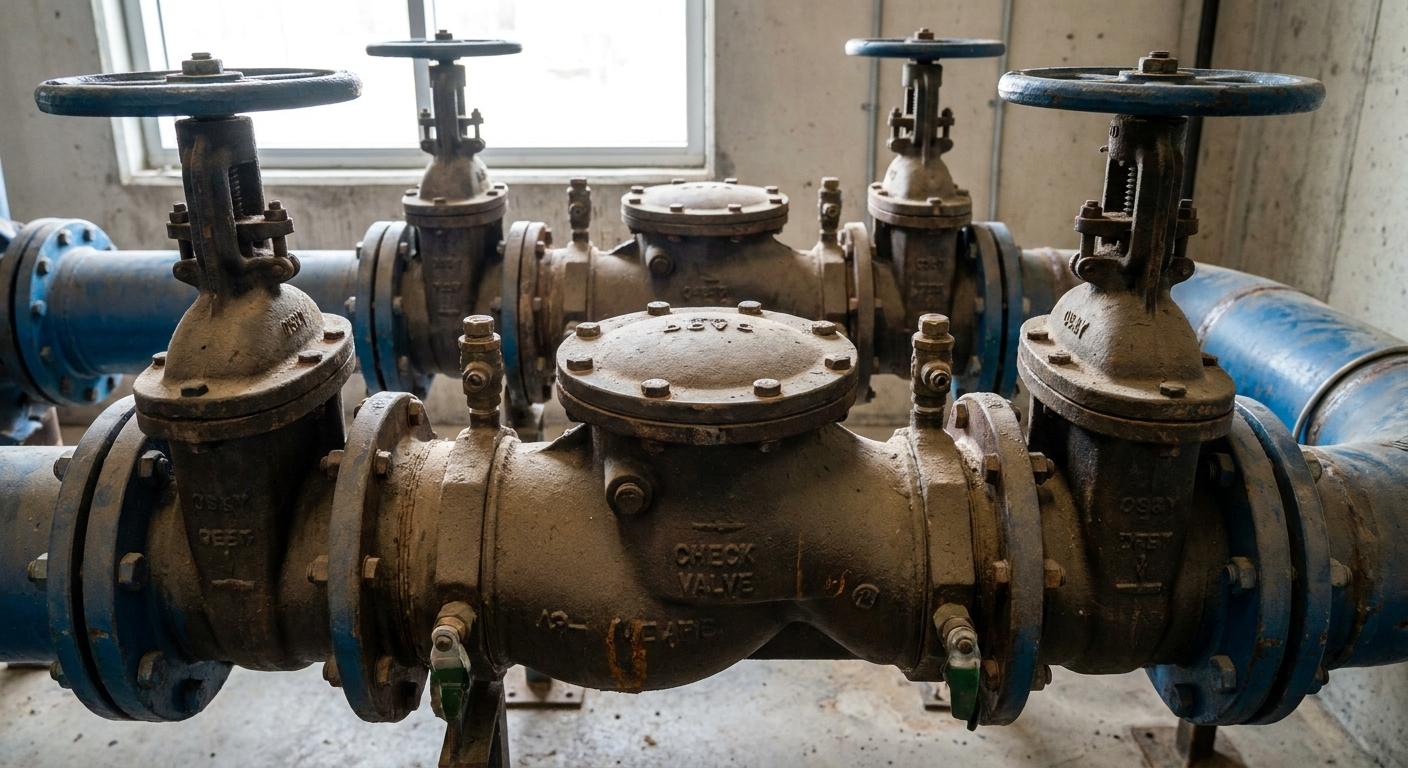
- Double Check Valve Assembly (DC): used for lower-hazard situations such as many fire sprinkler lines
- Pressure Vacuum Breaker (PVB) and Spill-Resistant Vacuum Breaker (SVB): common on irrigation systems
- Air Gap: a physical separation, the most reliable method but not always practical
Installation also has rules: assemblies generally must be above ground, accessible for testing, protected from freezing and flooding, and installed at the right height. If yours is buried in a vault, blocked by landscaping, or installed backward, a tester may flag it before they can even certify it. Your supplier's cross-connection specialist can tell you the exact requirements for your site.
Practical Steps to Stay Compliant
If you want to keep this simple, here's the routine that works for most California property owners:
- Know your assembly. Find out what type you have, where it is, and its serial number. The annual notice usually lists it.
- Mark your calendar. Testing is due every year, often on the anniversary of installation or on a date your supplier assigns. Don't wait for the notice to arrive.
- Hire a certified tester. Confirm they hold a current AWWA or ABPA certification your supplier accepts, and that they'll file the report for you.
- Fix failures fast. If the assembly fails, get it repaired or replaced and retested inside your supplier's deadline.
- Keep your records. Save every test report. They prove compliance if there's ever a dispute or a property sale.
The whole process is usually quick and affordable when you stay ahead of it. The expensive, stressful version is the one where you wait until you get a shutoff warning.
The Bottom Line
California's backflow rules come from the state, through Title 17 and the newer Cross-Connection Control Policy Handbook, but your local water supplier is the one who enforces them. If you have a testable assembly, you need an annual test by a certified tester, and you need to keep the paperwork. Miss it long enough and you risk losing water service. Stay on top of it and it's a minor yearly errand.
Sources
- California Code of Regulations, Title 17, Cross-Connection Control (Sections 7583-7605)
- State Water Resources Control Board, Cross-Connection Control Policy Handbook
- EPA, Cross-Connection Control Manual
- American Water Works Association (AWWA), Cross-Connection Control and Backflow Prevention
- USC Foundation for Cross-Connection Control and Hydraulic Research
Annual backflow testing isn't something to put off until you get a shutoff notice. If you're due for a test, or you're not even sure what kind of assembly you have, find a certified backflow tester near you at FindBackflowTesters.com. We list trusted, certified testers across California who know your local water supplier's rules and can file the report for you, so you can check this off and get back to running your business.
Need a compliance test filed?
Tell us your service type and property details so we can help route the request to backflow testers near you.