Backflow Testing Requirements for Industrial Facilities
Industrial facilities are one of the clearest examples of why backflow programs exist. Once a site has chemical processes, industrial equipment, treated boilers, water reuse, or other higher-risk plumbing conditions, the utility is no longer looking at a simple low-risk commercial connection. It is looking at a property that could create a serious cross-connection hazard if water ever flows the wrong way.
That is why industrial properties are often handled more strictly than standard office or retail sites. The exact rules still depend on the utility, state regulator, plumbing authority, and site conditions, but the pattern is consistent across official guidance: higher hazard means tighter assembly requirements, closer review, and dependable annual testing and reporting.
Seattle Public Utilities lists wastewater treatment plants, metal plating industries, chemical plants, petroleum processing or storage plants, beverage bottling plants, and food processing plants among examples of high health hazard facilities. New York City DEP likewise lists metal plating, fabrication, laundries and dry cleaners, food processing, sewage handling, toxic chemical storage, chemically treated boilers, and premises that reuse or recycle water among the properties generally required to install backflow prevention devices.
If you need the public-health background first, start with why backflow testing is required. If you are comparing local market coverage and provider options, the city pages for Austin, Philadelphia, and Seattle are useful next stops.
Why industrial facilities are treated as higher hazard
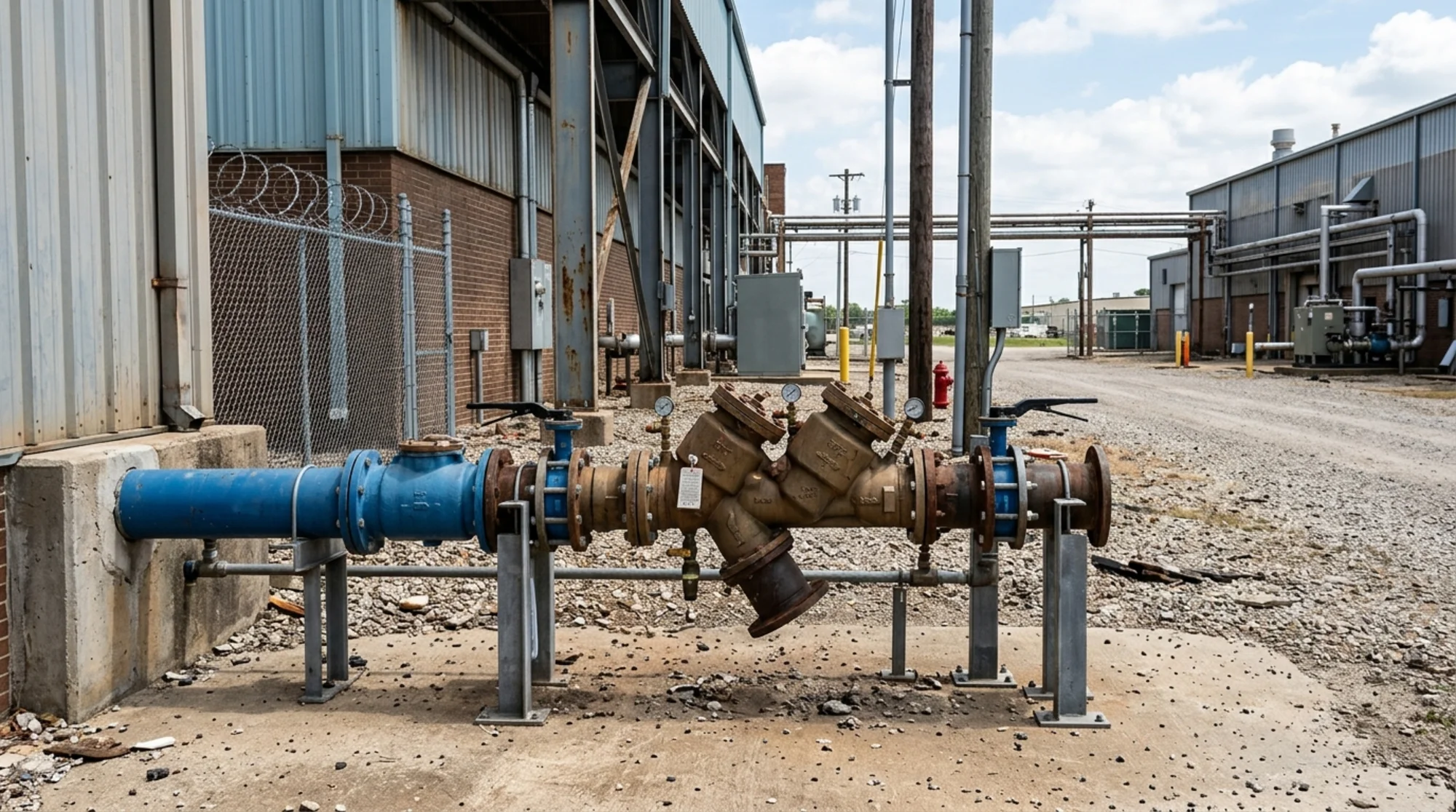
Exterior of an industrial facility with a large reduced pressure backflow assembly installed near the water service entrance, realistic utility infrastructure, daylight, no logos or text overlay
The core issue is not the building label. It is the hazard profile of the connection.
EPA explains that the Safe Drinking Water Act protects public health by regulating the nation’s public drinking water supply. Local backflow programs are one of the practical ways utilities protect that supply at the service-connection level. When a property contains substances or processes that could contaminate potable water, utilities tend to treat it as a higher-risk site.
Utility examples make that real quickly. Seattle’s high health hazard list includes chemical plants, laboratories, commercial laundries, car washes, petroleum processing or storage plants, and food processing plants. New York City DEP names a similarly broad set of industrial or semi-industrial uses, including metal fabrication, treated boilers, sewage handling, water reuse, and toxic chemical storage.
A facility can become a backflow concern because of:
- process chemicals,
- industrial washing or cleaning systems,
- chemically treated boilers,
- reclaimed or recycled water,
- multiple service lines,
- production equipment connected to potable water,
- or storage and pumping conditions that create backpressure.
That is also why a simple internet checklist is never the final authority. The utility or cross-connection control specialist decides what protection is required for the actual installation.
What utilities usually require at industrial sites
The exact assembly depends on hazard level, service layout, and local rules, but industrial facilities are commonly pushed toward stronger forms of protection.
Seattle Public Utilities says high health hazard facilities are required to have premises isolation and specifically requires a Reduced Pressure Backflow Assembly or Reduced Pressure Detector Assembly as premises isolation for those high health hazards. That assembly is installed just downstream of the meter or city union, where ownership transfers.
Portland Water Bureau describes the same decision in practical terms: the location of the assembly, the service size, and the hazard level of the connection determine which assembly should be used. Its guidance explains that an RPBA may be installed on either low- or high-hazard connections, while a DCVA is commonly used where the hazard does not pose a health risk. Portland also notes that fire-related systems with chemicals, additives, storage tanks, or high-rise auxiliary sources may require a reduced pressure detector assembly.
For facility teams, the takeaway is simple:
- Do not assume one assembly type fits every industrial property.
- Do not assume one device protects every risk point inside a complex facility.
- Do treat premises isolation, process hazards, and fire-system hazards as separate review questions.
Some sites only need utility-side premises isolation and annual testing. Others may have additional internal protection requirements because of specific equipment, production lines, boilers, lab functions, or fire-system configurations.
If you are building a local compliance playbook, keep both market pages and program pages close at hand. Internal references like the Austin Water backflow testing program, the Philadelphia Water Department backflow testing program, and the general FAQs page make it faster to align the site team, the tester, and the utility process.
Testing, reporting, and who is allowed to do the work
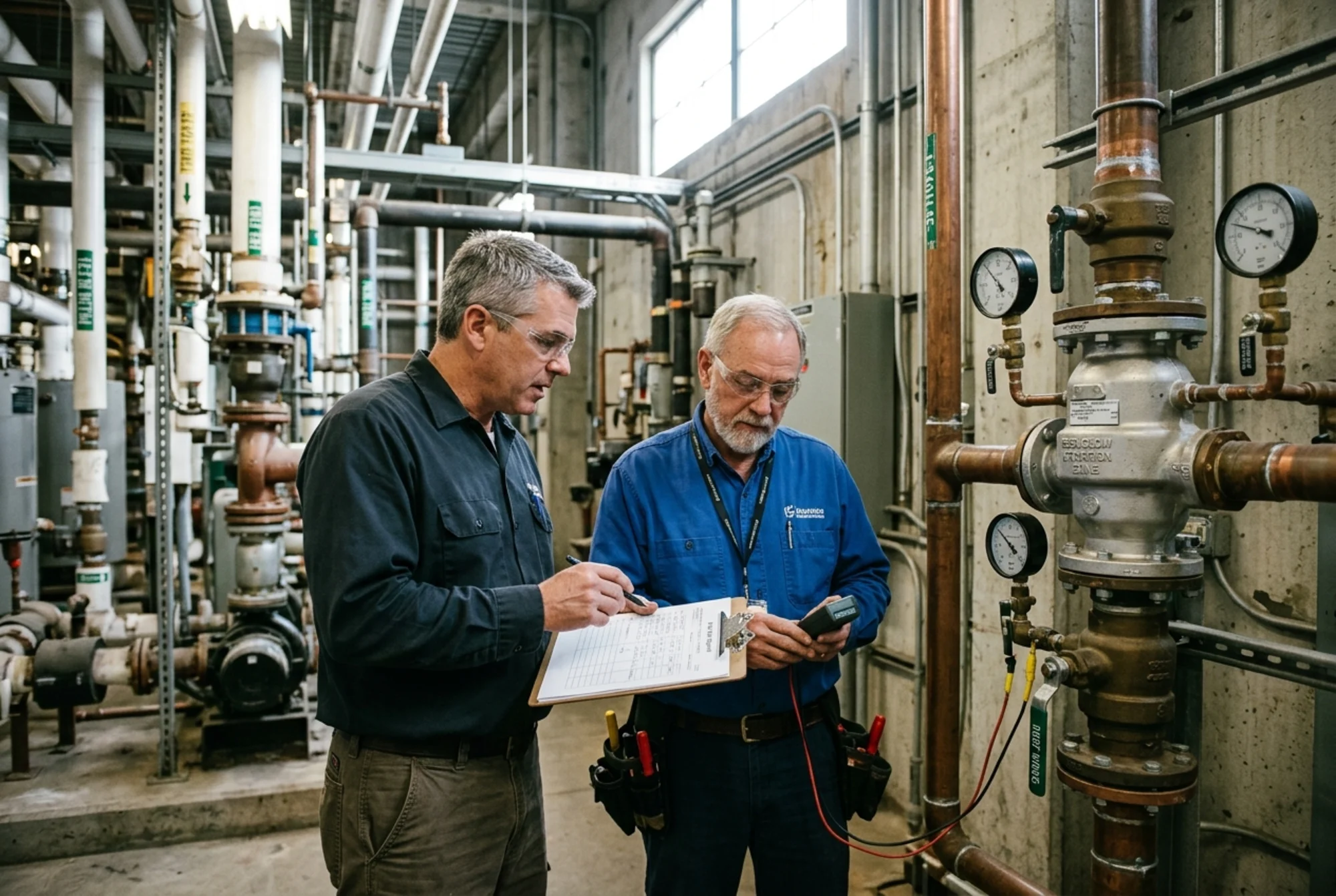 Certified backflow tester and industrial maintenance manager reviewing a field test report in a plant mechanical room beside piping and gauges, realistic documentary style, natural lighting, no logos or text overlay
Once the right assembly is in place, the next risk is operational, not theoretical. Industrial facilities get into trouble when the device exists but the testing, reporting, or documentation chain breaks.
Seattle Public Utilities says all installed backflow assemblies must be tested annually by a State of Washington certified backflow assembly tester, and also after repair or replacement. Its testing page further states that annual testing is the only way to ensure the assemblies are functioning properly and warns that non-compliance charges and possible water-service termination can follow if testing is not completed.
Washington State DOH adds another important compliance layer by specifying field test report content requirements under WAC 246-292-036 and publishing supporting guidance, forms, and BAT certification resources. That matters because industrial properties often assume that if the technician visited, the job is done. In reality, incomplete documentation can leave the account exposed even after the field work happened.
New York City DEP shows how formal this can get. Its guidance says property owners must use qualified design and plumbing professionals for installation, submit the required plans for approval, complete initial testing after installation, and then test the device every 12 months. It also warns that failing to perform the annual test can result in fines or the disconnection of water service.
So the real compliance workflow is usually:
- confirm the assembly requirement,
- verify the tester holds the right credential for the jurisdiction,
- schedule the test with enough lead time for repairs,
- make sure the report is submitted correctly,
- and save proof that the cycle is actually closed.
CDC’s drinking-water guidance reinforces the same operational mindset: treat water-safety controls as active systems that need maintenance, not passive equipment you forget about once installed.
Common red flags at industrial facilities
Industrial teams should slow down and get specialist input when any of the following are present:
- chemical processing or plating operations,
- food or beverage production,
- wastewater handling,
- commercial laundering or heavy washing,
- chemically treated boilers,
- toxic chemical storage,
- reclaimed, recycled, or auxiliary water supplies,
- multiple service lines,
- or fire systems that include additives, pumps, or auxiliary supply arrangements.
Those conditions do not all trigger the exact same device or paperwork path, but they are strong signals that the property should not be managed like a low-risk office building.
A practical compliance checklist for facility managers
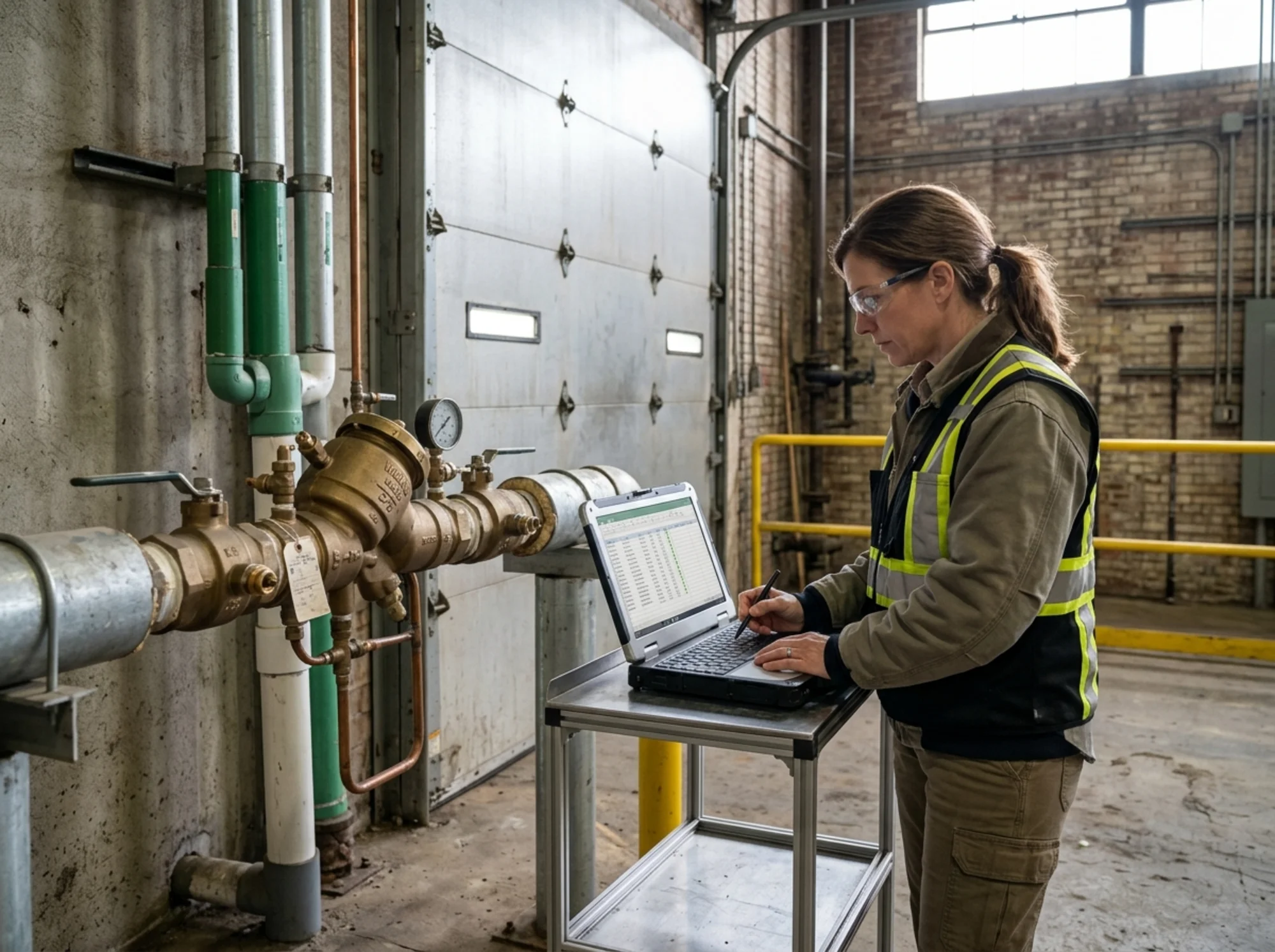 Industrial facility manager using a compliance checklist to track assembly inventory, annual test due dates, repair follow-up, and utility submission status on a laptop near a service entrance backflow assembly, realistic natural light, no logos or text overlay
A simple internal checklist prevents most avoidable misses:
1. Build an assembly register
Track the service line, assembly type, size, location, serial information, last passing test, expected next due date, and document storage location.
2. Flag the hazard drivers
Note whether the site has chemicals, process water, treated boilers, fire-system additives, reused water, or other features likely to change the required protection level.
3. Verify the credential before booking
Check the tester against the state or utility program instead of assuming last year’s vendor is still the right fit.
4. Schedule early enough for failure scenarios
Industrial facilities should avoid last-minute scheduling because a failed assembly can create repair coordination, shutdown planning, or compliance deadline pressure.
5. Treat the report as part of the job
Do not mark the task complete until the report is submitted, accepted when required, saved internally, and the next due cycle is updated.
6. Escalate failed tests immediately
Open the repair task the same day, assign ownership, schedule the retest, and keep the utility-facing deadline visible until a passing result is on file.
Bottom line
Industrial facilities are not automatically handled the same way, but they are very often treated as higher-hazard connections because of the real contamination risk that process equipment, chemicals, water reuse, and specialized plumbing systems can create.
That usually means three things matter more than anything else:
- the utility’s hazard determination,
- the correct assembly selection,
- and reliable annual testing and reporting.
If your facility has not had a serious review in a while, start there. Confirm what the utility expects, verify that the existing assembly still matches the hazard, and make sure the testing and paperwork process is tight before the next due date arrives.
Sources
This article references guidance and regulations from authoritative sources including:
- U.S. Environmental Protection Agency (EPA) - Overview of the Safe Drinking Water Act
- American Water Works Association (AWWA) - Cross-Connection Control and Backflow Prevention resources
- Washington State Department of Health - Cross-Connection Control and Backflow Prevention
- Seattle Public Utilities - Requirements & Types of Backflow Prevention
- Seattle Public Utilities - Backflow Assembly Testing
- New York City Department of Environmental Protection - Backflow Prevention Frequently Asked Questions
- Portland Water Bureau - How to choose and install a backflow prevention assembly
- Centers for Disease Control and Prevention (CDC) - Preventing Drinking Water-Related Illnesses
Last updated: May 7, 2026