Backflow Testing for Laundromats and Dry Cleaners
Backflow Testing for Laundromats and Dry Cleaners
If you run a laundromat or dry cleaner, backflow compliance can feel like one more technical building issue that shows up with very little context. The hard part is that there is no single national rule saying every laundry-type business must use one identical device or follow one identical testing workflow.
What is consistent is the public-health reason behind these programs. EPA says the Safe Drinking Water Act protects public health by regulating the nation’s public drinking water supply, and local utilities, states, and water systems work together to make those standards real on the ground. Backflow testing is one of the practical ways they do that.
For laundromats and dry cleaners, the useful question is not just, “Do I have a backflow preventer somewhere?” It is, “How does my utility classify this property, what hazard does it see here, and what testing or reporting does that trigger?” If you want the broader foundation first, start with why backflow testing is required.
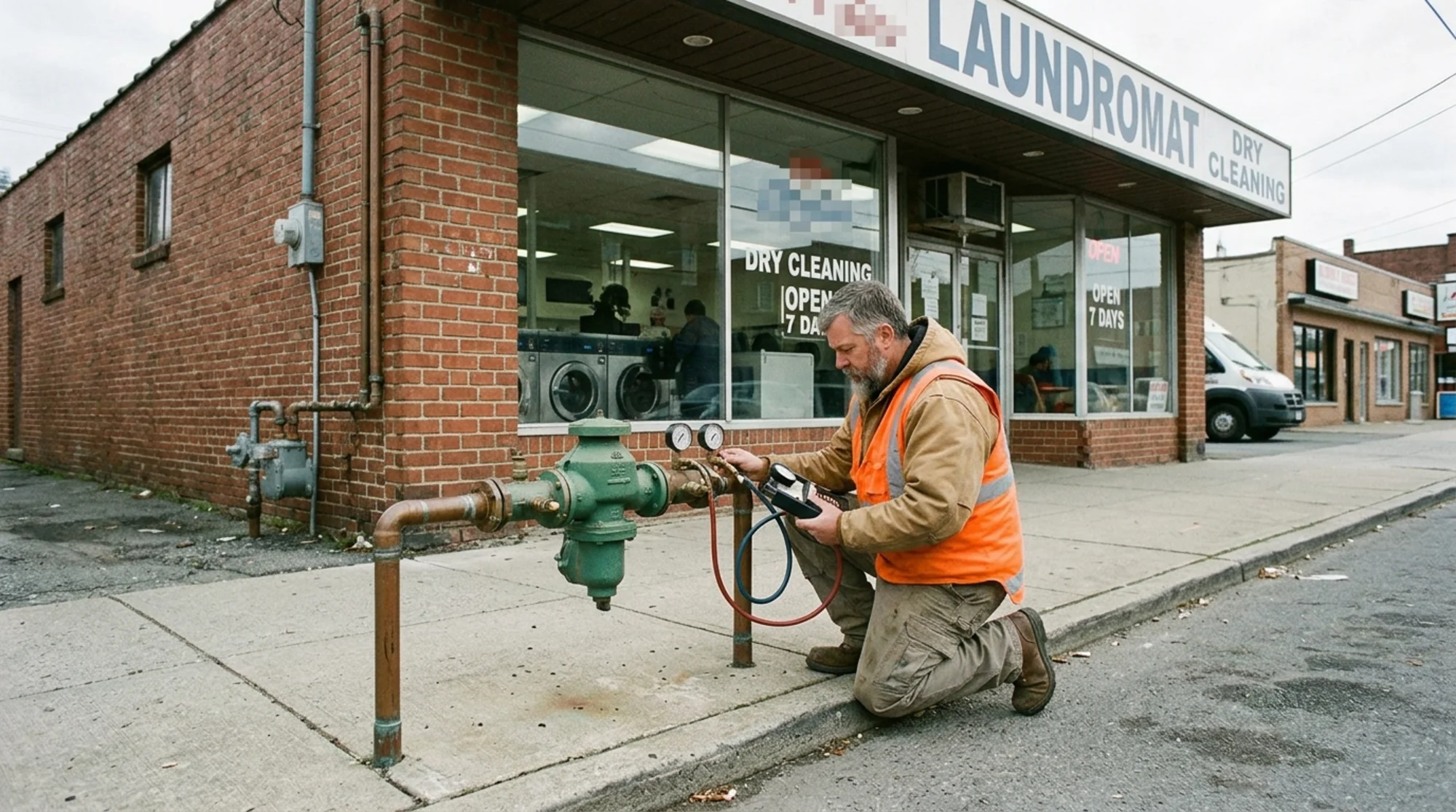
A neighborhood laundromat or dry cleaner with a certified tester inspecting an outdoor backflow prevention assembly near the water service entrance, natural daylight, commercial storefront context, no logos or text overlay
Why laundromats and dry cleaners get extra scrutiny
Some utility programs do not name these businesses directly. Others do, very clearly.
New York City DEP is one of the clearest official examples. Its cross-connection controls page says pressure changes can cause water to flow backward into city water lines, potentially contaminating the public supply. It also explicitly lists laundries and dry cleaners among the types of businesses that must install backflow prevention devices unless they receive a specific exemption.
That does not mean every utility in the country copies New York City’s exact rules. It does show that this business category is not treated as a casual low-risk use everywhere.
Why the extra attention? It usually comes back to the kinds of plumbing conditions these sites can have, depending on the setup:
- boilers or water-heating systems that may use treatment chemicals,
- hose-connected cleaning or service equipment,
- multiple service lines or complicated plumbing layouts,
- process water connections,
- or equipment that raises cross-connection questions during a hazard review.
A basic self-service laundromat and a dry cleaner with different equipment are not automatically identical from a hazard standpoint. That is exactly why owners should avoid guessing from business labels alone.
If you manage multiple sites, this is also a good reminder that requirements can vary by market. Comparing pages like Philadelphia, Pennsylvania and Austin, Texas can help you see how local programs frame compliance.
What utilities and testers are actually looking for
In practice, most programs care about three things.
1. Whether the property creates a meaningful cross-connection risk
Philadelphia Water Department says non-potable supplies containing hazardous substances can compromise drinking water, which is why the city maintains cross-connection control regulations, approved assemblies, certified technicians, and official forms. That is a useful lens for laundry-type properties. Utilities are not looking only at the name on the storefront. They are looking at whether the plumbing setup could allow contaminated or non-potable water to move back toward the public supply.
2. Whether the right assembly is installed for the actual hazard
Portland Water Bureau says the assembly type for commercial properties depends on the location, service size, and hazard level of the connection. It notes that double check valve assemblies are commonly used where the hazard does not pose a health risk, while reduced pressure backflow assemblies provide stronger protection against backpressure or backsiphonage conditions.
That matters because owners sometimes think “a backflow device” is a single product category. It is not. The correct assembly depends on the site and the utility’s hazard evaluation.
3. Whether annual testing and reporting are being handled correctly
Seattle Public Utilities says annual testing is required to make sure assemblies are functioning properly, and owners remain responsible for getting the test done on time. Washington’s Department of Health publishes backflow assembly tester duties and field-test-report content requirements, which tells you the paperwork side is not optional.
So even when the mechanical side seems simple, the compliance side still matters. If a report is incomplete, late, or submitted by the wrong person, the property can stay out of compliance even after a visit happened.
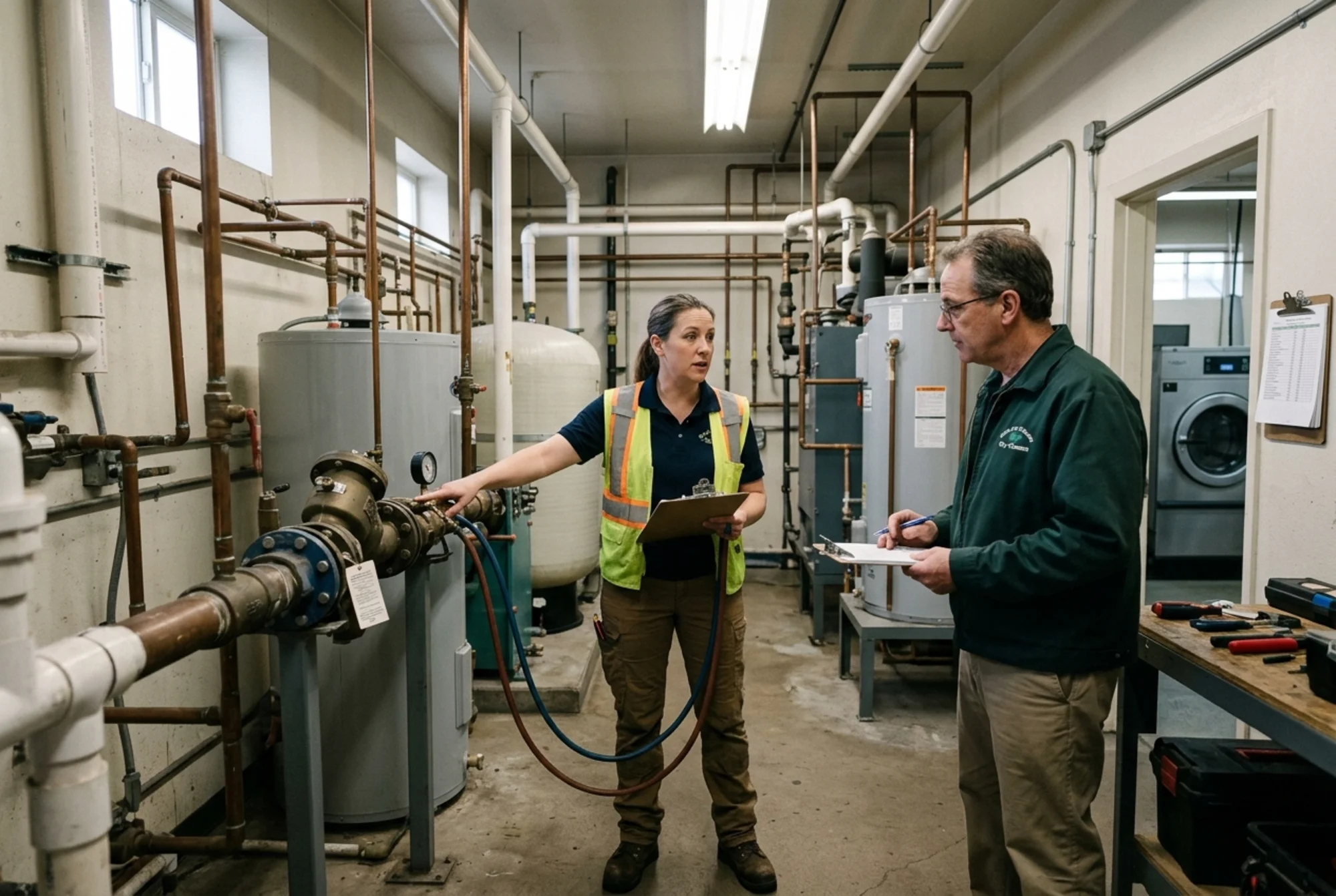 Realistic indoor mechanical room or utility area at a laundromat or dry cleaner, visible piping and water-heating equipment, a certified tester and site manager discussing a backflow assembly and hazard classification, natural industrial lighting, no text overlay
Common site conditions that raise questions
Not every laundromat or dry cleaner has the same setup, but these are the kinds of details that often lead to closer review.
Boilers and treated water systems
If a property has boilers or related water treatment, utilities may look more closely at whether the connection needs stronger isolation. NYC DEP separately lists premises with water boilers that use treatment chemicals among properties requiring backflow protection. That does not automatically tell you which assembly your site needs, but it does show how these systems can affect the hazard picture.
Hose-connected or chemical-adjacent equipment
Any site with hose bibs, cleaning stations, or equipment near chemical handling raises more questions than a plain retail suite with only restrooms and hand sinks. Even when the risk is manageable, utilities may still want a formal device and annual test cycle in place.
Building changes over time
A lot of compliance problems show up after the property changes, not because the business suddenly became risky overnight. New equipment, a remodel, tenant turnover, or plumbing changes can all affect what the utility expects.
That is why older assumptions like “we never had to do this before” are not very reliable. If the property has changed, the answer may have changed too.
Shared responsibility in leased spaces
Some operators lease space in a larger center or mixed-use property. In that case, the backflow assembly may protect the whole building rather than the tenant space alone. Before you assume the landlord is handling everything, confirm:
- where the assembly is,
- who owns the compliance deadline,
- who hires the tester,
- and who keeps the records.
Our guide on how utilities track backflow test compliance is useful if you want the utility-side view of why missing records keep turning into notices.
What the testing and compliance process usually looks like
For most owners, the annual process is more structured than it first appears.
First, the property either already has a testable assembly on file or is told one is required. If the device is newly installed or the site is being reviewed, there may also be plan or approval steps before the ongoing annual cycle really settles in.
Then a qualified tester performs the field test. Seattle says these tests must be done by a State of Washington Certified Backflow Assembly Tester, and Washington DOH publishes both certification resources and field-report expectations. Other states and utilities use their own credentialing systems, but the pattern is similar: the person testing the device usually needs to be recognized by the applicable program.
After the field test, the report still has to be completed correctly and accepted. NYC DEP says annual device testing is required every 12 months, and failure to perform the annual test can lead to fines or disconnection of water service. Seattle similarly warns that non-compliance charges or possible water termination can result when testing is not completed.
In other words, the job is not finished when the gauges come off. It is finished when the device passes, the report is complete, and the utility has what it needs.
If you are comparing program expectations, our Philadelphia Water Department backflow testing page and Austin Water backflow testing page are good utility-specific starting points.
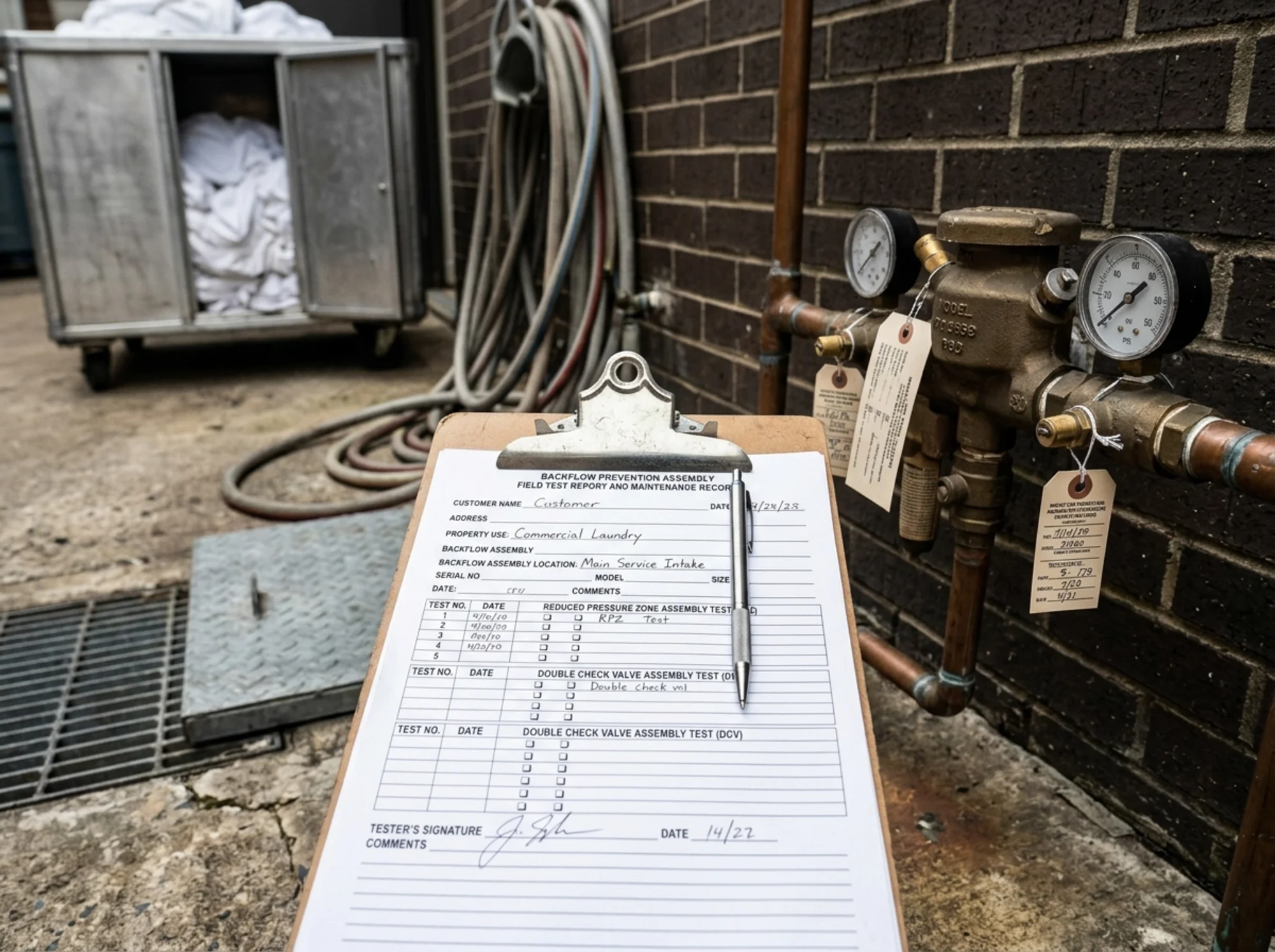 A clipboard with a completed backflow field test report and maintenance records beside a commercial backflow assembly serving a laundry-type business, organized compliance paperwork, natural lighting, no logos or text
Best practices for owners and managers
You do not need to become a backflow expert to stay ahead of this. A few practical habits go a long way.
Keep a simple assembly record
At minimum, track:
- assembly location,
- assembly type,
- size and serial number if available,
- last passing test date,
- next due date,
- tester name and credential,
- and a copy of the submitted report.
Ask direct questions instead of assuming
Before your next deadline, ask:
- Does my utility classify this property or plumbing setup as requiring annual testing?
- What assembly type is on file for this location?
- Who submits the report, the tester or the property?
- If the assembly fails, who handles repair and retest?
- If we changed equipment or plumbing, does the utility need to re-evaluate the site?
Treat paperwork as part of the job
Philadelphia publishes official forms. Washington publishes report-content requirements. Seattle tells owners they are still responsible for timely testing. All of that points to the same reality: good paperwork is not extra credit. It is part of compliance.
Use local program resources when the answer is fuzzy
If your utility’s public guidance is thin, do not improvise. CDC says people with concerns about tap water should contact their utility or health department. That same mindset applies here. When the site setup is unusual, the safest move is to confirm the requirement with the program instead of making a guess that turns into a violation later.
For quick baseline answers, our FAQs and how to choose a qualified backflow tester can help you sort out the next step.
Bottom line
Laundromats and dry cleaners are the kind of properties that often draw closer backflow scrutiny because of site-specific hazard questions, not because every location in America follows one identical rulebook.
What we can say confidently from official sources is that some utilities, including NYC DEP, explicitly include laundries and dry cleaners among businesses required to install backflow prevention devices. We can also say that annual testing, qualified testers, accepted assemblies, and complete reports are recurring themes across utility and state guidance.
So the safest approach is simple: confirm how your local program classifies the site, make sure the installed assembly matches the hazard, and treat the annual test plus paperwork as a routine operating task instead of a last-minute fire drill.
Sources
This article references guidance and regulations from authoritative sources including:
- U.S. Environmental Protection Agency (EPA) - Overview of the Safe Drinking Water Act
- American Water Works Association (AWWA) - Cross-Connection Control and Backflow Prevention resources
- Centers for Disease Control and Prevention (CDC) - Preventing Drinking Water-Related Illnesses
- New York City Department of Environmental Protection - Backflow Prevention Devices
- Washington State Department of Health - Cross-Connection Control and Backflow Prevention
- Seattle Public Utilities - Backflow Assembly Testing
- Philadelphia Water Department - Cross-Connection & Backflow Compliance
- Portland Water Bureau - How to choose and install a backflow prevention assembly
Last updated: May 3, 2026