Backflow Testing Cost Breakdown by Device Type: 2026 Price Guide
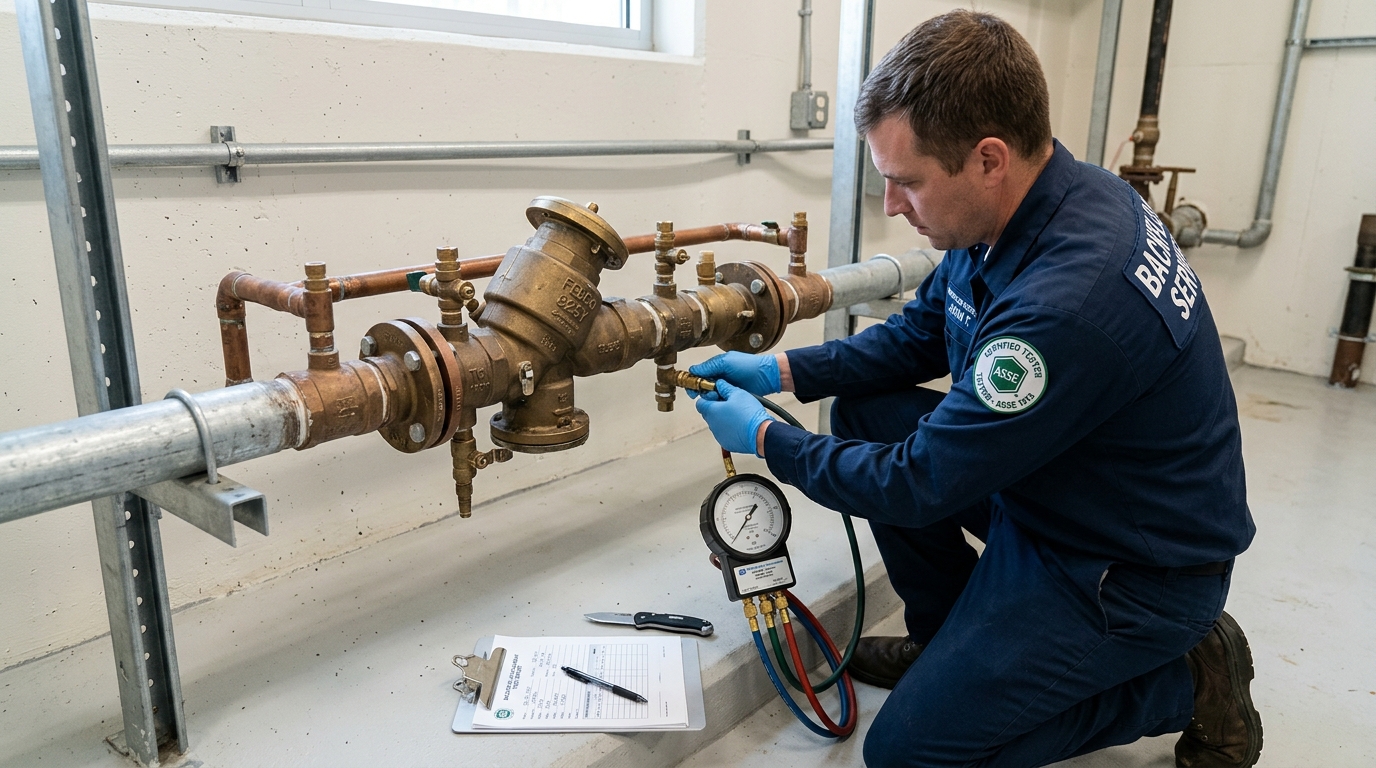
What You're Actually Paying For When You Get a Backflow Test
Backflow testing prices look random until you understand the device sitting on your property. A $35 test and a $400 test can both be legitimate quotes — the difference is the assembly, the access, and the paperwork your water purveyor demands. Before you compare quotes, you need to know what device you have, how testers are pricing it in 2026, and which line items are negotiable.
This guide breaks down real cost ranges by device type, explains why prices shift between residential and commercial work, and gives you a checklist to make sure you're not overpaying — or hiring someone who's cutting corners to win the bid.
The Four Device Types That Drive Price
Every certified tester quotes based on the assembly type first, then layers in access, location, and reporting fees. The four devices you'll encounter:
- Atmospheric Vacuum Breaker (AVB) — usually not testable, but sometimes inspected
- Pressure Vacuum Breaker (PVB) — common on irrigation systems
- Double Check Valve Assembly (DCVA or DC) — common on fire lines and low-hazard commercial
- Reduced Pressure Zone Assembly (RPZ or RP) — required for high-hazard cross-connections
The test procedure for each is different. An RPZ has three test cocks and requires verifying the relief valve opens at a specific pressure differential. A PVB has a simpler air-inlet check. That difference in labor — usually 10 to 25 minutes of actual gauge time — drives most of the price spread.
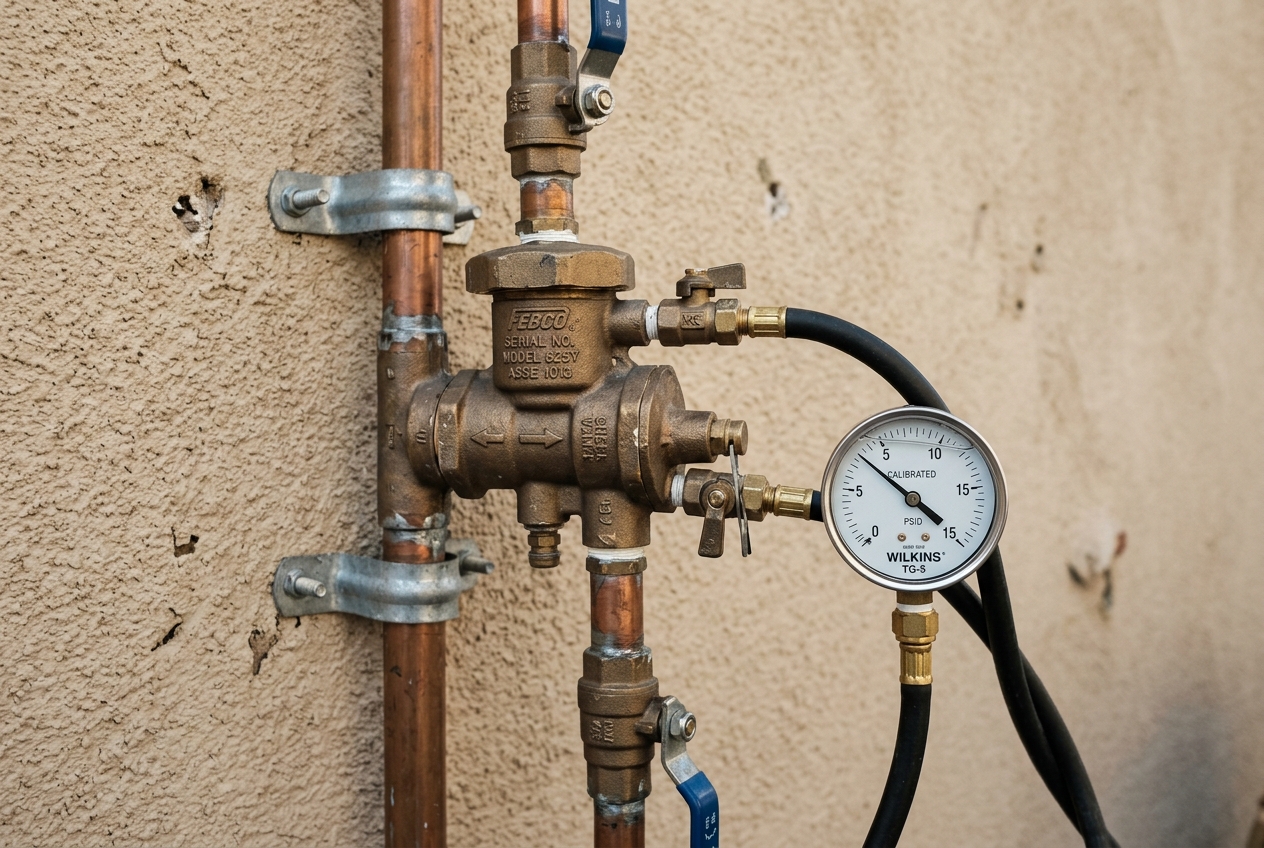 Close-up of a brass RPZ backflow assembly with test cocks and a calibrated test gauge connected by hoses, mounted on a copper supply line against a beige stucco wall
Residential Cost Ranges in 2026
For single-family homes, you're almost always testing either a PVB on the irrigation system or, less commonly, a DCVA on a fire sprinkler line. Here's what fair pricing looks like this year across most U.S. metros:
PVB (irrigation) — $35 to $95 This is the most common residential test. A tester pulls up, opens the test cocks, runs a 5-minute procedure, and submits the report. Expect the lower end ($35–$55) in competitive markets like Phoenix, Dallas, and most of Florida. Expect the higher end ($75–$95) in the Pacific Northwest, Northeast, and California, where licensing requirements and labor costs run higher.
DCVA (residential fire line or duplex) — $55 to $150 Slightly more labor than a PVB, and these are often installed in pits or vaults that require lifting a lid. Prices climb fast if the lid is heavy, buried under landscaping, or if the tester needs a confined-space entry assessment.
RPZ (residential, rare) — $85 to $200 You'll see these on homes with boilers, irrigation systems connected to chemical injectors, or pools with auto-fill lines in jurisdictions that classify them as high-hazard. The RPZ procedure takes longer and the assemblies are more sensitive — a single piece of grit can cause a fail, which means a callback and a repair charge.
If you're being quoted over $200 for a standard residential PVB with easy access, you're either in a very expensive market or you're being upsold. Get a second quote.
Commercial Cost Ranges in 2026
Commercial pricing is where the math gets interesting. The device matters, but so does the building, the schedule, and the water purveyor's reporting system.
Single DCVA (small commercial, 2"–3") — $85 to $250 Strip-mall tenants, small offices, restaurants without grease traps tied to the domestic line — this is the workhorse test. Most testers price it as a single-assembly visit with no surprises.
Single RPZ (small commercial, 1"–2") — $125 to $300 Common on coffee shops with espresso machines, dental offices, salons with chemical processing, and any building with a boiler. The 1" and 1.5" sizes are quick; 2" RPZs take longer because the test cocks are stiffer and the relief valve is more sensitive to debris.
Large RPZ (4"–10", fire or domestic) — $250 to $750+ This is where pricing splits dramatically. A 4" RPZ on an easily accessible fire riser in a heated mechanical room might run $250. The same assembly in a flooded vault 8 feet below grade, requiring a confined-space permit and a two-person crew, can hit $750 or more. For 6"–10" assemblies — common on hospitals, schools, and industrial facilities — expect $400 to $1,200 per assembly when crews need to coordinate water shutoffs with the building.
Detector Check Assemblies (DDCV/DCDA on fire lines) — $125 to $400 These have a small bypass meter that gets tested alongside the main assembly. Some testers price the bypass separately, some bundle it. Always ask.
Multi-assembly properties — volume discounts apply If you have 5 or more assemblies at one address, expect a 10–25% discount per device versus single-assembly pricing. Testers love multi-assembly jobs because the windshield time is amortized.
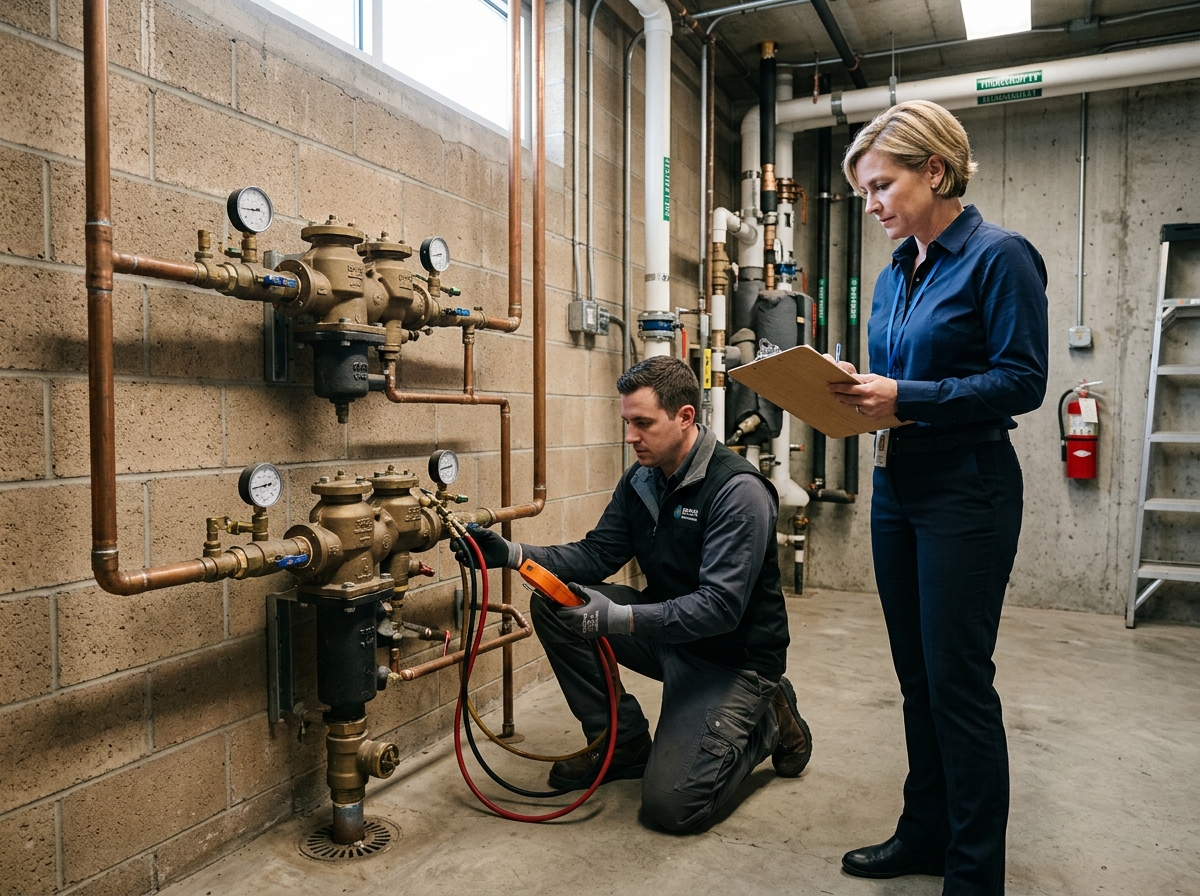 A property manager in a button-down shirt standing in a mechanical room with two large brass RPZ assemblies mounted on a wall, holding a clipboard while a tester kneels with a test kit
Why Two Quotes for the "Same" Device Can Differ by 3x
Once you understand the assembly, the next variable is everything around it. Here's what legitimately changes the price:
Access conditions. A PVB in a flower bed at 6" above grade costs less than the same PVB in a locked utility closet on the third floor. Vault assemblies — RPZs and DCVAs installed below grade — almost always cost more because of lid weight, water in the pit, and confined-space considerations.
Water shutoff coordination. Testing an RPZ requires briefly interrupting water flow. For a home, this is invisible. For a hospital, restaurant during lunch, or 24/7 data center, it requires scheduling, notifications, and sometimes after-hours labor at 1.5x to 2x the day rate.
Reporting fees. Many municipalities now charge a backflow program fee or require electronic submission through a third-party system like BSI Online, SyncBackflow, Aqua Backflow, or Tokay. Some testers absorb this $5–$25 per report into their price; others itemize it. Either is fine — what matters is that it gets submitted on time.
Repair vs. test pricing. A test is just the inspection. If your device fails, you'll pay for parts and labor on top of the test fee. Common repairs:
- PVB poppet rebuild kit installed: $75–$150
- DCVA check replacement: $100–$250 per check
- RPZ relief valve rebuild: $150–$350
- Full RPZ replacement (2"): $800–$1,800 installed
- Full RPZ replacement (6"): $4,500–$12,000 installed
Most reputable testers will offer to rebuild on the spot if they have the parts on the truck, saving you a second trip charge.
Travel and minimum-call fees. Rural properties or properties more than 30 miles from the tester's base often carry a $25–$75 trip charge. Some testers have a $95–$150 minimum that supersedes their per-assembly rate if you only have one small device.
What the Water Purveyor Actually Requires
You're paying for two things: the physical test, and the documentation that proves it happened. The documentation matters more than most property owners realize. A test that doesn't get submitted, or that gets submitted with the wrong assembly serial number, is legally a non-test — and you can get a shutoff notice for it even though a tester was on site.
When you hire someone, confirm:
- They are certified in your state or by your water purveyor (ASSE 5110, AWWA, or state-specific credentials).
- Their gauge is calibrated within the last 12 months (some purveyors require every 6 months, and they will reject reports from an out-of-date gauge).
- They submit through whatever system your water purveyor uses, not just a paper copy mailed to you.
- They give you a copy of the report — digital is fine — with the assembly serial number, test cock readings, and pass/fail clearly noted.
If a tester can't answer questions about which system your purveyor uses, they're either new to your area or unprepared. That's a yellow flag, especially for commercial work where a missed submission can trigger a code-violation letter.
Annual vs. Multi-Year Pricing
Most jurisdictions require annual testing on RPZ and DCVA assemblies. Some allow biennial testing on low-hazard DCVAs, and some health-department-regulated facilities require semi-annual.
Many testers offer multi-year service agreements at a 5–15% discount in exchange for locking in their renewal date. These can be worth it if:
- You have multiple assemblies and want one invoice per year
- You manage a portfolio of properties and want one vendor relationship
- You've had submission failures in the past and want a vendor who tracks deadlines for you
They are not worth it if the agreement bundles in expensive "preventive maintenance" services you don't need, or if it has an auto-renewal clause without a clear cancellation window. Read the cancellation terms before signing.
 A homeowner reviewing a backflow test report on a tablet at a kitchen counter, with a paper invoice and a coffee mug beside the tablet
Red Flags in Pricing
After years of complaints filed with state plumbing boards and water utilities, a few patterns show up repeatedly:
- "Free test" offers that require a repair quote. Some companies test for $0 and then claim the device failed, charging $400+ for a "necessary" rebuild. Always ask to see the gauge readings and the failure criteria.
- Refusing to provide the report directly. If a tester says "the water company has it, you don't need a copy," walk away. You are legally entitled to the report.
- Quoting much higher prices for commercial than the device warrants. A 1.5" RPZ at a coffee shop should not cost $600 unless there's a real access problem. If the quote is dramatically out of line, get two more quotes.
- Pressure to replace rather than repair. Most assemblies can be rebuilt for under $300. Full replacement is rarely justified unless the body is cracked, the assembly is more than 25 years old, or repair parts are no longer manufactured.
How to Get a Fair Quote in 10 Minutes
The fastest way to know if you're being quoted fairly:
- Find the assembly tag on the device. It will list make, model, size, and serial number. Take a photo.
- Check your last test report. It tells you the device type, size, and the previous pass/fail. If you can't find it, your water purveyor can email it.
- Call two or three local testers with that information. Ask: "What's your flat rate to test a [size + type] at a [residential / commercial] address with [easy / vault / mechanical room] access?"
- Confirm the report-submission process before booking. Ask which system they use and whether the submission fee is included.
- Schedule during off-peak times. May–July is heavy irrigation-testing season; rates and availability are tighter. October–March often has lower pricing for testers trying to fill the calendar.
A homeowner can usually book a PVB test the same week for under $75. A property manager with 3+ assemblies can almost always negotiate $20–$40 off per device by bundling the visit.
Final Thought
Backflow testing is one of those services where the cheapest option is usually fine for simple devices and the most expensive option is rarely justified except for difficult access. Most of the price you pay reflects two things: the actual test procedure (mostly fixed by device type) and the access logistics (highly variable). Once you know which device you have and where it lives, you can quote-shop confidently — and recognize when a quote is either too good to be true or padded with line items you don't need.
Keep your last test report on file, photograph your assembly tag, and renew with the same vendor when their pricing stays reasonable. Continuity saves you money and prevents the small administrative errors — wrong serial number, missed submission deadline, expired gauge — that turn a $75 test into a code-violation headache.