How Backflow Contamination Events Actually Happen: Real Examples
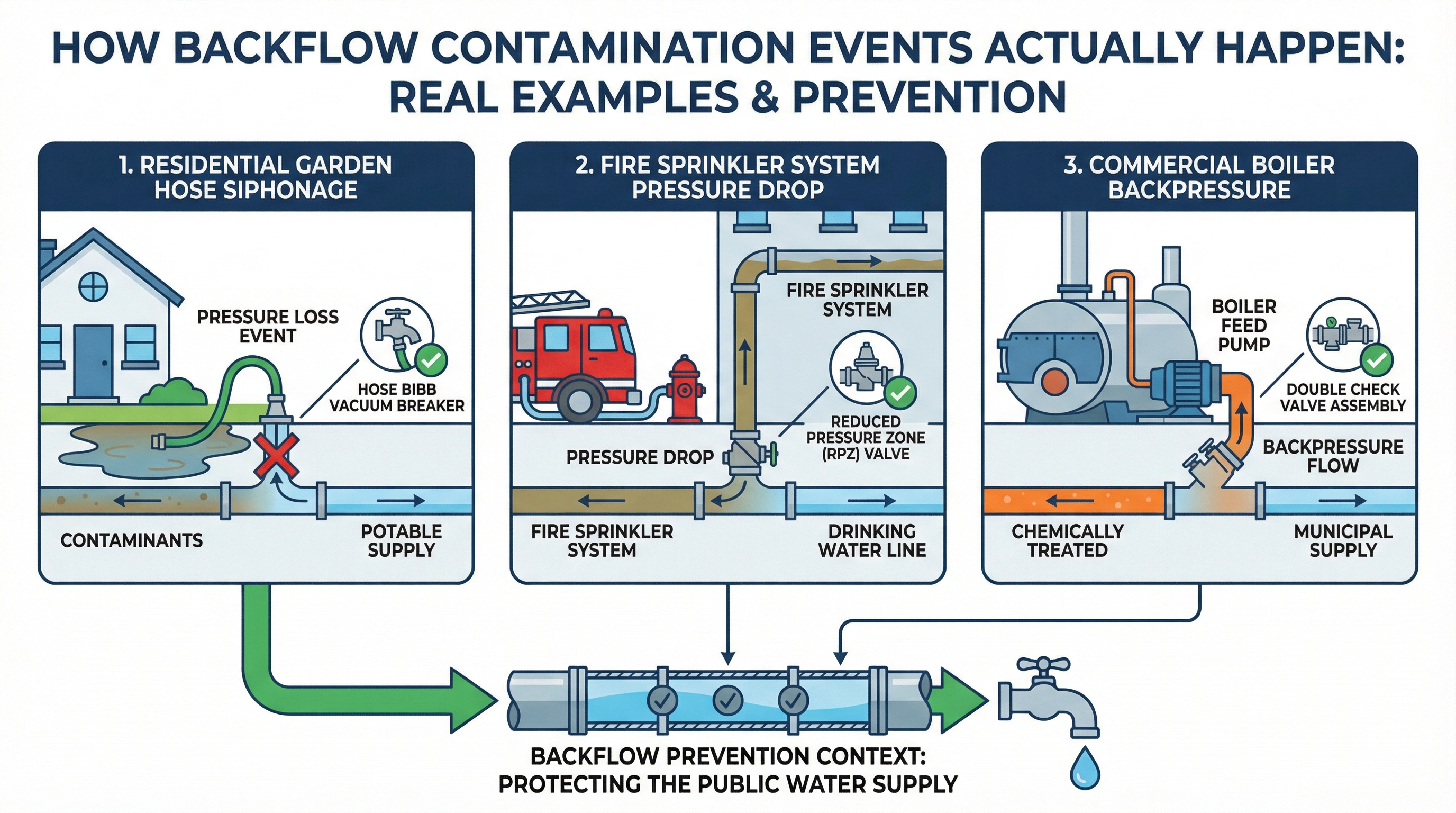
When people hear about backflow testing requirements, a common reaction is skepticism. Does water really flow backward? Can contamination actually reach the drinking water supply through my plumbing? These are fair questions — and the answer to both is an unequivocal yes.
Backflow contamination events are documented regularly by the CDC, state health departments, and water utilities. They range from minor water quality complaints to serious public health emergencies. Understanding how they happen makes the case for backflow prevention far more concrete than any regulation can.

How Contamination Reaches Drinking Water
Backflow contamination follows a consistent pattern: a cross-connection exists (a link between potable water and a contamination source), a pressure change occurs (supply pressure drops or downstream pressure increases), and contaminants flow backward through the cross-connection into the potable water system.
The two mechanisms that drive this:
Back-siphonage occurs when supply pressure drops, creating a vacuum that pulls water backward. Think of sucking on a straw — when the pressure at the supply end drops below the pressure at the contamination end, the contamination gets drawn into the supply.
Back-pressure occurs when downstream pressure exceeds supply pressure, pushing contaminated water backward. This happens with pumped systems, elevated tanks, and pressurized chemical injection equipment.
Both mechanisms are well-documented by the American Water Works Association and the CDC.
Documented Contamination Scenarios
The following scenarios represent real categories of backflow events documented by health authorities and water utilities. While specific identifying details are generalized to protect privacy, every scenario type has occurred multiple times across different jurisdictions.
The Irrigation System Chemical Backflow
What happened: A residential property had an in-ground irrigation system connected to the domestic water supply without a backflow preventer. The irrigation system included a chemical fertilizer injection system. During a water main break two blocks away, supply pressure dropped dramatically. The fertilizer solution was siphoned backward through the irrigation connection, into the home's plumbing, and into the water main serving the neighborhood.
Result: Multiple neighbors reported foul-smelling, discolored water. The utility issued a do-not-drink advisory for the affected area. The chemical concentrations detected were above safe drinking water levels.
What would have prevented it: A properly installed and tested PVB or RPZ assembly on the irrigation supply line.
The Boiler Chemical Contamination
What happened: A commercial building's hot water boiler system was connected to the potable water supply for makeup water. The boiler system was treated with chromate-based corrosion inhibitors — chemicals that are effective for boiler maintenance but toxic to humans. When a booster pump on the building's water system created back-pressure exceeding the street main pressure, boiler treatment chemicals were pushed backward through the makeup water connection into the potable supply.
Result: Building occupants reported green-tinted water with a metallic taste. Testing confirmed chromate contamination above EPA maximum contaminant levels. The building was evacuated and the water system was flushed for several days.
What would have prevented it: An RPZ assembly on the boiler makeup water line, which is required by most plumbing codes but had never been installed in this older building.
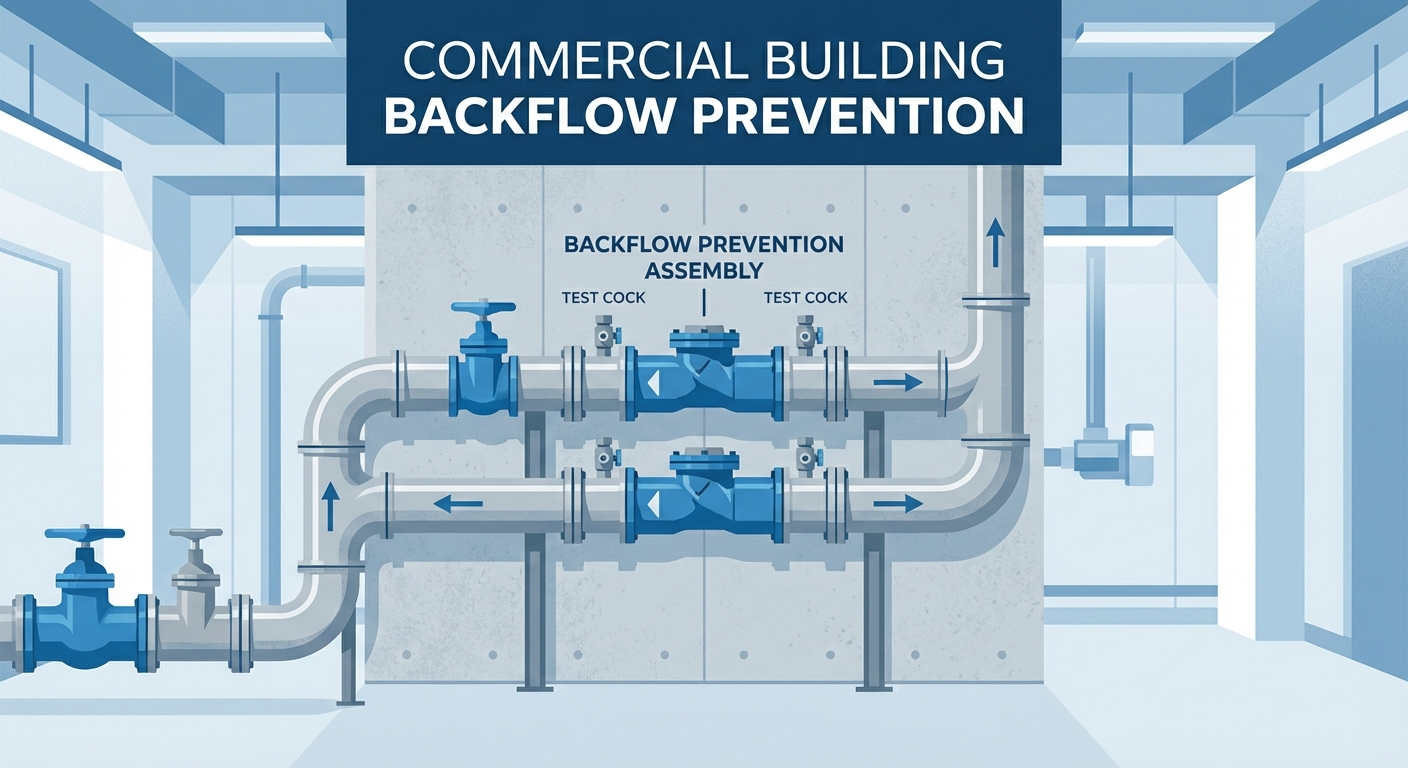 Commercial and industrial connections to the public water supply carry the highest risk of contamination backflow.
The Garden Hose Incident
This is one of the most common and underappreciated backflow scenarios.
What happened: A homeowner left a garden hose running in a bucket of soapy water used for car washing. The hose end was submerged below the water surface, creating a cross-connection. When the water utility performed hydrant flushing on the same block (which temporarily reduces system pressure), the soapy water was siphoned backward through the hose, through the home's plumbing, and into the water main.
Result: The homeowner and neighbors reported soapy-tasting water. While not a severe health hazard, it demonstrated how easily contamination can enter the system through a connection as simple as a garden hose.
What would have prevented it: A hose bibb vacuum breaker on the outdoor faucet ($3-$8 at any hardware store) — or simply keeping the hose end above the water surface.
The Funeral Home Cross-Connection
What happened: A funeral home's embalming fluid supply was connected to the potable water system for dilution purposes. The cross-connection was not protected by a backflow prevention device. A pressure fluctuation in the supply main caused embalming chemicals (including formaldehyde) to backflow into the public water system.
Result: Area residents reported strong chemical odors from their tap water. The utility detected formaldehyde and other embalming chemicals in the distribution system. A boil-water advisory was issued and the affected section of main was flushed extensively.
What would have prevented it: An RPZ assembly on the funeral home's water service connection. This is a textbook high-hazard cross-connection that absolutely requires RPZ protection.
The Swimming Pool Backflow
What happened: A residential swimming pool had an automatic fill valve connected directly to the home's potable water supply without any backflow protection. During a period of unusually high demand on the water system (hot summer afternoon with heavy irrigation use), system pressure dropped. Heavily chlorinated and chemically treated pool water was drawn backward into the home's plumbing and potentially into the distribution main.
Result: The homeowner noticed chemical taste and odor at interior faucets. The pool chemistry (high chlorine, cyanuric acid, algaecides) had contaminated the home's potable water.
What would have prevented it: A backflow preventer on the pool fill line — required by code in most jurisdictions but sometimes omitted during DIY pool installations.
Why These Events Still Happen
Despite cross-connection control programs, backflow events continue to occur because:
- Not all cross-connections are identified. Older properties may have cross-connections that predate the utility's program.
- Devices fail between tests. A device that passed last year's test may have failed since. That's why annual testing exists — to catch failures.
- DIY installations bypass protections. Homeowners who install irrigation systems, pools, or other connections without permits may not install required backflow protection.
- Compliance gaps exist. Some property owners ignore testing notices, leaving devices untested and potentially non-functional.
What This Means for You
Every property with a backflow prevention device is a link in the chain that protects the public water supply. Your annual backflow test verifies that your link is holding. When you skip the test or ignore the notice, you're creating a gap in the system — a gap that could lead to exactly the kinds of contamination events described above.
The consequences extend beyond your property. A backflow event through your unprotected or untested connection can affect your neighbors, your entire block, or even a larger section of the distribution system.
The Bottom Line
Backflow contamination isn't theoretical — it's documented, it's recurring, and it's preventable. The cross-connection control program your utility manages, and the annual testing requirement they enforce, exist because these events are real.
Your part is straightforward: maintain your backflow prevention device, get it tested annually, and make sure it's working. It's a small investment that protects your drinking water and your community's.
Find a certified backflow tester in your area and stay current on your testing. For details on what annual testing involves, read what happens after you get a backflow test notice.
Sources
This article references guidance and regulations from authoritative sources including:
- Centers for Disease Control and Prevention (CDC) - Cross-Connection Control and Backflow Prevention — Surveillance data on waterborne disease outbreaks related to backflow
- U.S. Environmental Protection Agency (EPA) - Safe Drinking Water Act — Federal authority for drinking water protection
- American Water Works Association (AWWA) - Manual M14: Backflow Prevention and Cross-Connection Control — Documented contamination event case studies and prevention strategies
- USC Foundation for Cross-Connection Control and Hydraulic Research - Manual of Cross-Connection Control — Technical analysis of backflow mechanisms and real-world case documentation
Last updated: March 14, 2026