What Does Backflow Assembly Testing Actually Cost in 2026?
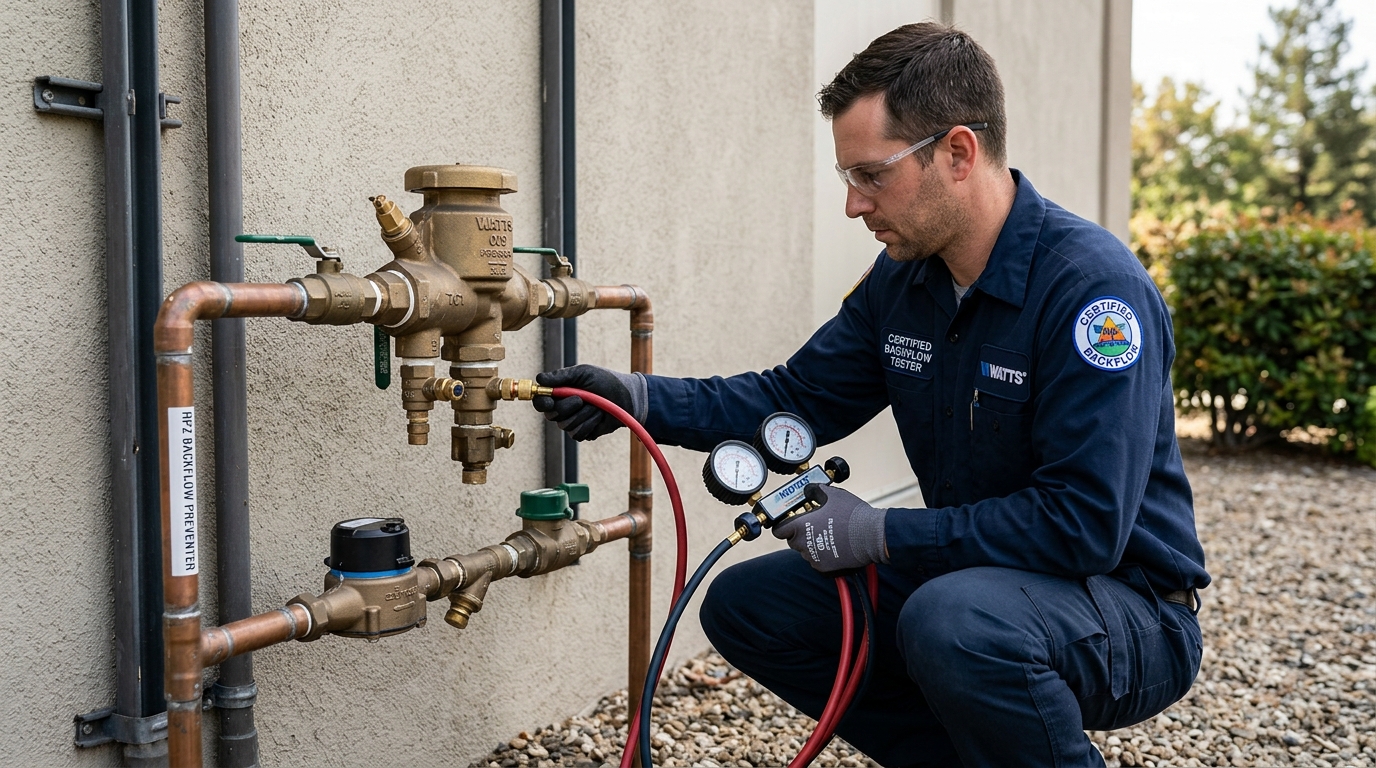
What Does Backflow Assembly Testing Actually Cost?
If you own property with a backflow prevention assembly, you already know the device is required by your local water utility. What catches many people off guard is the recurring cost of keeping it compliant. Every year—sometimes more often—a certified tester has to inspect your assembly, file paperwork, and confirm it's protecting the public water supply from contamination.
So what should you expect to pay? The answer depends on where you live, what type of assembly you have, how many devices are on your property, and whether repairs are needed. This guide breaks down real-world backflow testing fees so you can budget accurately and avoid overpaying.
Typical Fee Ranges in 2026
Backflow assembly testing fees vary significantly by region, but most residential customers in the United States pay between $75 and $250 per device per annual test. Commercial properties with larger or more complex assemblies typically pay $150 to $400+ per device.
Here's a general breakdown:
| Assembly Type | Residential Range | Commercial Range |
|---|---|---|
| Double Check Valve Assembly (DCVA) | $75–$150 | $125–$250 |
| Reduced Pressure Zone (RPZ) | $100–$200 | $175–$400 |
| Pressure Vacuum Breaker (PVB) | $75–$125 | $100–$200 |
| Spill-Resistant PVB (SVB) | $80–$140 | $110–$225 |
These ranges cover the test itself—showing up, attaching a differential pressure gauge kit, running the test, and submitting the report to your water purveyor. They do not include repairs, which are billed separately.
If you're in a major metro area like Los Angeles, Chicago, or New York, expect to land on the higher end. Rural areas and smaller municipalities often see lower testing fees because overhead costs are lower and competition among certified testers can drive prices down.
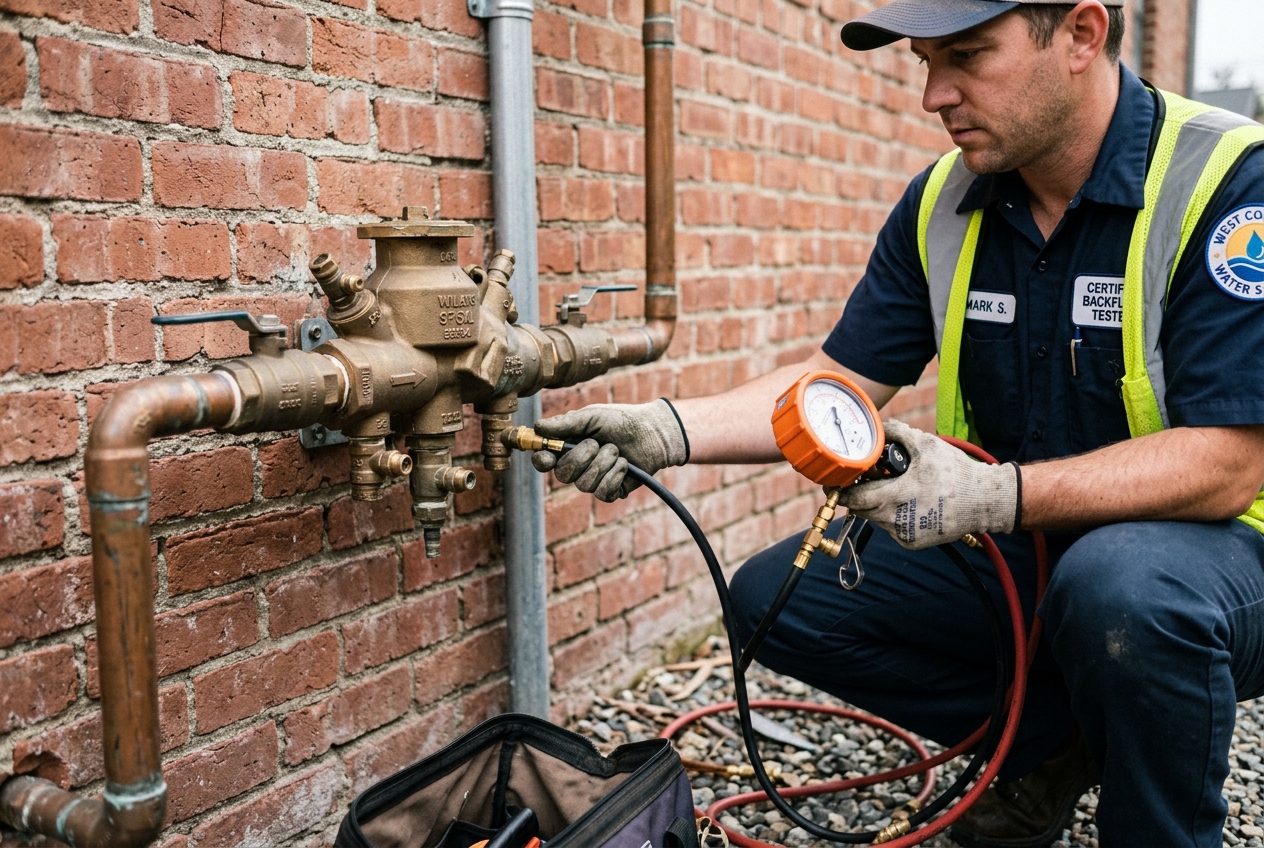 Certified backflow tester attaching gauge kit to an RPZ assembly mounted on an exterior wall
What's Included in the Testing Fee
A standard backflow assembly test fee should cover:
- Travel to your property. Most testers include one trip in their base fee. If your property is outside their normal service area, some charge a trip fee on top.
- The physical test. The tester connects a calibrated differential pressure gauge to the test cocks on your assembly and checks each internal valve (check valves, relief valve on RPZ devices) for proper operation. This typically takes 15 to 30 minutes per device.
- The test report. After completing the test, the tester fills out a standardized form—often the format required by your state or municipality—documenting pass/fail results and specific pressure readings.
- Filing with your water utility. In most jurisdictions, the certified tester submits the completed test report directly to your water purveyor or cross-connection control program. Some utilities accept electronic submissions; others still require paper forms.
What is usually not included:
- Replacement parts (springs, seats, o-rings, check modules, relief valve kits)
- Labor for repairs if the assembly fails the test
- Permit fees charged by some municipalities for the test itself
- Shut-down or drain-down of fire suppression systems
Understanding this distinction is critical. A $125 test can quickly become a $400+ visit if your assembly fails and requires rebuild kits and additional labor.
Why Prices Vary So Much
Several factors drive the spread in backflow testing costs:
1. Geographic Location
Labor rates, cost of living, and local regulations all affect pricing. A tester in San Francisco has different overhead than one in rural Oklahoma. Some states also require testers to hold specific licenses beyond the basic backflow certification, which limits the supply of qualified professionals and can push prices up.
2. Assembly Size and Type
Larger assemblies (2-inch and above) take more time to test and are more common on commercial properties. A 6-inch RPZ on a fire line is a different job than a 3/4-inch DCVA on a residential irrigation system. Testers price accordingly.
3. Number of Assemblies on Site
Many testers offer volume discounts. If you have three assemblies on your commercial property, you'll often pay less per device than if you had just one. For property managers overseeing multiple buildings, negotiating a per-device rate for all locations can save hundreds of dollars annually.
4. Access and Site Conditions
Assemblies installed in pits, confined spaces, or behind locked fences require extra time and sometimes specialized equipment. If the tester can't access the test cocks easily—because of vegetation overgrowth, a buried vault full of water, or a missing pit lid—expect to pay more or face a return trip charge.
5. Emergency or Rush Scheduling
If your water utility sends a compliance notice with a short deadline and you need same-week testing, some companies charge a premium. Planning ahead and scheduling your test before the deadline approaches is the simplest way to avoid rush fees.
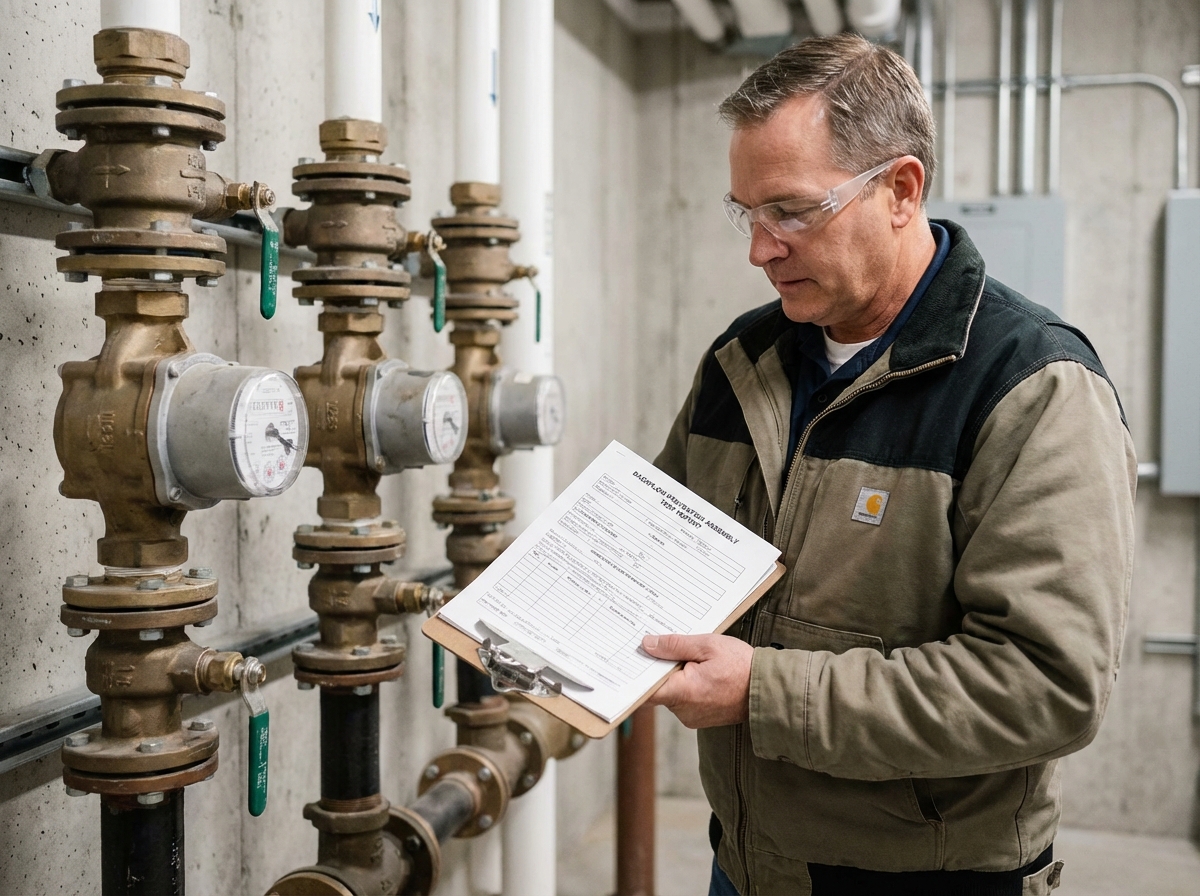 Property manager reviewing a backflow test report on a clipboard next to a row of commercial water meters
Common Extra Charges to Watch For
Beyond the base test fee, here are charges that legitimately show up on invoices—and some that shouldn't:
Legitimate extra charges:
- Repair labor: If your assembly fails, the tester may offer to repair it on the spot. Expect $50–$150 in additional labor depending on the complexity, plus parts. Rebuilding an RPZ relief valve, for instance, requires a kit that runs $30–$80 for residential sizes.
- Retest fee: After repairs, the assembly must be retested. Some testers include one retest in their repair labor charge. Others bill it separately at $25–$75.
- Confined space entry: Testing assemblies in below-grade vaults classified as confined spaces may require additional safety equipment and training. A $50–$100 surcharge for confined space entry is reasonable.
- Fire line drain/refill coordination: Testing a backflow assembly on a fire suppression line means temporarily taking the system offline. Some testers coordinate this with your fire alarm monitoring company, which adds time and cost.
Charges to question:
- "Administrative fees" beyond what your utility charges. The tester's overhead should be built into their base price.
- Excessively high parts markups. A $15 check valve kit billed at $75 is a red flag. Ask for an itemized parts list.
- Charges for filing the report when this is already standard practice included in the test fee.
How to Get Fair Pricing
Getting a reasonable price on backflow testing isn't complicated, but it does require a little effort:
Get multiple quotes. Call at least two or three certified testers in your area. Ask for their per-device rate, whether that includes the report filing, and what they charge if repairs are needed. Comparing quotes is the fastest way to identify outliers.
Ask about multi-device or multi-year pricing. If you have several assemblies or manage multiple properties, many testers will negotiate a lower per-unit rate for guaranteed volume. Some offer annual service agreements that lock in pricing and guarantee scheduling priority.
Schedule early in the compliance cycle. Most water utilities send annual test reminders with a 30 to 90-day window. Scheduling early gives you more options and avoids rush premiums. It also gives you time to get repairs done if your assembly fails.
Verify the tester's certification. Every state or municipality maintains a list of certified backflow assembly testers. Using an uncertified person—even if they're cheaper—means the test results won't be accepted by your water utility, and you'll pay twice. In most jurisdictions, testers must hold a current certification from an approved program (such as ABPA, ASSE, or a state-specific program) and use a calibrated gauge with a current calibration certificate.
Don't automatically choose the cheapest option. The lowest bid sometimes means corners are being cut—skipping test cocks, not properly evaluating relief valve operation, or submitting incomplete reports. A thorough test by a qualified professional protects you from liability and ensures your assembly actually works when it matters.
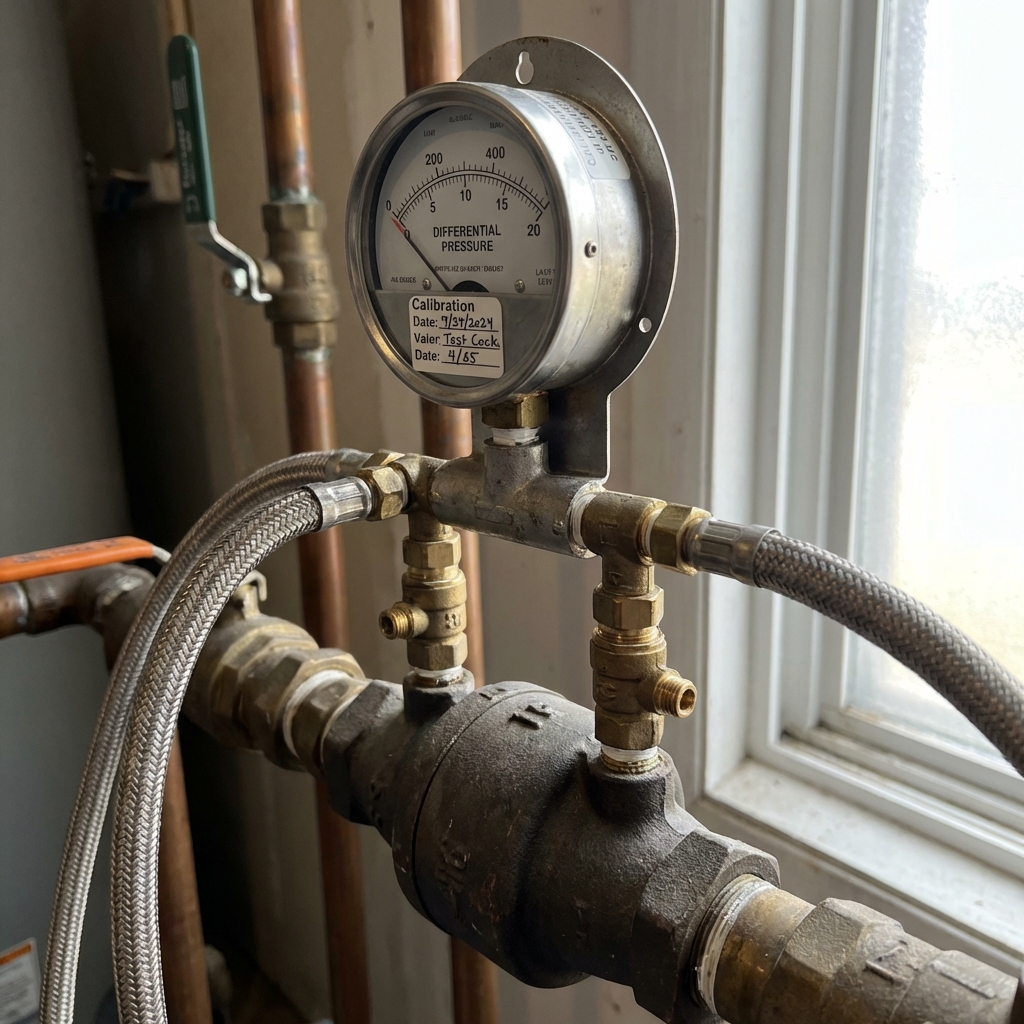 Close-up of a calibrated differential pressure gauge connected to test cocks on a double check valve assembly
What Happens If You Don't Get Tested
Skipping your annual backflow test isn't just a paperwork issue. Here's what can happen:
- Water service shutoff. Many utilities will shut off your water if you don't submit a passing test report by the deadline. They're not bluffing—this happens routinely.
- Daily fines. Some jurisdictions impose fines for non-compliance, ranging from $25 to $500 per day depending on the municipality.
- Liability exposure. If a backflow incident contaminates the public water supply and your assembly wasn't tested, you could face significant legal and financial liability.
- Failed property transactions. Some real estate transactions require proof of backflow compliance. Missing test records can delay closings.
The cost of annual testing is minimal compared to any of these outcomes.
Special Considerations for Commercial Properties
Commercial property owners and managers face additional complexity:
Multiple assemblies across different systems. A single commercial building might have separate backflow assemblies for domestic water, irrigation, fire suppression, and mechanical systems. Each one requires its own test and report.
Coordination with tenants and operations. Testing often requires a brief water shutoff. For restaurants, medical facilities, and manufacturing operations, this needs to be planned carefully to minimize disruption.
Record-keeping requirements. Some industries—food service, healthcare, laboratories—have their own compliance requirements beyond what the water utility mandates. Keeping organized records of all test reports, repairs, and certifications is essential.
Budget planning. With multiple devices and the possibility of repairs, commercial backflow compliance costs can run into thousands of dollars annually. Build this into your maintenance budget as a fixed line item, not an unexpected expense.
Next Steps
If you're due for a backflow assembly test—or you're not sure when your last one was—here's what to do:
- Check with your water utility. Find out your compliance deadline and whether they have a list of approved testers in your area.
- Locate your assemblies. Know where they are, what type they are, and what size they are. This information helps testers give you accurate quotes.
- Get quotes from certified professionals. Use a directory like FindBackflowTesters.com to connect with certified testers near you and compare pricing.
- Schedule before the deadline. Give yourself enough lead time for repairs if your assembly doesn't pass on the first test.
- Keep your records. Save copies of all test reports, even if your tester files them electronically with the utility. You may need them for property sales, insurance claims, or future compliance questions.
Backflow assembly testing is one of those maintenance tasks that's easy to put off—until it becomes urgent. Understanding the fees involved and planning ahead keeps you compliant, protects public health, and prevents unpleasant surprises on your water bill.